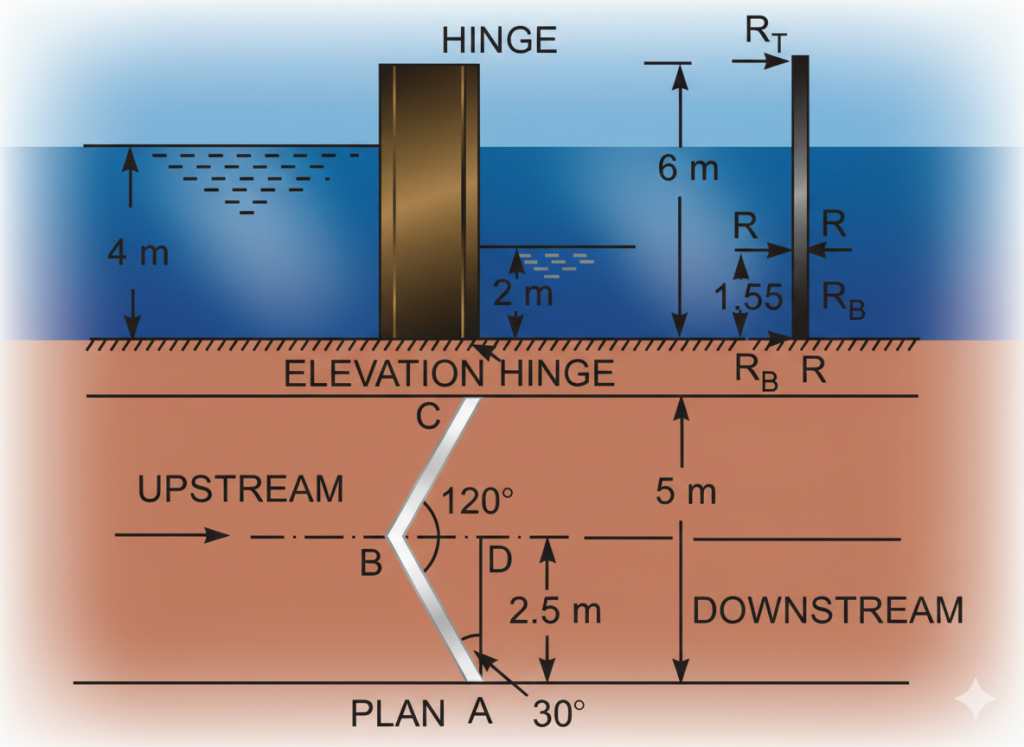
Problem Statement
The end gates ABC of a lock are 9 m high and when closed include an angle of 120°. The width of the lock is 10 m. Each gate is supported by two hinges located at 1 m and 6 m above the bottom of the lock. The depths of water on the two sides are 8 m and 4 m respectively. Find: (i) Resultant water force on each gate, (ii) Reaction between the gates AB and BC, and (iii) Force on each hinge.
Given Data
- Height of each gate, \( H_{gate} = 9 \, \text{m} \)
- Width of lock, \( W_{lock} = 10 \, \text{m} \)
- Angle between gates = 120°
- Upstream water level, \( H_1 = 8 \, \text{m} \)
- Downstream water level, \( H_2 = 4 \, \text{m} \)
- Hinge locations: 1 m and 6 m from the bottom
Diagram of Lock Gates

Solution
1. Gate Geometry
The angle \( \theta \) for one gate with respect to the lock's centerline is:
The width of each gate leaf (\(l\)) is calculated as:
2. Forces on a Single Gate
Upstream Force (\(F_1\)):
This force acts at \( H_1 / 3 = 8/3 \approx 2.67 \, \text{m} \) from the bottom.
Downstream Force (\(F_2\)):
This force acts at \( H_2 / 3 = 4/3 \approx 1.33 \, \text{m} \) from the bottom.
(i) Resultant Water Force on Each Gate (\(F\))
3. Location of Resultant Force (\(x\))
Taking moments about the bottom of the gate to find the location \(x\) of the resultant force F:
(ii) Reaction Between the Gates (\(P\))
The reaction \(P\) between the two gates is given by:
(iii) Force on Each Hinge
The total reaction from the hinges \(R\) is equal to the reaction between the gates \(P\).
Let \(R_T\) and \(R_B\) be the reactions at the top (6 m) and bottom (1 m) hinges. The distance between them is 5 m.
Taking moments about the bottom hinge (at 1 m) to find \(R_T\):
Now, we find \(R_B\):
(i) Resultant water force on each gate is \( F \approx 1359.2 \, \text{kN} \).
(ii) Reaction between the gates is \( P \approx 1359.2 \, \text{kN} \).
(iii) Force on the top hinge is \( R_T \approx 575.46 \, \text{kN} \).
(iii) Force on the bottom hinge is \( R_B \approx 783.73 \, \text{kN} \).
Explanation of Concepts
Forces on Lock Gates: The net force on a lock gate is the difference between the hydrostatic force from the higher upstream water level and the force from the lower downstream level. This net force acts perpendicular to the gate's surface.
Equilibrium of Gates: This net water force (\(F\)) is balanced by two other forces: a compressive reaction force (\(P\)) from the opposing gate where they meet, and a total reaction force from the hinges (\(R\)). For the standard miter gate design, the hinge reaction \(R\) is equal in magnitude to \(P\).
Hinge Force Distribution: The total hinge reaction (\(R\)) is distributed between the top and bottom hinges. To find the individual forces on each hinge, we use the principle of moments. By taking moments about one hinge, we can calculate the force on the other, ensuring the gate does not rotate.