Problem Statement
A rectangular tank is moving horizontally in the direction of its length with a constant acceleration of 2.4 m/s². The length, width and depth of the tank are 6 m, 2.5 m and 2 m respectively. If the depth of water in the tank is 1 m and the tank is open at the top, calculate: (i) the angle of the water surface to the horizontal, (ii) the maximum and minimum pressure intensities at the bottom, (iii) the total force due to water acting on each end of the tank.
Given Data
- Constant acceleration, \( a = 2.4 \, \text{m/s}^2 \)
- Length of tank, \( L = 6 \, \text{m} \)
- Width of tank, \( b = 2.5 \, \text{m} \)
- Initial depth of water, \( h_{initial} = 1 \, \text{m} \)
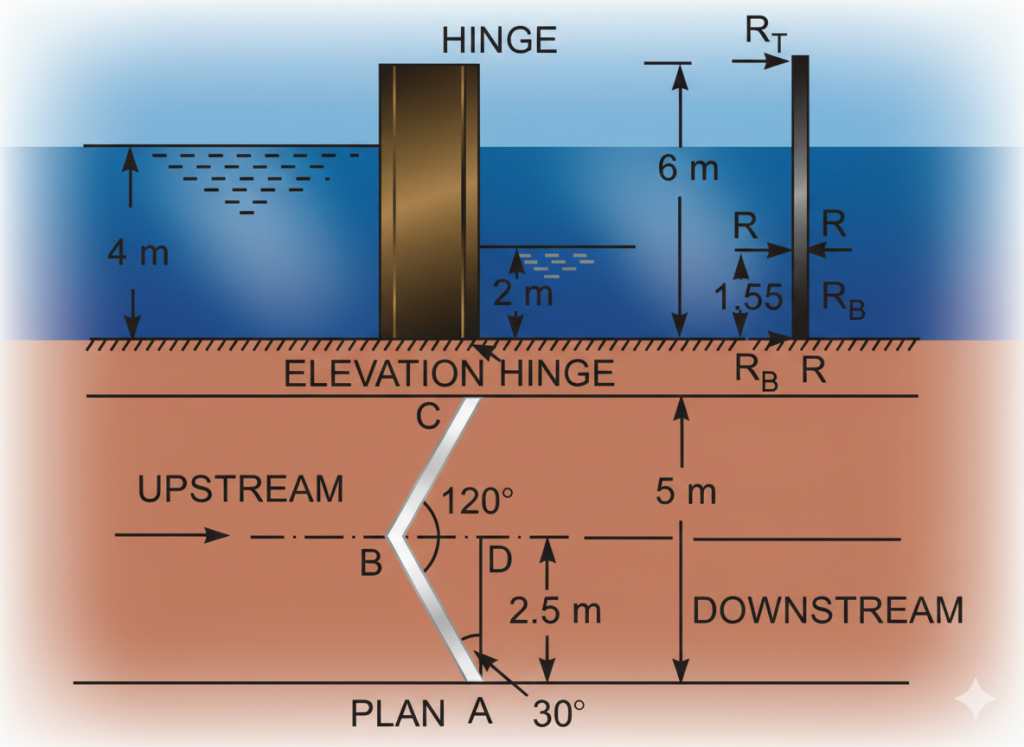
Diagram of Accelerating Tank

Solution
(i) Angle of the Water Surface to the Horizontal (\(\theta\))
The angle of the water surface is determined by the ratio of horizontal acceleration to gravitational acceleration.
(ii) Maximum and Minimum Pressure Intensities
First, we find the depths at the rear (maximum depth, \(h_2\)) and front (minimum depth, \(h_1\)) ends of the tank. The change in depth occurs over half the length of the tank (\(L/2 = 3\) m).
The maximum pressure intensity occurs at the bottom rear (point A):
The minimum pressure intensity occurs at the bottom front (point B):
(iii) Total Force on Each End
Force on the front end (\(F_1\)):
Force on the rear end (\(F_2\)):
(i) Angle of water surface is \( \theta \approx 13.74^\circ \).
(ii) Maximum pressure is \( P_{max} \approx 17008.5 \, \text{N/m}^2 \), Minimum pressure is \( P_{min} \approx 2611.4 \, \text{N/m}^2 \).
(iii) Total force on the front end is \( F_1 \approx 869 \, \text{N} \).
(iii) Total force on the rear end is \( F_2 \approx 36862 \, \text{N} \).
Explanation of Concepts
Tilted Water Surface: When a container of fluid is subjected to constant horizontal acceleration, the free surface of the fluid tilts. It is no longer horizontal. The surface forms an angle where the inertial force (due to acceleration) and the gravitational force on any fluid particle are in equilibrium. The tangent of this angle (\(\theta\)) is the ratio of the horizontal acceleration (\(a\)) to the vertical acceleration due to gravity (\(g\)).
Pressure in Accelerated Fluid: The pressure at any point within the fluid still depends on the vertical depth, but this depth is measured from the new, inclined free surface. This causes the pressure at the bottom of the tank to be non-uniform, being highest at the deeper (rear) end and lowest at the shallower (front) end.
Control Volume for Verification
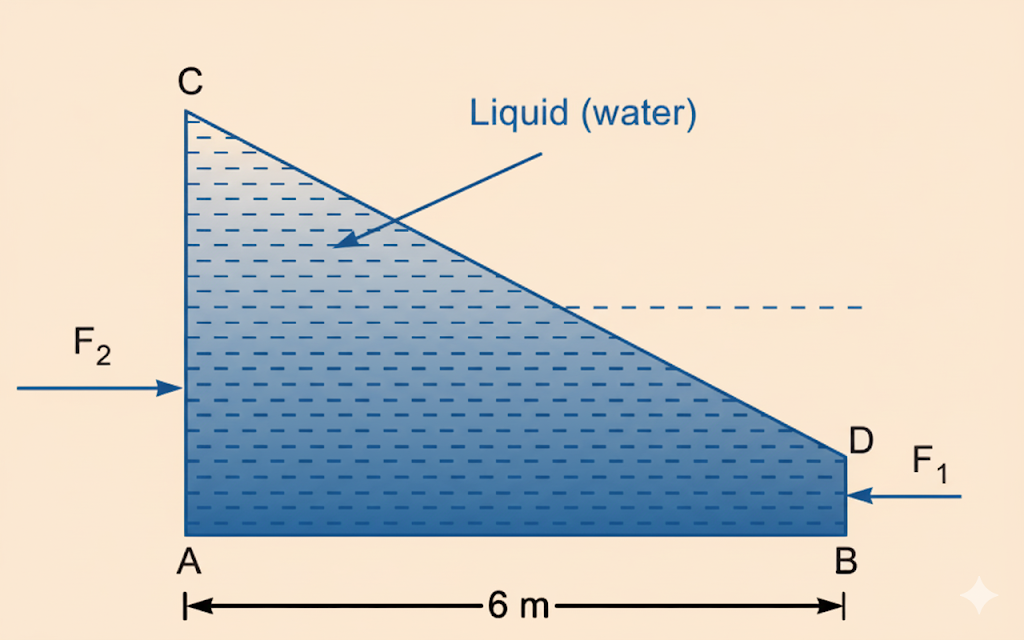
Verification via Newton's Second Law: The net force on the body of water in the horizontal direction must be equal to the mass of the water multiplied by its acceleration (\(F_{net} = ma\)). The net force is the difference between the hydrostatic force on the rear end (\(F_2\)) and the front end (\(F_1\)).