Ashok Sapkota

Ashok Sapkota is a dedicated engineer currently serving at the Department of Water Resources and Irrigation in Nepal. With a strong educational background, Ashok completed his Bachelor's degree from the Institute of Engineering (IOE), Pulchowk Campus, Nepal. He is currently pursuing a Master's degree in Construction Management at the same prestigious institution.

Ashok's professional expertise lies in water resources and irrigation engineering, where he applies his knowledge to contribute to Nepal's water management and agricultural development.

Beyond his professional commitments, Ashok is passionate about sharing his engineering insights. He regularly writes blogs on various engineering topics, aiming to educate and inspire others in the field.

With a combination of practical experience, ongoing advanced education, and a drive to share knowledge, Ashok Sapkota represents the new generation of engineers working to shape Nepal's future.

An embankment, having total volume of 2000 m3 is to be constructed having a bulk density of 1.98 g/cm3 and a placement water content of 18%. The soil is to be obtained either from borrow area A or borrow area B, which have voids ratio of 0.78 and 0.69, respectively and water content of 16% and 12%, respectively. Taking G = 2.66, for both the soils, determine the volume of soil required to be excavated from each of the areas. If the cost of excavation is 35 per m3 in each area, but cost of transportation is 32 and 36 per m3 from areas A and B respectively, which of the borrow areas is more economical?

Soil Mechanics Problems Problem Statement An embankment, having a total volume of 2000 m3, is to be constructed with a […]
An embankment, having total volume of 2000 m3 is to be constructed having a bulk density of 1.98 g/cm3 and a placement water content of 18%. The soil is to be obtained either from borrow area A or borrow area B, which have voids ratio of 0.78 and 0.69, respectively and water content of 16% and 12%, respectively. Taking G = 2.66, for both the soils, determine the volume of soil required to be excavated from each of the areas. If the cost of excavation is 35 per m3 in each area, but cost of transportation is 32 and 36 per m3 from areas A and B respectively, which of the borrow areas is more economical? Read More »

An embankment, having a total volume of 5000 m3, has a water content of 16% and a dry density of 1.75 g/cm3. If it was constructed from a borrow pit where the undisturbed soil has a water content of 13% and a voids ratio of 0.6, calculate the quantity of soil which was excavated for the construction of the above embankment. Take the specific gravity of soil solids as 2.68.

Soil Mechanics Problems Problem Statement An embankment, having a total volume of 5000 m3, has a water content of 16%

An embankment, having a total volume of 5000 m3, has a water content of 16% and a dry density of 1.75 g/cm3. If it was constructed from a borrow pit where the undisturbed soil has a water content of 13% and a voids ratio of 0.6, calculate the quantity of soil which was excavated for the construction of the above embankment. Take the specific gravity of soil solids as 2.68. Read More »

It is required to prepare a compacted cylindrical specimen of 40 mm dia. and 80 mmlength from oven dry soil. The specimen is required to have water content of 10% and percent air voids of 18%. Taking G = 2.70, determine the mass of soil and mass of water, required for the preparation ofthe above specimen.

Soil Mechanics Problems Problem Statement It is required to prepare a compacted cylindrical specimen of 40 mm diameter and 80

It is required to prepare a compacted cylindrical specimen of 40 mm dia. and 80 mmlength from oven dry soil. The specimen is required to have water content of 10% and percent air voids of 18%. Taking G = 2.70, determine the mass of soil and mass of water, required for the preparation ofthe above specimen. Read More »

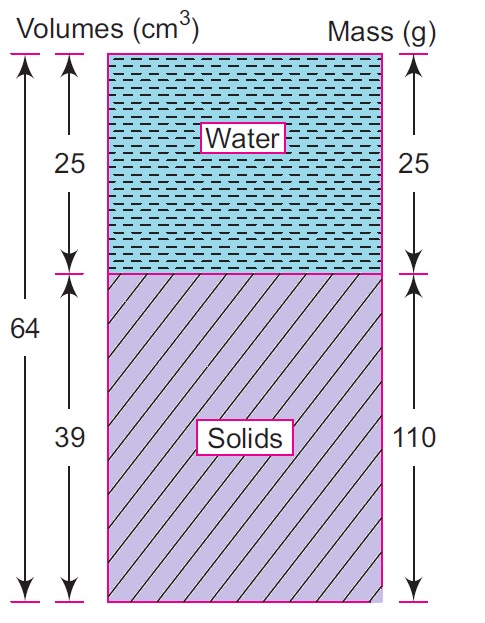
A cube of dried clay having sides 4 cm long has a mass of 110 g. The same cube of soil, when saturated at unchanged volume, has mass of 135 g. Draw the soil element showing the volumes and weights of the constituents, and then determine the specific gravity of soil solids and the voids ratio.

A cube of dried clay having sides 4 cm long has a mass of 110 g. The same cube of soil, when saturated at unchanged volume, has a mass of 135 g. Draw the soil element showing the volumes and weights of the constituents, and then determine the specific gravity of soil solids and the voids ratio.

Soil Mechanics Problems Problem Statement A cube of dried clay having sides 4 cm long has a mass of 110

A cube of dried clay having sides 4 cm long has a mass of 110 g. The same cube of soil, when saturated at unchanged volume, has a mass of 135 g. Draw the soil element showing the volumes and weights of the constituents, and then determine the specific gravity of soil solids and the voids ratio. Read More »

A soil has a bulk unit weight of 20.11 kN/m3 and water content of 15%. Calculatethe water content if the soil partially dries to a unit weight of 19.42 kN/m3 and the voids ratio remainsunchanged.

Soil Mechanics Problems Problem Statement A soil has a bulk unit weight of 20.11 kN/m3 and a water content of

A soil has a bulk unit weight of 20.11 kN/m3 and water content of 15%. Calculatethe water content if the soil partially dries to a unit weight of 19.42 kN/m3 and the voids ratio remainsunchanged. Read More »

Calculate the unit weights and specific gravities of solids of (a) a soil composed ofpure quartz and (b) a soil composed of 60% quartz, 25% mica and 15% iron oxide. Assume that bothsoils are saturated and have voids ratio of 0.63. Take average G for quartz = 2.66, for mica = 3.0 andfor iron oxide = 3.8.

Soil Mechanics Problems Problem Statement Calculate the unit weights and specific gravities of solids for: (a) A soil composed of

Calculate the unit weights and specific gravities of solids of (a) a soil composed ofpure quartz and (b) a soil composed of 60% quartz, 25% mica and 15% iron oxide. Assume that bothsoils are saturated and have voids ratio of 0.63. Take average G for quartz = 2.66, for mica = 3.0 andfor iron oxide = 3.8. Read More »

A natural soil deposit has a bulk unit weight of 18.44 kN/m3 and water content of 5%.Calculate the amount of water required to be added to 1 cubic metre of soil to raise the water contentto 15%. Assume the voids ratio to remain constant. What will then be the degree of saturation? AssumeG = 2.67.

Soil Mechanics Problems Problem Statement A natural soil deposit has a bulk unit weight of 18.44 kN/m3 and water content

A natural soil deposit has a bulk unit weight of 18.44 kN/m3 and water content of 5%.Calculate the amount of water required to be added to 1 cubic metre of soil to raise the water contentto 15%. Assume the voids ratio to remain constant. What will then be the degree of saturation? AssumeG = 2.67. Read More »

The mass specific gravity (apparent specific gravity) of a soil equals 1.64. The specificgravity of solids is 2.70. Determine the voids ratio under the assumption that the soil is perfectly dry.What would be the voids ratio, if the sample is assumed to have a water content of 8%?

Density Index of Sand Deposit Problem Statement The mass specific gravity (apparent specific gravity) of a soil equals 1.64. The

The mass specific gravity (apparent specific gravity) of a soil equals 1.64. The specificgravity of solids is 2.70. Determine the voids ratio under the assumption that the soil is perfectly dry.What would be the voids ratio, if the sample is assumed to have a water content of 8%? Read More »

The in-situ percentage voids of a sand deposit is 34%. To determine the density index, dried sand from the stratum was first filled loosely in a 1000 cm3 mould and then vibrated to achieve maximum density. The loose dry mass in the mould was 1610 g, and the dense dry mass at maximum compaction was found to be 1980 g. Determine the density index if the specific gravity of the sand particles is 2.67.

Density Index of Sand Deposit Problem Statement The in-situ percentage voids of a sand deposit is 34%. To determine the

The in-situ percentage voids of a sand deposit is 34%. To determine the density index, dried sand from the stratum was first filled loosely in a 1000 cm3 mould and then vibrated to achieve maximum density. The loose dry mass in the mould was 1610 g, and the dense dry mass at maximum compaction was found to be 1980 g. Determine the density index if the specific gravity of the sand particles is 2.67. Read More »

The in-situ density of an embankment, compacted at a water content of 12%, was determined using a core cutter. The empty mass of the cutter was 1286 g, and the cutter filled with soil had a mass of 3195 g. The volume of the cutter is 1000 cm3. Determine the bulk density, dry density, and degree of saturation of the embankment. 

Embankment Density and Saturation Analysis Problem Statement The in-situ density of an embankment, compacted at a water content of 12%,

The in-situ density of an embankment, compacted at a water content of 12%, was determined using a core cutter. The empty mass of the cutter was 1286 g, and the cutter filled with soil had a mass of 3195 g. The volume of the cutter is 1000 cm3. Determine the bulk density, dry density, and degree of saturation of the embankment.  Read More »

An undisturbed sample of soil has a volume of 100 cm3 and mass of 190 g. On oven drying for 24 hours, the mass is reduced to 160 g. If the specific gravity of grains is 2.68, determine the water content, voids ratio, and degree of saturation of the soil.

Soil Mechanics: Water Content, Voids Ratio, and Degree of Saturation Problem Statement An undisturbed sample of soil has a volume

An undisturbed sample of soil has a volume of 100 cm3 and mass of 190 g. On oven drying for 24 hours, the mass is reduced to 160 g. If the specific gravity of grains is 2.68, determine the water content, voids ratio, and degree of saturation of the soil. Read More »

A soil sample has a porosity of 40%. The specific gravity of solids is 2.70. Calculate(a) voids ratio, (b) dry density, (c) unit weight if the soil is 50% saturated, and (d) unit weight if the soilis completely saturated.

Numerical Problem in Soil Engineering Numerical Problem: Soil Properties Given: Porosity, \( n = 40\% = 0.4 \) Specific Gravity

A soil sample has a porosity of 40%. The specific gravity of solids is 2.70. Calculate(a) voids ratio, (b) dry density, (c) unit weight if the soil is 50% saturated, and (d) unit weight if the soilis completely saturated. Read More »

Scroll to Top