Ashok Sapkota

Ashok Sapkota is a dedicated engineer currently serving at the Department of Water Resources and Irrigation in Nepal. With a strong educational background, Ashok completed his Bachelor's degree from the Institute of Engineering (IOE), Pulchowk Campus, Nepal. He is currently pursuing a Master's degree in Construction Management at the same prestigious institution.

Ashok's professional expertise lies in water resources and irrigation engineering, where he applies his knowledge to contribute to Nepal's water management and agricultural development.

Beyond his professional commitments, Ashok is passionate about sharing his engineering insights. He regularly writes blogs on various engineering topics, aiming to educate and inspire others in the field.

With a combination of practical experience, ongoing advanced education, and a drive to share knowledge, Ashok Sapkota represents the new generation of engineers working to shape Nepal's future.

. In the fig., a 2.4m diameter cylinder plugs a rectangular hole in a tank that is 1.4m long. With what force is the cylinder pressed against the bottom of the tank due to the 2.7m depth of water?

In the fig., a 2.4m diameter cylinder plugs a rectangular hole in a tank that is 1.4m long. With what force is the cylinder pressed against the bottom of the tank due to the 2.7m depth of water?

Gate Force Problems Problem Statement In the figure, a 2.4 m diameter cylinder plugs a rectangular hole in a tank […]

In the fig., a 2.4m diameter cylinder plugs a rectangular hole in a tank that is 1.4m long. With what force is the cylinder pressed against the bottom of the tank due to the 2.7m depth of water? Read More »

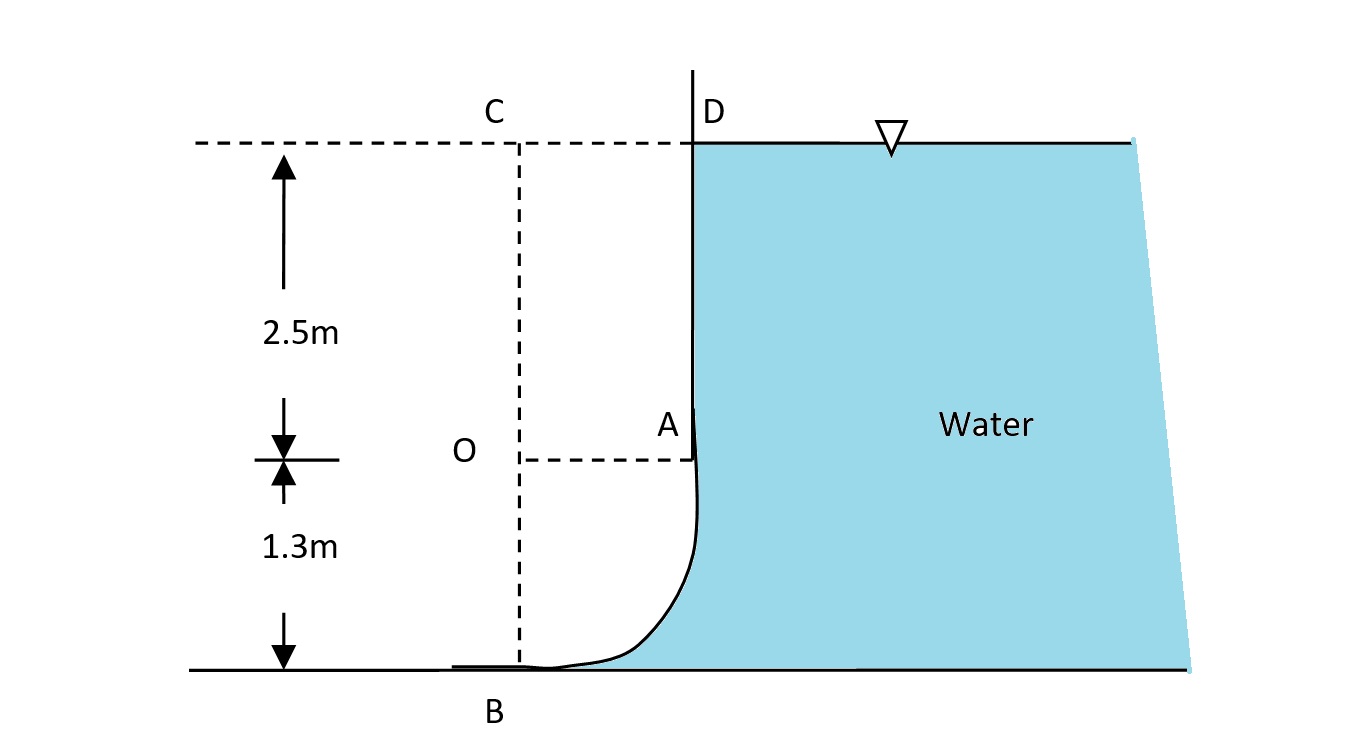
The water is on the right side of the curved surface AB, which is one quarter of a circle of radius 1.3m. The tank’s length is 2.1m. Find the horizontal and vertical component of the hydrostatic acting on the curved surface.

The water is on the right side of the curved surface AB, which is one quarter of a circle of radius 1.3m. The tank’s length is 2.1m. Find the horizontal and vertical component of the hydrostatic acting on the curved surface.

Gate Force Problems Problem Statement The water is on the right side of the curved surface AB, which is one

The water is on the right side of the curved surface AB, which is one quarter of a circle of radius 1.3m. The tank’s length is 2.1m. Find the horizontal and vertical component of the hydrostatic acting on the curved surface. Read More »

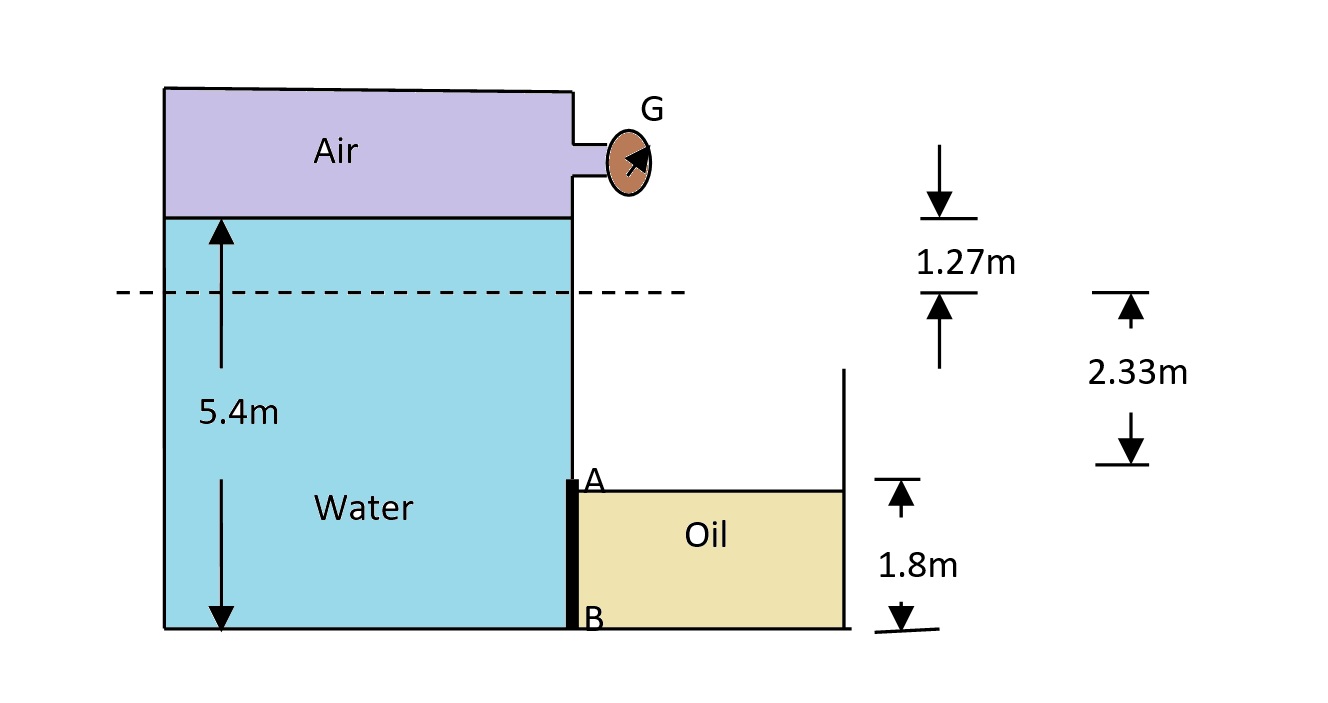
Gate AB in the fig. is 1.25m wide and hinged at A. Gage G reads -12.5KN/m2, while oil (sp gr = 0.75) is in the right tank. What horizontal force must be applied at B for equilibrium of gate AB?

Gate AB in the fig. is 1.25m wide and hinged at A. Gage G reads -12.5KN/m2, while oil (sp gr = 0.75) is in the right tank. What horizontal force must be applied at B for equilibrium of gate AB?

Gate Force Problems Problem Statement Gate AB in the figure is 1.25 m wide and hinged at A. Gauge G

Gate AB in the fig. is 1.25m wide and hinged at A. Gage G reads -12.5KN/m2, while oil (sp gr = 0.75) is in the right tank. What horizontal force must be applied at B for equilibrium of gate AB? Read More »

The gate AB shown is hinged at A and is in the form of quarter-circle wall of radius 12m. If the width of the gate is 30m, calculate the force required P to hold the gate in position.

The gate AB shown is hinged at A and is in the form of quarter-circle wall of radius 12m. If the width of the gate is 30m, calculate the force required P to hold the gate in position.

Gate Force Problems Problem Statement The gate AB shown is hinged at A and is in the form of a

The gate AB shown is hinged at A and is in the form of quarter-circle wall of radius 12m. If the width of the gate is 30m, calculate the force required P to hold the gate in position. Read More »

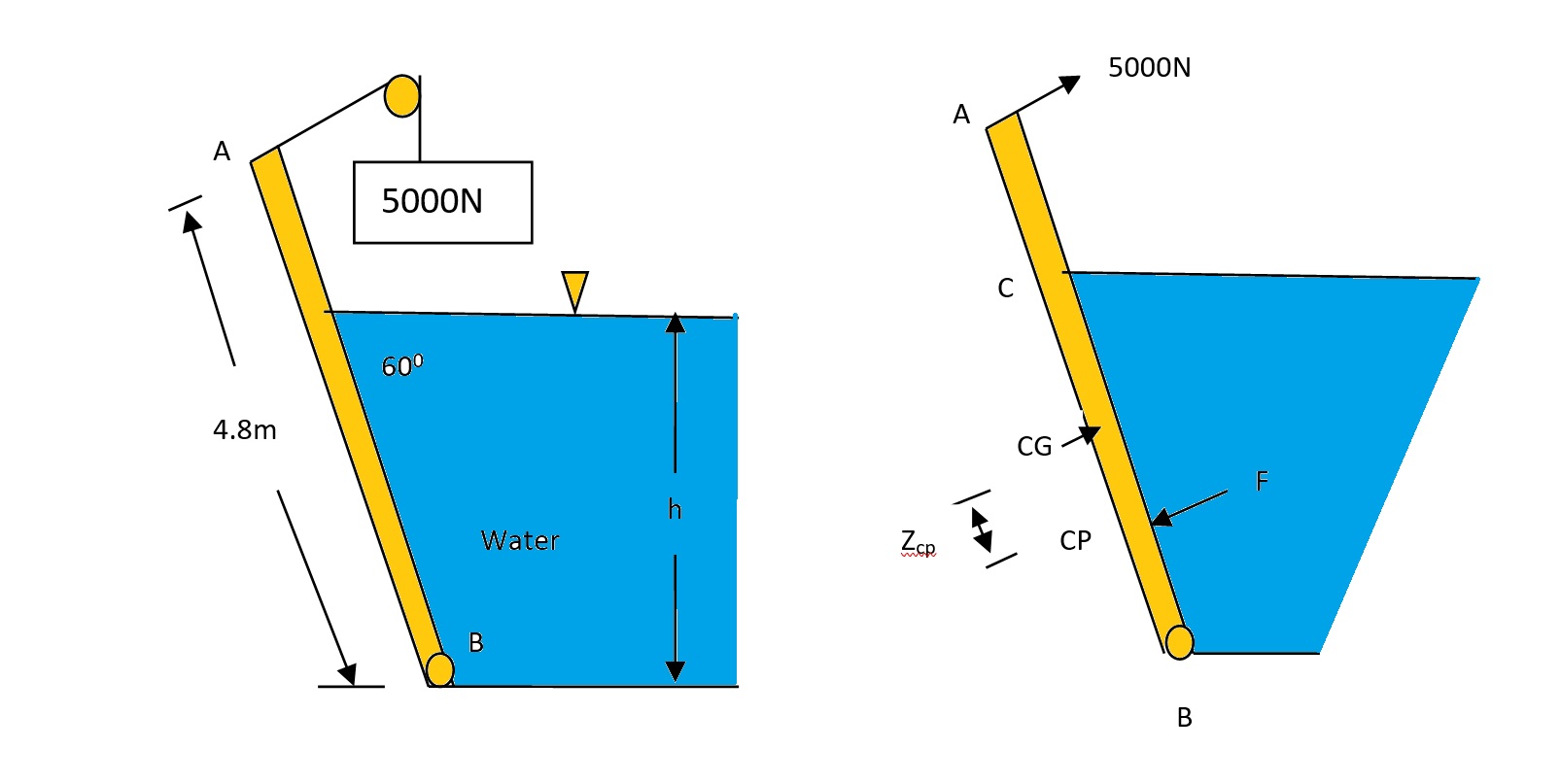
The gate in the fig. is 1.2m wide, is hinged at point B, and rests against a smooth wall at A. Compute (a) the force on the gate due to sea water pressure, (b) the horizontal force exerted by the wall at point A, and (c) the reaction at hinge B.

The gate in the fig. is 1.2m wide, is hinged at point B, and rests against a smooth wall at A. Compute (a) the force on the gate due to sea water pressure, (b) the horizontal force exerted by the wall at point A, and (c) the reaction at hinge B.

Gate Force Problems Problem Statement The gate in the figure is 1.2 m wide, hinged at point B, and rests

The gate in the fig. is 1.2m wide, is hinged at point B, and rests against a smooth wall at A. Compute (a) the force on the gate due to sea water pressure, (b) the horizontal force exerted by the wall at point A, and (c) the reaction at hinge B. Read More »

Scroll to Top