Application of Momentum Principle

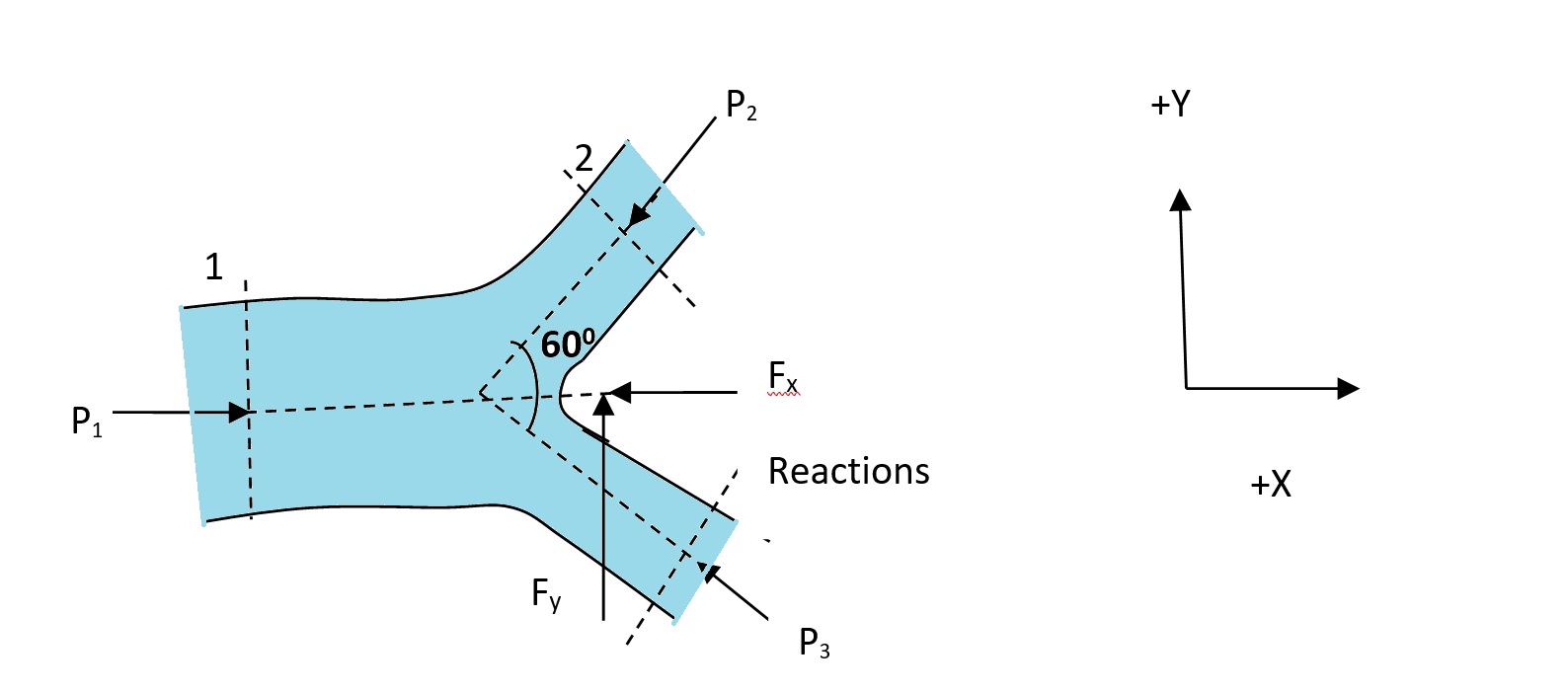
A main pipe of diameter 500mm branches in two pipes of diameter 300mm each in the horizontal plane. Angle between the branches is 600, which is symmetrical with respect to the main pipe. Flow discharge through the main pipe is 1.0 m3/s, which is equally divided into the branch pipes. If the pressure intensity at the main pipe is 400KPa, find the magnitude and direction of resultant force in the bend. Assume no loss of energy due to branch junction and in pipe sections.

A main pipe of diameter 500mm branches in two pipes of diameter 300mm each in the horizontal plane. Angle between the branches is 60°, which is symmetrical with respect to the main pipe. Flow discharge through the main pipe is 1.0 m³/s, which is equally divided into the branch pipes. If the pressure intensity at the main pipe is 400 kPa, find the magnitude and direction of resultant force in the bend. Assume no loss of energy due to branch junction and in pipe sections.

Pipe Branch Force Calculation – Fluid Mechanics Solution Pipe Branch Force Calculation Fluid Mechanics Problem Solution Problem Statement A main […]

A main pipe of diameter 500mm branches in two pipes of diameter 300mm each in the horizontal plane. Angle between the branches is 60°, which is symmetrical with respect to the main pipe. Flow discharge through the main pipe is 1.0 m³/s, which is equally divided into the branch pipes. If the pressure intensity at the main pipe is 400 kPa, find the magnitude and direction of resultant force in the bend. Assume no loss of energy due to branch junction and in pipe sections. Read More »

A 150mm diameter pipe on the horizontal plane carries water under the head of 16m of water with the velocity of 3.5 m/s. Find the direction and magnitude of the pipe bend, if the axis of the bend was turned with angle 750. Assume no loss of energy at the pipe bend.

A 150mm diameter pipe on the horizontal plane carries water under the head of 16m of water with the velocity of 3.5 m/s. Find the direction and magnitude of the pipe bend, if the axis of the bend was turned with angle 75°. Assume no loss of energy at the pipe bend.

Pipe Bend Force Calculation – Fluid Mechanics Solution Pipe Bend Force Calculation Fluid Mechanics Problem Solution Problem Statement A 150mm

A 150mm diameter pipe on the horizontal plane carries water under the head of 16m of water with the velocity of 3.5 m/s. Find the direction and magnitude of the pipe bend, if the axis of the bend was turned with angle 75°. Assume no loss of energy at the pipe bend. Read More »

A 450 pipe bend tapers from 600mm diameter at inlet to 300mm diameter at outlet. The pressure at inlet is 140KN/m2 and the rate of flow is 0.425m3/s. At outlet the pressure is 123KN/m2 gauge. Neglecting friction, calculate the resultant force exerted by the water on the bend in magnitude and direction. The bend lies in a horizontal plane.

A 45° pipe bend tapers from 600mm diameter at inlet to 300mm diameter at outlet. The pressure at inlet is 140 kN/m² and the rate of flow is 0.425 m³/s. At outlet the pressure is 123 kN/m² gauge. Neglecting friction, calculate the resultant force exerted by the water on the bend in magnitude and direction. The bend lies in a horizontal plane.

Pipe Bend Force Calculation – Fluid Mechanics Solution Pipe Bend Force Calculation Fluid Mechanics Problem Solution Problem Statement A 45°

A 45° pipe bend tapers from 600mm diameter at inlet to 300mm diameter at outlet. The pressure at inlet is 140 kN/m² and the rate of flow is 0.425 m³/s. At outlet the pressure is 123 kN/m² gauge. Neglecting friction, calculate the resultant force exerted by the water on the bend in magnitude and direction. The bend lies in a horizontal plane. Read More »

The discharge of water through a 1300 bend is 30 litres/s. The bend is lying in the horizontal plane and the diameters at the entrance and exit are 200mm and 100mm respectively. The pressure measured at the entrance is 100 kN/m2, what is the magnitude and direction of the force exerted by the water on the bend?

The discharge of water through a 130° bend is 30 litres/s. The bend is lying in the horizontal plane and the diameters at the entrance and exit are 200mm and 100mm respectively. The pressure measured at the entrance is 100 kN/m². What is the magnitude and direction of the force exerted by the water on the bend?

Pipe Bend Force Calculation – Fluid Mechanics Solution Pipe Bend Force Calculation Fluid Mechanics Problem Solution Problem Statement The discharge

The discharge of water through a 130° bend is 30 litres/s. The bend is lying in the horizontal plane and the diameters at the entrance and exit are 200mm and 100mm respectively. The pressure measured at the entrance is 100 kN/m². What is the magnitude and direction of the force exerted by the water on the bend? Read More »

A 500mm pipe carrying 0.8 m3/s of oil (sp gr 0.85) has a 900 bend in a horizontal plane. The loss of head in the bend is 1.1m of oil, and the pressure at the entrance is 290KPa. Determine the resultant force exerted by the oil on the bend.

A 500mm pipe carrying 0.8 m3/s of oil (sp gr 0.85) has a 900 bend in a horizontal plane. The loss of head in the bend is 1.1m of oil, and the pressure at the entrance is 290KPa. Determine the resultant force exerted by the oil on the bend.

Pipe Bend Force Calculation – Fluid Mechanics Solution Pipe Bend Force Calculation Fluid Mechanics Problem Solution Problem Statement A 500mm

A 500mm pipe carrying 0.8 m3/s of oil (sp gr 0.85) has a 900 bend in a horizontal plane. The loss of head in the bend is 1.1m of oil, and the pressure at the entrance is 290KPa. Determine the resultant force exerted by the oil on the bend. Read More »

A 60cm pipe is connected to a 30cm pipe by a standard reducer fitting. For the same flow of 0.9 m3/s of water and a pressure of 200Kpa, what force is exerted by the water on the reducer, neglecting any lost head?

A 60cm pipe is connected to a 30cm pipe by a standard reducer fitting. For the same flow of 0.9 m3/s of water and a pressure of 200Kpa, what force is exerted by the water on the reducer, neglecting any lost head?

Pipe Reducer Force Calculation – Fluid Mechanics Solution Pipe Reducer Force Calculation Fluid Mechanics Problem Solution Problem Statement A 60cm

A 60cm pipe is connected to a 30cm pipe by a standard reducer fitting. For the same flow of 0.9 m3/s of water and a pressure of 200Kpa, what force is exerted by the water on the reducer, neglecting any lost head? Read More »

Scroll to Top