
Problem Statement
A wooden log of 0.6 m diameter and 5 m length is floating in river water. Find the depth of the wooden log in water when the sp. gravity of the log is 0.7.
Given Data
- Diameter of log, \( D = 0.6 \, \text{m} \) (Radius, \( R = 0.3 \, \text{m} \))
- Length of log, \( L = 5 \, \text{m} \)
- Specific gravity of log, \( S.G. = 0.7 \)
- Density of log, \( \rho_{log} = 700 \, \text{kg/m}^3 \)
- Density of water, \( \rho_{water} = 1000 \, \text{kg/m}^3 \)
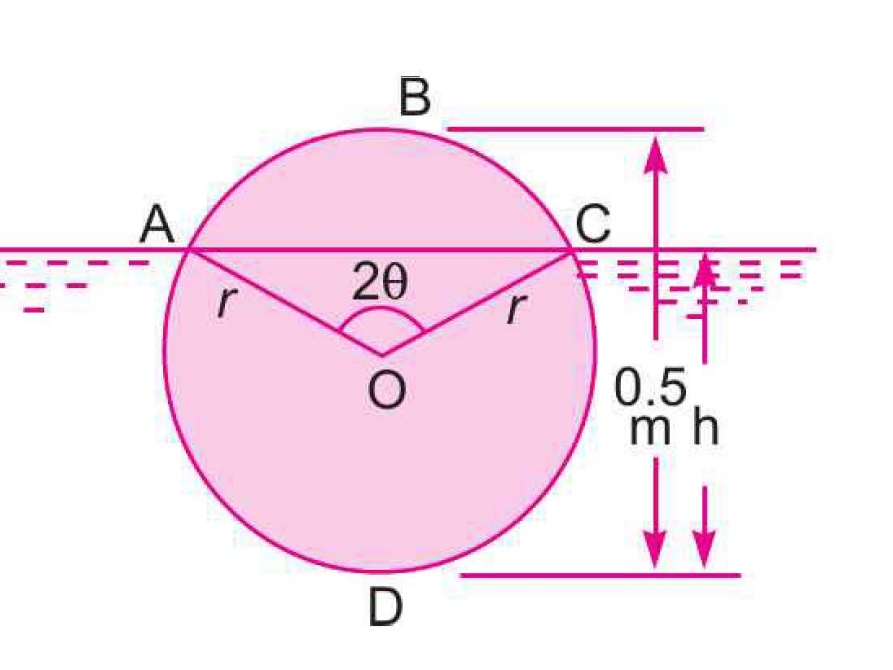
Diagram of the Floating Log
Solution
According to the principle of flotation, the weight of the floating log is equal to the weight of the water it displaces.
1. Weight of the Wooden Log
2. Volume of Water Displaced
For equilibrium, \(W_{displaced} = W_{log}\). The volume of water displaced is:
3. Depth of Immersion (\(h\))
The area of the submerged circular segment (\(A_{seg}\)) is the displaced volume divided by the length.
The area of a circular segment is given by \( A_{seg} = R^2 \cos^{-1}\left(\frac{R-h}{R}\right) - (R-h)\sqrt{2Rh - h^2} \). A simpler approach is to relate the area to the angle \(2\theta\) subtended by the segment at the center.
This is a transcendental equation that requires iterative solving. Let \(x = 2\alpha\). We need to solve \(x - \sin(x) = 4.391\).
Let's try another geometric approach used in the source text relating area to \(h\). Let \(h\) be the depth. A common relation is \( \frac{A_{seg}}{A_{circle}} = \frac{V_{displaced}}{V_{log}} \).
This matches our earlier finding. Solving for \(h\) from the segment area formula is complex. A common approximation or lookup table is often used. However, following the trial-and-error method from the prompt (which relates area to the angle from the vertical) to solve for angle \(\theta\):
Solving \( \theta - 57.32 \cos\theta \sin\theta = 54.01 \) (where \(\theta\) is in degrees):
- For \(\theta = 70^\circ\), Result = -2.41
- For \(\theta = 72^\circ\), Result = +1.14
- For \(\theta = 71.5^\circ\), Result = +0.248
- For \(\theta = 71^\circ\), Result = -0.376
The solution is between 71° and 71.5°. Let's use \(\theta \approx 71.3^\circ\).
The depth of immersion \(h\) is related to this angle by geometry:
Since the specific gravity is > 0.5, the log is more than half submerged. The angle \(\theta\) in the book's method appears to be from the vertical to the edge. Let's call it \(\phi\).
The depth of the wooden log in water is \( h \approx 0.396 \, \text{m} \).
Explanation of Concepts
Archimedes' Principle of Flotation: This principle states that a floating object displaces a weight of fluid equal to its own weight. We use this to find the required volume of displaced water by first calculating the log's total weight.
Submerged Volume and Depth: The calculated volume of displaced water corresponds to the volume of the log that is submerged. For a cylinder floating on its side, this submerged volume has a circular segment as its cross-section. The main challenge is to relate the area of this segment back to a vertical depth of immersion, \(h\).
Transcendental Equation: The geometric formula relating the area of a circular segment to its depth (or the angle it subtends) is complex and does not have a direct algebraic solution. This results in a transcendental equation, which must be solved using iterative numerical methods or trial and error to find the angle that gives the required area, as demonstrated in the solution.


