Identify the biggest (or longest) of the main survey lines in chain surveying:
Try it first: pick an option, then read the explanation.
Correct answer: A. Base line
Detailed Explanation: Types of Survey Lines
In chain surveying, the area is divided into a network of triangles. The lines forming this network have specific names and purposes. Understanding these is key to understanding the survey process.
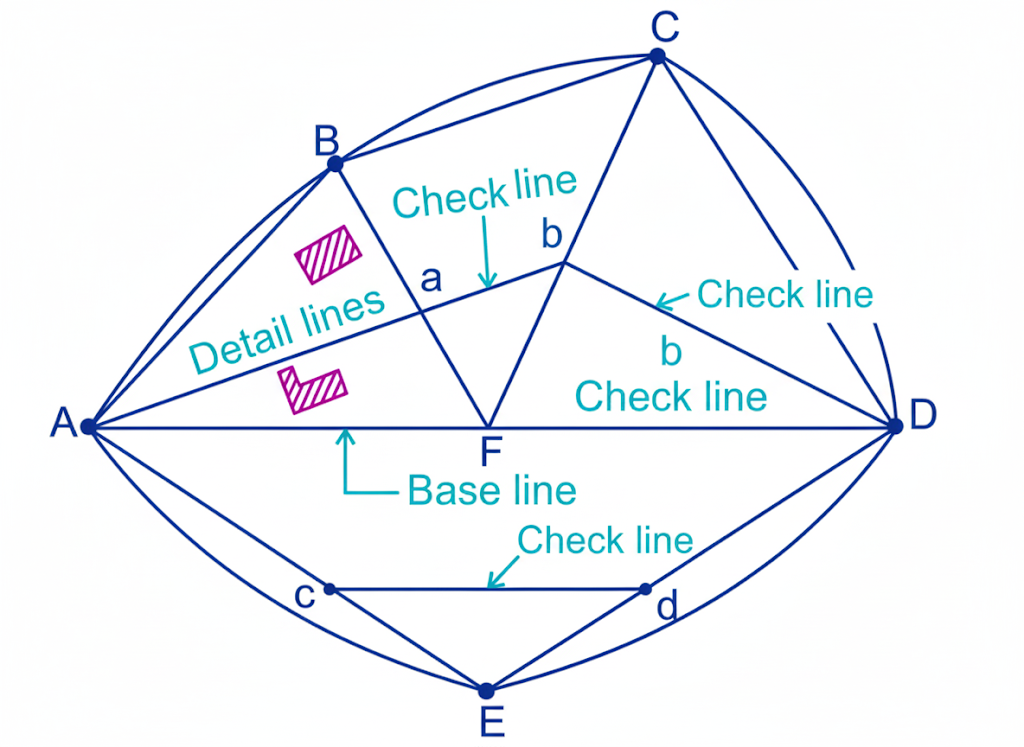
Definitions of Key Survey Lines
- Base Line: This is the most important line in the survey framework. It is the longest of all the main survey lines and serves as the foundation upon which the entire structure of triangles is built. Due to its critical role, the base line is measured with the highest degree of accuracy, often using a precision instrument like an Invar tape.
- Main Lines: These are the lines that connect the main survey stations, typically running along the boundaries of the survey area. The base line is the primary main line.
- Tie Line: A line joining tie stations (which are sub-stations on the main survey lines). Its purpose is to locate interior details of the area that are far from the main lines and to help break up large triangles into smaller, more manageable ones.
- Check Line: Also known as a proof line, this line is measured to check the accuracy of the framework of triangles. For example, if you measure a check line on the ground, its length should match the length of the same line when plotted on the map. A discrepancy indicates an error in measurement or plotting.
Given these definitions, the base line is by far the longest and most fundamental line in a chain survey.