
When a brick is cut into two halves longitudinally, one part is called—
🔬 Understanding Brick Closers and Specials
In brick masonry, it's often necessary to cut bricks into smaller pieces to finish a course at the end of a wall (a quoin) or around an opening. These cut pieces are called "closers," and they are essential for maintaining the correct bond and ensuring that vertical joints do not align.
Longitudinally: This means cutting the brick lengthwise, parallel to its longest side (the stretcher face).
⚖️ Detailed Analysis of the Options
Let's evaluate each term to identify the correct name for a brick cut in half lengthwise.
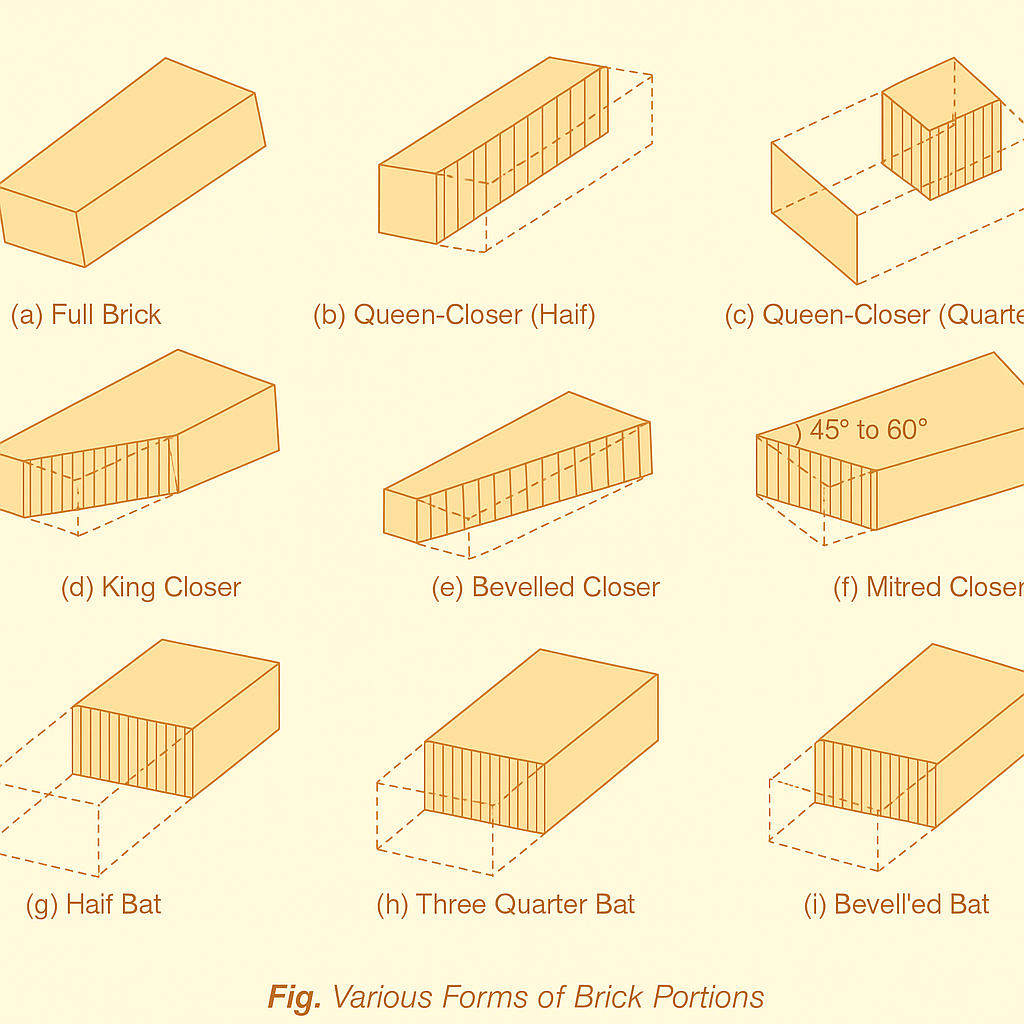
(c) Queen closer
Why it's correct: A queen closer is created by cutting a standard brick in half along its length. The resulting piece has the same length and height as the original brick but is only half the width. It is used at the beginning of a course next to the quoin header to create the proper bond lap.
(a) King closer
Why it's incorrect: A king closer is a more complex cut. A triangular piece is removed from the corner of the brick, starting from the center of the header face to the center of the stretcher face. It is used for creating angled or oblique corners.
(b) Cornice brick
Why it's incorrect: This is a specially manufactured brick with a decorative profile. It is not a cut brick but a special shape used to build an ornamental cornice at the top of a wall.
(d) Voussoir
Why it's incorrect: A voussoir is a wedge-shaped stone or brick used to construct an arch or vault. It is a specific component of an arch, not a closer used in a standard wall bond.
💡 Study Tips for Brick Terminology
- Queen is Cut in Half (Long): Remember that a Queen closer is a brick cut into two long, slender halves.
- King has a Corner Cut: A King closer has a corner cut off, making it look like it has a "crown."
- Visualize the Cuts: Refer to diagrams like the one above to visually memorize the difference between a Queen closer (a simple half-cut) and a King closer (a corner cut).