Problem Statement
A caisson for closing the entrance to a dry dock is of trapezoidal form, 16 m wide at the top and 10 m wide at the bottom, and 6 m deep. Find the total pressure and centre of pressure on the caisson if the water on the outside is just level with the top and the dock is empty.
Given Data
- Width at top, \( b_{top} = 16 \, \text{m}\)
- Width at bottom, \( b_{bottom} = 10 \, \text{m}\)
- Depth of caisson, \( d = 6 \, \text{m}\)
- Fluid is water, so density \(\rho = 1000 \, \text{kg/m}^3\)
Diagram
The trapezoidal caisson and its dimensions.

Solution (Decomposition Method)
(i) Total Pressure (Force)
First, calculate the area of the trapezoid:
Next, find the depth of the Centre of Gravity (\(\bar{h}\)) by treating the trapezoid as a central rectangle and two side triangles.
Now, calculate the total pressure (force):
(ii) Centre of Pressure (\(h^*\))
The centre of pressure is found using \( h^* = \frac{I_G}{A\bar{h}} + \bar{h} \). We need to find the moment of inertia (\(I_G\)) of the trapezoid about its own centroid using the parallel axis theorem.
1. M.O.I. of the central rectangle (10x6) about the trapezoid's C.G.:
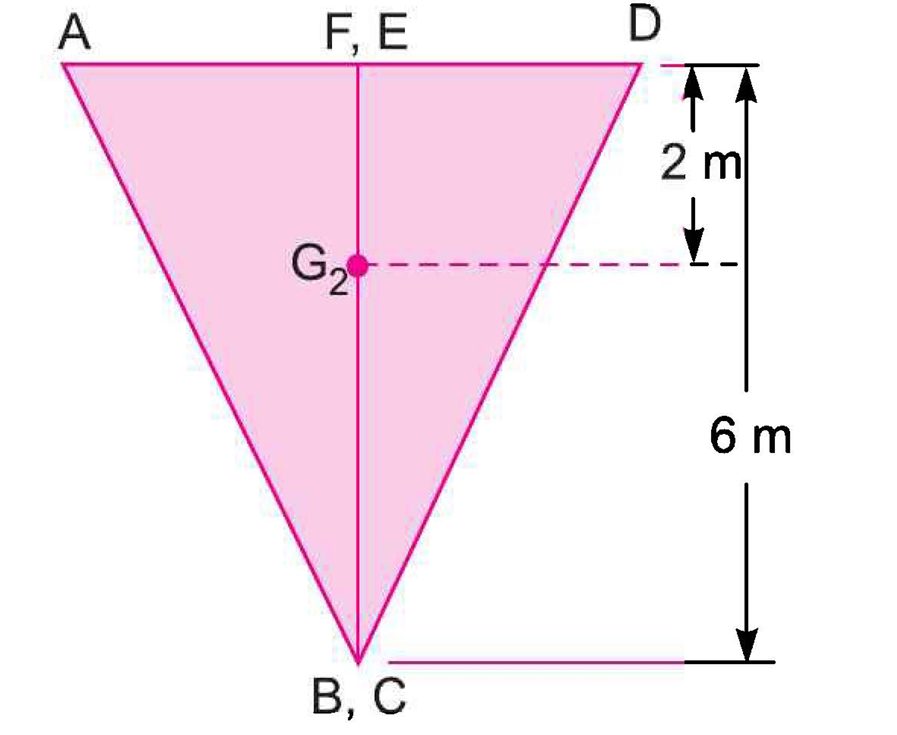
2. M.O.I. of the two side triangles about the trapezoid's C.G.:
Decomposition for M.O.I. calculation.
3. Total M.O.I. and Centre of Pressure:
Alternate Solution (Formula Method)
Using standard formulas for a trapezoid (where \(a\) is top width, \(b\) is bottom width):
Moment of Inertia \(I_G\) from formula:
Centre of Pressure \(h^*\):
Total Pressure (Force): \( F \approx 2.12 \, \text{MN} \)
Centre of Pressure: \( h^* \approx 3.833 \, \text{m} \) below the free surface
Explanation of Concepts
Composite Shapes: To find properties like the Centre of Gravity (\(\bar{h}\)) and Moment of Inertia (\(I_G\)) for a complex shape like a trapezoid, it is often easiest to break it down into simpler shapes (a rectangle and two triangles).
Parallel Axis Theorem: This theorem is essential for finding the moment of inertia of a composite shape. It states that the M.O.I. of a shape about any axis is the M.O.I. about its own centroidal axis plus its area times the square of the distance between the two parallel axes (\(I = I_G + Ad^2\)). We use it here to shift the M.O.I. of the rectangle and triangles to the overall C.G. of the trapezoid.
Physical Meaning
The total force on the caisson is over 2.1 million Newtons, equivalent to the weight of about 216 metric tons. This enormous force is what the caisson structure must be designed to withstand without failing.
The centre of pressure at 3.833 m is significantly deeper than the centre of gravity at 2.769 m. This is because the pressure is not uniform; it is zero at the top and maximum at the bottom. The resultant force acts at this lower point, and knowing its precise location is critical for designing the caisson's structural supports and bracing to prevent it from rotating or collapsing under the immense, unevenly distributed load.