
Chainage is the distance measured ..................
Correct Answer:
A. Along a chain line
🗺️ Understanding Chainage
Chainage is the cumulative horizontal distance measured along a survey line from a starting point. It represents a point's location along the length of a line, such as the centerline of a road, railway, or pipeline.
It is often referred to as Stationing. It is the distance measured along the chain length. This term is usually used in conjunction with route surveying along the survey control line for projects like highways and canals.
🔬 Detailed Analysis of the Options
- A. Along a chain line: This is the correct definition. Chainage is fundamentally a measurement of progress *along* the main survey line.
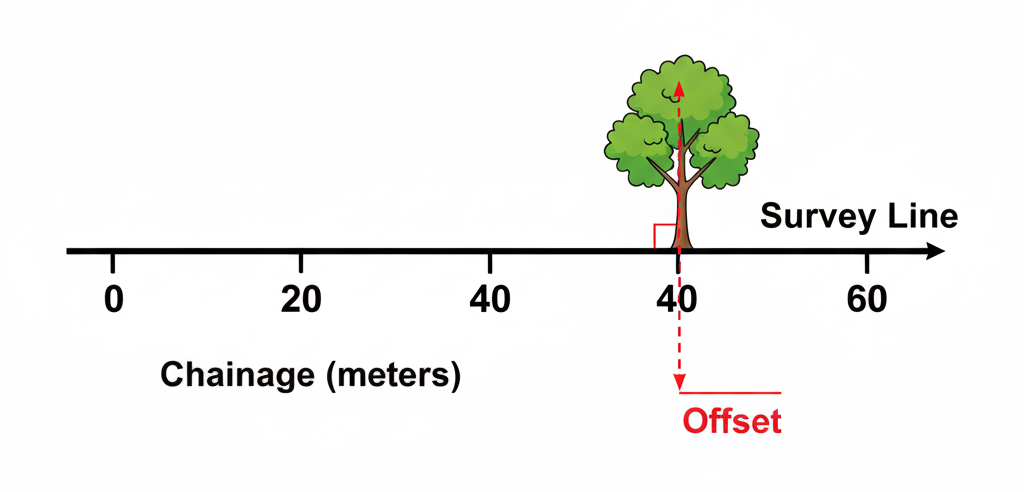
- B. Perpendicular to a chain line: This describes an offset. An offset is a measurement taken at a right angle from the chain line to locate features (like buildings, trees, etc.) that are not on the main line itself.
- C. Perpendicular to a tie line: This is also an offset, but measured from a secondary line (a tie line) rather than the main survey line.
🖼️ Chainage vs. Offset
The diagram below clarifies the difference. The numbers along the straight survey line represent the chainage. The measurement taken at 90° from the chain line to the feature is the offset.
💡 Key Takeaway
To easily remember the difference:
- Chainage = Distance ALONG the line.
- Offset = Distance AWAY FROM the line (at 90°).