Problem Statement
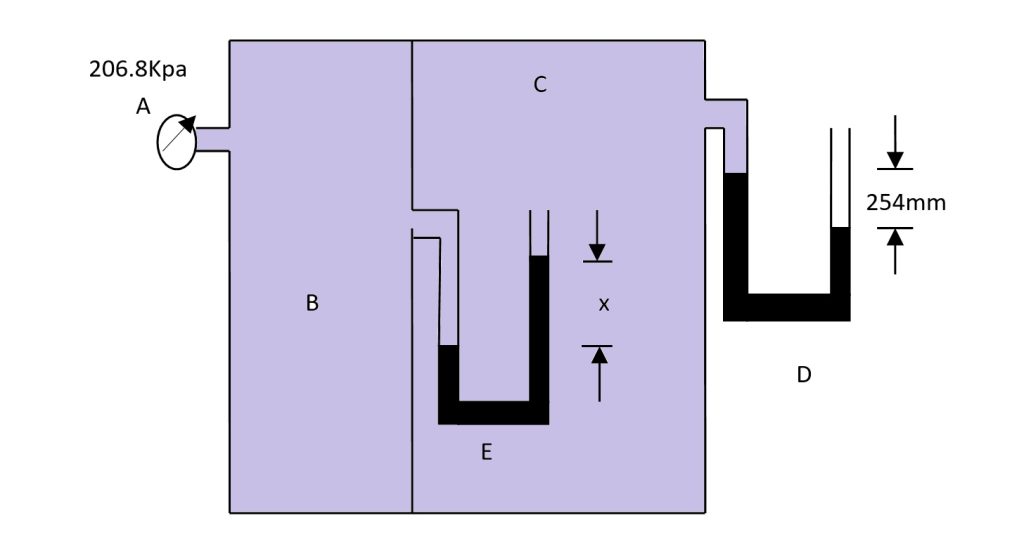
Compartments B and C in the figure are closed and filled with air. The barometer reads \( 99.98 \, \text{kPa} \). When gauges A and D read as indicated, what should be the value of \( x \) for gauge E? (Mercury in each tube)
Solution
Given:
- Gauge A pressure (\( P_A \)) = \( 206.8 \, \text{kPa} = 206800 \, \text{Pa} \)
- Specific weight of mercury (\( \gamma_{\text{m}} \)) = \( 13.6 \times 9810 = 133416 \, \text{N/m}^3 \)
Pressure Equation:
Starting from gauge A and neglecting air, the pressure balance equation is:
\( P_A – \gamma_{\text{m}} x + \gamma_{\text{m}} \times 0.254 = 0 \)
Substitute the values:
\( 206800 – 133416 x + 133416 \times 0.254 = 0 \)
Simplify to solve for \( x \):
\( 206800 – 133416 x + 33986.464 = 0 \)
\( 240786.464 = 133416 x \)
\( x = \frac{240786.464}{133416} \)
Final Value:
\( x = 1.8 \, \text{m} \)
Explanation
This problem determines the height \( x \) in a mercury-filled gauge system using hydrostatic principles:
- The pressure at gauge A contributes to the pressure difference observed in the system.
- The specific weight of mercury is used to calculate the pressure due to the height difference in the columns.
- The final value of \( x \) is derived from the pressure balance equation by simplifying and isolating the variable.
Physical Meaning
- Hydrostatic Balance: The height difference \( x \) reflects the equilibrium condition of the pressures in the mercury-filled columns.
- Specific Weight of Mercury: Mercury’s high specific weight significantly influences the pressure changes with height.
- Gauge Pressure: All calculations are relative to atmospheric pressure, simplifying the analysis by neglecting external air pressure effects.