Ashok Sapkota

Ashok Sapkota is a dedicated engineer currently serving at the Department of Water Resources and Irrigation in Nepal. With a strong educational background, Ashok completed his Bachelor's degree from the Institute of Engineering (IOE), Pulchowk Campus, Nepal. He is currently pursuing a Master's degree in Construction Management at the same prestigious institution.

Ashok's professional expertise lies in water resources and irrigation engineering, where he applies his knowledge to contribute to Nepal's water management and agricultural development.

Beyond his professional commitments, Ashok is passionate about sharing his engineering insights. He regularly writes blogs on various engineering topics, aiming to educate and inspire others in the field.

With a combination of practical experience, ongoing advanced education, and a drive to share knowledge, Ashok Sapkota represents the new generation of engineers working to shape Nepal's future.

. What distance must the sides of a tank be carried above the surface of water contained in it if the tank is to undergo a uniform horizontal acceleration of 3m/s2 without spilling any water?

What distance must the sides of a tank be carried above the surface of water contained in it if the tank is to undergo a uniform horizontal acceleration of 3m/s2 without spilling any water?

Tank Side Clearance under Acceleration Problem Statement What distance must the sides of a tank be carried above the surface

What distance must the sides of a tank be carried above the surface of water contained in it if the tank is to undergo a uniform horizontal acceleration of 3m/s2 without spilling any water? Read More »

An open rectangular tank 1.5mx1mx1.2m high is completely filled with water when at rest. Determine the volume spilled after the tank acquired a linear uniform acceleration of 0.6 m/s2 in the horizontal direction.

An open rectangular tank 1.5mx1mx1.2m high is completely filled with water when at rest. Determine the volume spilled after the tank acquired a linear uniform acceleration of 0.6 m/s2 in the horizontal direction.

Volume Spilled from Accelerating Tank Problem Statement An open rectangular tank with dimensions 1.5 m × 1 m × 1.2

An open rectangular tank 1.5mx1mx1.2m high is completely filled with water when at rest. Determine the volume spilled after the tank acquired a linear uniform acceleration of 0.6 m/s2 in the horizontal direction. Read More »

An open cubical tank with each side 1.5m contains oil of specific weight 7.5KN/m3 up to a depth of 1.3m. Find the forces acting on the side of the tank when it is being moved with an acceleration of 4m/s2 in vertically upward and downward direction.

An open cubical tank with each side 1.5m contains oil of specific weight 7.5KN/m3 up to a depth of 1.3m. Find the forces acting on the side of the tank when it is being moved with an acceleration of 4m/s2 in vertically upward and downward direction.

Force on Tank Side Analysis Problem Statement An open cubical tank with each side measuring 1.5 m contains oil with

An open cubical tank with each side 1.5m contains oil of specific weight 7.5KN/m3 up to a depth of 1.3m. Find the forces acting on the side of the tank when it is being moved with an acceleration of 4m/s2 in vertically upward and downward direction. Read More »

A rectangular tank 2m long, 1.5m wide and 1.5m deep is filled with oil of specific gravity 0.8. Find the force acting on the bottom of the tank when (a) the vertical acceleration 5m/s2 acts upwards (b) the vertical acceleration 5m/s2 acts downwards.

A rectangular tank 2m long, 1.5m wide and 1.5m deep is filled with oil of specific gravity 0.8. Find the force acting on the bottom of the tank when (a) the vertical acceleration 5m/s2 acts upwards (b) the vertical acceleration 5m/s2 acts downwards.

Force on Tank Bottom Analysis Problem Statement A rectangular tank measuring 2 m in length, 1.5 m in width, and

A rectangular tank 2m long, 1.5m wide and 1.5m deep is filled with oil of specific gravity 0.8. Find the force acting on the bottom of the tank when (a) the vertical acceleration 5m/s2 acts upwards (b) the vertical acceleration 5m/s2 acts downwards. Read More »

An open rectangular tank 3m long and 2m wide is filled with water to a depth of 1.5m. Find the slope of the water surface when the tank moves with an acceleration of 5m/s2 up a 300 inclined plane. Also calculate the pressure on the bottom at both ends.

An open rectangular tank 3m long and 2m wide is filled with water to a depth of 1.5m. Find the slope of the water surface when the tank moves with an acceleration of 5m/s2 up a 300 inclined plane. Also calculate the pressure on the bottom at both ends.

Open Rectangular Tank Analysis Problem Statement An open rectangular tank, measuring 3 m in length and 2 m in width,

An open rectangular tank 3m long and 2m wide is filled with water to a depth of 1.5m. Find the slope of the water surface when the tank moves with an acceleration of 5m/s2 up a 300 inclined plane. Also calculate the pressure on the bottom at both ends. Read More »

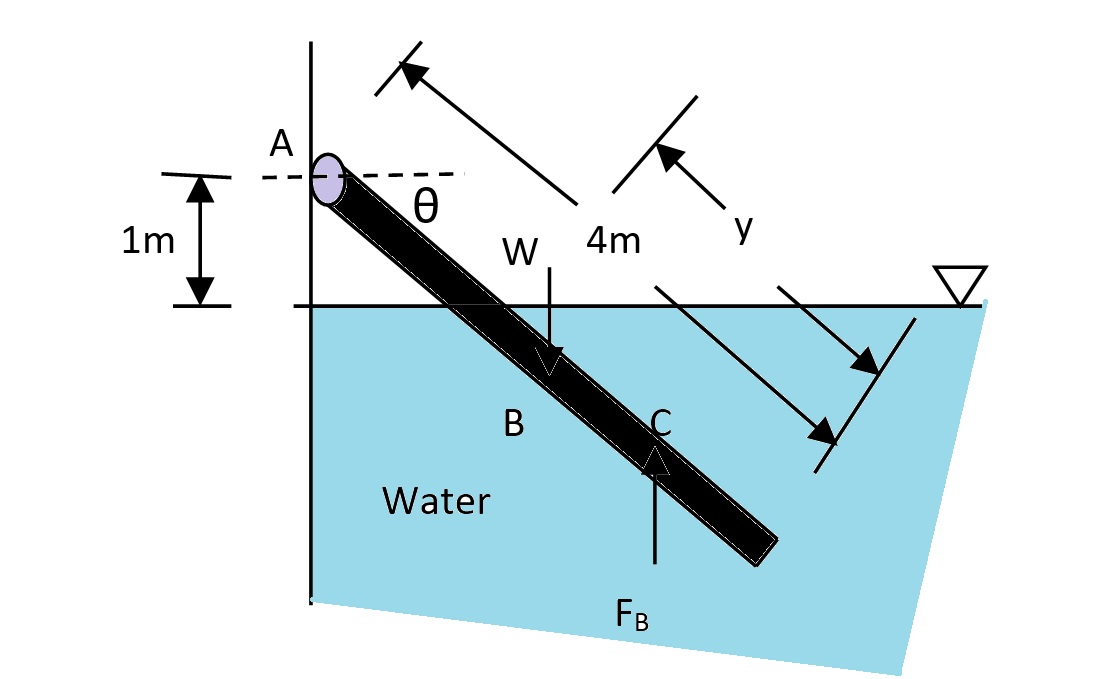
The wooden beam shown in the figure is 200mmx200mm and 4m long. It is hinged at A and remains in equilibrium at θ with the horizontal. Find the inclination θ. Sp. gr. of wood = 0.6.

The wooden beam shown in the figure is 200mmx200mm and 4m long. It is hinged at A and remains in equilibrium at θ with the horizontal. Find the inclination θ. Sp. gr. of wood = 0.6.

Wooden Beam Equilibrium Analysis Problem Statement The wooden beam shown in the figure has a cross-sectional dimension of 200 mm

The wooden beam shown in the figure is 200mmx200mm and 4m long. It is hinged at A and remains in equilibrium at θ with the horizontal. Find the inclination θ. Sp. gr. of wood = 0.6. Read More »

A cone of base radius R and height H floats in water with the vertex downwards. If θ is the semi-vertex angle of the cone and h is the depth of immersion, show that for stable equilibrium 〖Sec〗^2 θ>H/h.

A cone of base radius R and height H floats in water with the vertex downwards. If θ is the semi-vertex angle of the cone and h is the depth of immersion, show that for stable equilibrium Sec^2 θ>H/h.

Stability Analysis Problem Statement A cone of base radius R and height H floats in water with its vertex downwards.

A cone of base radius R and height H floats in water with the vertex downwards. If θ is the semi-vertex angle of the cone and h is the depth of immersion, show that for stable equilibrium Sec^2 θ>H/h. Read More »

If a solid conical buoy of height H and relative density S floats in water with axis vertical and apex upwards, show that the height above the water surface of the conical buoy is equal to H(1-S)^(1/3).

If a solid conical buoy of height H and relative density S floats in water with axis vertical and apex upwards, show that the height above the water surface of the conical buoy is equal to H(1-S)^(1/3).

If a solid conical buoy of height H and relative density S floats in water with axis vertical and apex

If a solid conical buoy of height H and relative density S floats in water with axis vertical and apex upwards, show that the height above the water surface of the conical buoy is equal to H(1-S)^(1/3). Read More »

Consider a homogeneous right circular cylinder of length L, radius R, and specific gravity S, floating in water (S = 1) with its axis vertical. Show that the body is stable is  .

Consider a homogeneous right circular cylinder of length L, radius R, and specific gravity S, floating in water (S =

Consider a homogeneous right circular cylinder of length L, radius R, and specific gravity S, floating in water (S = 1) with its axis vertical. Show that the body is stable is  . Read More »

A plate of metal 1.1mx1.1mx2mm is to be lifted up with a velocity of 0.1m/s through an infinitely extending gap 20mm wide containing an oil of sp. gr. 0.9 and viscosity 2.1NS/m2. Find the force required to lift the plate assuming the plate to remain midway in the gap. Assume the weight of the plate to be 30N.

A plate of metal 1.1mx1.1mx2mm is to be lifted up with a velocity of 0.1m/s through an infinitely extending gap 20mm wide containing an oil of sp. gr. 0.9 and viscosity 2.1NS/m2. Find the force required to lift the plate assuming the plate to remain midway in the gap. Assume the weight of the plate to be 30N.

A plate of metal 1.1mx1.1mx2mm is to be lifted up with a velocity of 0.1m/s through an infinitely extending gap

A plate of metal 1.1mx1.1mx2mm is to be lifted up with a velocity of 0.1m/s through an infinitely extending gap 20mm wide containing an oil of sp. gr. 0.9 and viscosity 2.1NS/m2. Find the force required to lift the plate assuming the plate to remain midway in the gap. Assume the weight of the plate to be 30N. Read More »

A cylindrical buoy 1.8m in diameter, 1.2m high and weighing 10.5 KN floats in salt water of density 1025 kg/m3.

A cylindrical buoy 1.8m in diameter, 1.2m high and weighing 10.5 KN floats in salt water of density 1025 kg/m3. Its CG is 0.45m from the bottom. If a load of 3KN is placed on the top, find the maximum height of the CG of this load above the bottom if the buoy is to remain in stable equilibrium.

A cylindrical buoy 1.8m in diameter, 1.2m high and weighing 10.5 KN floats in salt water of density 1025 kg/m3.

A cylindrical buoy 1.8m in diameter, 1.2m high and weighing 10.5 KN floats in salt water of density 1025 kg/m3. Its CG is 0.45m from the bottom. If a load of 3KN is placed on the top, find the maximum height of the CG of this load above the bottom if the buoy is to remain in stable equilibrium. Read More »

Scroll to Top