Flow measurement

A sharp edged weir is to be constructed across a stream in which the normal flow is 200 litres/sec. If the maximum flow likely to occur in the stream is 5 times the normal flow then determine the length of weir necessary to limit the rise in water level to 40cm above that for normal flow. Cd=0.61.

Sharp-Edged Weir Design Analysis Sharp-Edged Weir Design Analysis Problem Statement A sharp-edged weir is to be constructed across a stream […]

A sharp edged weir is to be constructed across a stream in which the normal flow is 200 litres/sec. If the maximum flow likely to occur in the stream is 5 times the normal flow then determine the length of weir necessary to limit the rise in water level to 40cm above that for normal flow. Cd=0.61. Read More »

Water is flowing over a sharp-crested rectangular weir of width 50cm into a tank with cross-sectional area 0.6m2. After a period of 30s the depth of water in the tank is 1.4m. Assuming a discharge coefficient of 0.9, determine the height of the water above the weir. If the rectangular weir is replaced by a 900 notch weir with the same head and a discharge coefficient of 0.8, calculate the depth increase of the water in the tank after 30s.

Sharp-Crested Weir Flow Analysis Sharp-Crested Weir Flow Analysis Problem Statement Water is flowing over a sharp-crested rectangular weir of width

Water is flowing over a sharp-crested rectangular weir of width 50cm into a tank with cross-sectional area 0.6m2. After a period of 30s the depth of water in the tank is 1.4m. Assuming a discharge coefficient of 0.9, determine the height of the water above the weir. If the rectangular weir is replaced by a 900 notch weir with the same head and a discharge coefficient of 0.8, calculate the depth increase of the water in the tank after 30s. Read More »

A Venturimeter of throat diameter 0.07m is fitted in a 0.15m diameter vertical pipe in which liquid of relative density 0.8 flows downwards. Pressure gauges are fitted to the inlet and to the throat sections. The throat being 0.9m below the inlet. Taking the coefficient of the meter as 0.96 find the discharge a) when the pressure gauges read the same b) when the inlet gauge reads 15170 N/m2 higher than the throat gauge.

Venturimeter Discharge Analysis Venturimeter Discharge Analysis Problem Statement A Venturimeter of throat diameter 0.07 m is fitted in a 0.15

A Venturimeter of throat diameter 0.07m is fitted in a 0.15m diameter vertical pipe in which liquid of relative density 0.8 flows downwards. Pressure gauges are fitted to the inlet and to the throat sections. The throat being 0.9m below the inlet. Taking the coefficient of the meter as 0.96 find the discharge a) when the pressure gauges read the same b) when the inlet gauge reads 15170 N/m2 higher than the throat gauge. Read More »

A Venturimeter is to be fitted in a horizontal pipe of 0.15m diameter to measure a flow of water which may be anything up to 240m3/hour. The pressure head at the inlet for this flow is 18m above atmospheric and the pressure head at the throat must not be lower than 7m below atmospheric. Between the inlet and the throat there is an estimated frictional loss of 10% of the difference in pressure head between these points. Calculate the minimum allowable diameter for the throat.

Venturimeter Analysis Venturimeter Analysis for Flow Measurement Problem Statement A Venturimeter is to be fitted in a horizontal pipe of

A Venturimeter is to be fitted in a horizontal pipe of 0.15m diameter to measure a flow of water which may be anything up to 240m3/hour. The pressure head at the inlet for this flow is 18m above atmospheric and the pressure head at the throat must not be lower than 7m below atmospheric. Between the inlet and the throat there is an estimated frictional loss of 10% of the difference in pressure head between these points. Calculate the minimum allowable diameter for the throat. Read More »

A horizontal venturimeter with inlet and throat diameters of 400mm and 200mm respectively, is connected to a pipe. If the pressure in the inlet portion is 200KPa and the vacuum pressure (negative) on the throat is 400mm of mercury, find the rate of flow in the pipe taking Cd = 0.97.

Horizontal Venturimeter Flow Measurement Horizontal Venturimeter Flow Measurement Problem Statement A horizontal venturimeter with an inlet diameter of 400 mm

A horizontal venturimeter with inlet and throat diameters of 400mm and 200mm respectively, is connected to a pipe. If the pressure in the inlet portion is 200KPa and the vacuum pressure (negative) on the throat is 400mm of mercury, find the rate of flow in the pipe taking Cd = 0.97. Read More »

A venturimeter is used for measurement of discharge of water in a horizontal pipeline. The ratio of the upstream pipe diameter and throat is 2:1 and upstream diameter is 300mm. Mercury manometer connected at the pipe and throat shows the reading of 0.24m and the loss of head through the meter is 1/8 of the throat velocity head. Calculate the discharge in the pipe using the continuity and energy equations.

Venturimeter Discharge Measurement in a Horizontal Pipeline Venturimeter Discharge Measurement in a Horizontal Pipeline Problem Statement A venturimeter is used

A venturimeter is used for measurement of discharge of water in a horizontal pipeline. The ratio of the upstream pipe diameter and throat is 2:1 and upstream diameter is 300mm. Mercury manometer connected at the pipe and throat shows the reading of 0.24m and the loss of head through the meter is 1/8 of the throat velocity head. Calculate the discharge in the pipe using the continuity and energy equations. Read More »

A venturimeter with a throat diameter of 100mm is fitted in a vertical pipeline of 200mm diameter with oil of sp.gr. 0.88 flowing upwards. The venturimeter coefficient is 0.98. The pressure gauges are fitted at tapping points, one at the throat and the other in the inlet pipe 320mm below the throat. The difference between two pressure gauge readings is 28 KN/m2. Working from Bernoulli’s equation, determine (a) the volume rate of oil through the pipe, (b) the difference in level in the two limbs of mercury if it is connected to the tapping points and connecting pipes are filled with same oil.

Venturimeter Analysis in a Vertical Pipeline Venturimeter Analysis in a Vertical Pipeline Problem Statement A venturimeter with a throat diameter

A venturimeter with a throat diameter of 100mm is fitted in a vertical pipeline of 200mm diameter with oil of sp.gr. 0.88 flowing upwards. The venturimeter coefficient is 0.98. The pressure gauges are fitted at tapping points, one at the throat and the other in the inlet pipe 320mm below the throat. The difference between two pressure gauge readings is 28 KN/m2. Working from Bernoulli’s equation, determine (a) the volume rate of oil through the pipe, (b) the difference in level in the two limbs of mercury if it is connected to the tapping points and connecting pipes are filled with same oil. Read More »

A 20cmx10cm venturimeter is mounted in a vertical pipeline carrying oil of sp.gr. 0.8 flowing upwards. The throat section is 20cm above the entrance section of the venturimeter. The differential U-tube manometer shows a gauge deflection of 25cm. Calculate the discharge of the oil and the pressure difference between the entrance and the throat section. Take Cd =0.96

Venturimeter Discharge and Pressure Difference Calculation Venturimeter Discharge and Pressure Difference Calculation Problem Statement A 20 cm x 10 cm

A 20cmx10cm venturimeter is mounted in a vertical pipeline carrying oil of sp.gr. 0.8 flowing upwards. The throat section is 20cm above the entrance section of the venturimeter. The differential U-tube manometer shows a gauge deflection of 25cm. Calculate the discharge of the oil and the pressure difference between the entrance and the throat section. Take Cd =0.96 Read More »

An orificemeter is installed in a vertical pipeline of 250 mm diameter carrying oil with a specific gravity of 0.9. The oil flows upward. The elevation difference between the upstream and downstream manometer taps is 350 mm, and the differential U-tube manometer shows a gauge deflection of 200 mm. Given that the orifice diameter is 150 mm and the discharge coefficient (Cd) is 0.65, calculate the discharge of oil.

Discharge Calculation Using an Orificemeter in a Vertical Pipeline Discharge Calculation Using an Orificemeter in a Vertical Pipeline Problem Statement

An orificemeter is installed in a vertical pipeline of 250 mm diameter carrying oil with a specific gravity of 0.9. The oil flows upward. The elevation difference between the upstream and downstream manometer taps is 350 mm, and the differential U-tube manometer shows a gauge deflection of 200 mm. Given that the orifice diameter is 150 mm and the discharge coefficient (Cd) is 0.65, calculate the discharge of oil. Read More »

A horizontal venturimeter is used to measure the flow of water in a 200mm diameter pipe. The throat diameter of the venturimeter is 80mm and the discharge coefficient is 0.85. If the pressure difference between the two measurement points is 10cm of mercury, calculate the average velocity in the pipe.

Flow Measurement Using a Horizontal Venturimeter Flow Measurement Using a Horizontal Venturimeter Problem Statement A horizontal venturimeter is used to

A horizontal venturimeter is used to measure the flow of water in a 200mm diameter pipe. The throat diameter of the venturimeter is 80mm and the discharge coefficient is 0.85. If the pressure difference between the two measurement points is 10cm of mercury, calculate the average velocity in the pipe. Read More »

. A horizontal venturimeter in a water main has a 20cm diameter at one end and tapers to 10cm at its throat. A piezometer installed at the inlet reads 30cm, while the one at the throat reads 18cm. Determine the discharge through the main, if Cd = 0.98.

A horizontal venturimeter in a water main has a 20 cm diameter at one end and tapers to 10 cm at its throat. A piezometer installed at the inlet reads 30 cm, while the one at the throat reads 18 cm. Determine the discharge through the main if Cd = 0.98.

Fluid Mechanics Problem Solution Problem Statement A horizontal venturimeter in a water main has a 20 cm diameter at one

A horizontal venturimeter in a water main has a 20 cm diameter at one end and tapers to 10 cm at its throat. A piezometer installed at the inlet reads 30 cm, while the one at the throat reads 18 cm. Determine the discharge through the main if Cd = 0.98. Read More »

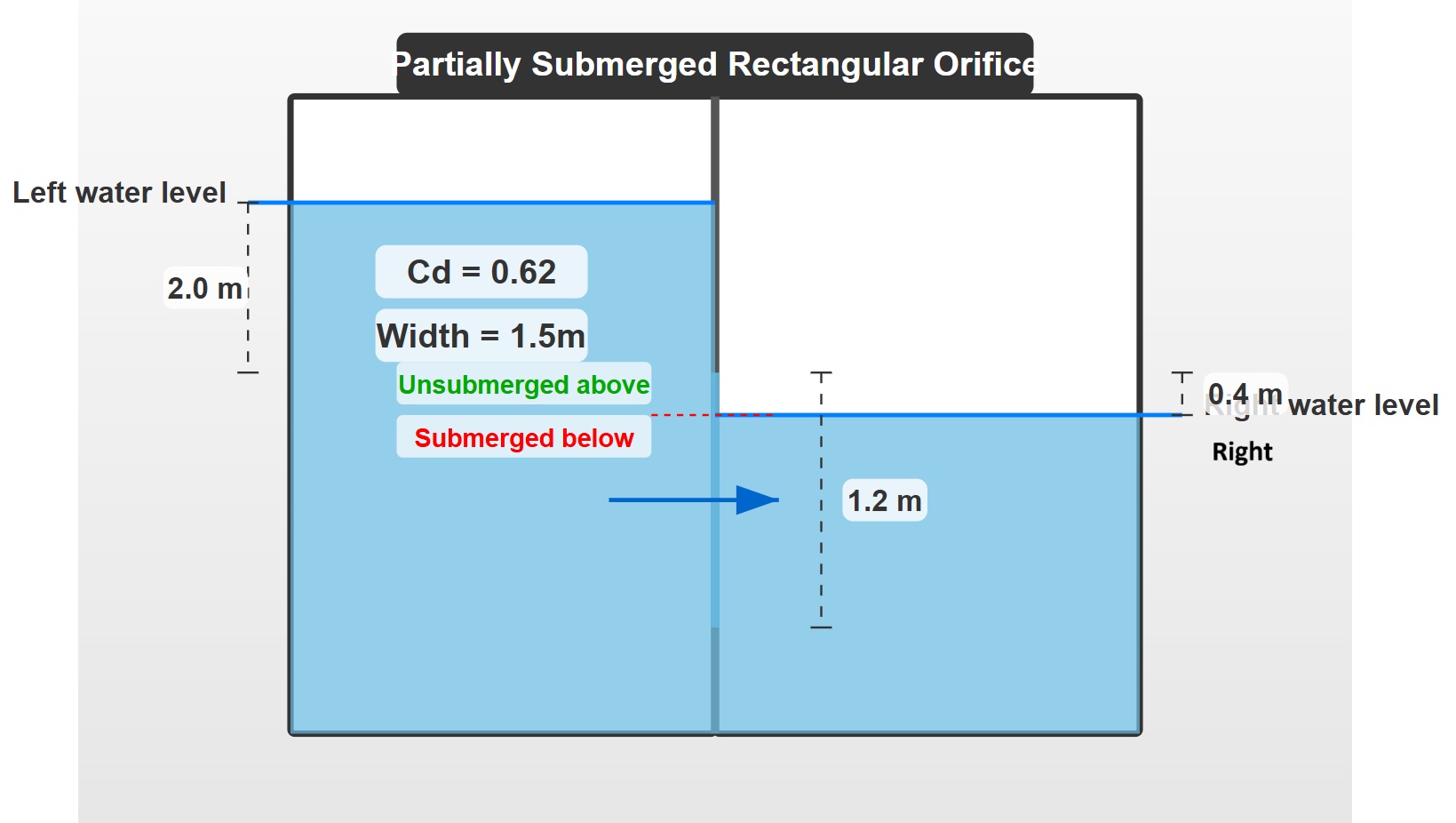
. A rectangular orifice of 1.5m wide and 1.2m deep is fitted in one side of a large tank. The water level on one side of the orifice is 2m above the top edge of the orifice, while on the other side of the orifice, the water level is 0.4m below its top edge. Calculate the discharge through the orifice if Cd = 0.62.

A rectangular orifice of 1.5 m wide and 1.2 m deep is fitted in one side of a large tank. The water level on one side of the orifice is 2 m above the top edge of the orifice, while on the other side the water level is 0.4 m below its top edge. Calculate the discharge through the orifice if Cd = 0.62.

Discharge Analysis of a Partially Submerged Rectangular Orifice Discharge Analysis of a Partially Submerged Rectangular Orifice Problem Statement A rectangular

A rectangular orifice of 1.5 m wide and 1.2 m deep is fitted in one side of a large tank. The water level on one side of the orifice is 2 m above the top edge of the orifice, while on the other side the water level is 0.4 m below its top edge. Calculate the discharge through the orifice if Cd = 0.62. Read More »

Scroll to Top