
Table of Contents
ToggleConcrete is one of the most versatile and widely used materials in construction, valued for its strength, durability, and adaptability to various forms and applications. Traditionally known for its load-bearing capacity, concrete’s development has expanded over the years to include numerous types tailored for specific functional and aesthetic needs. Beyond its role as a structural material, concrete has evolved to serve multiple purposes, incorporating specialized features such as enhanced durability, aesthetic appeal, and unique functionalities.
The classification of concrete can be approached from various angles, each emphasizing different properties and applications:
Classification of Concrete Based on Unit Weight
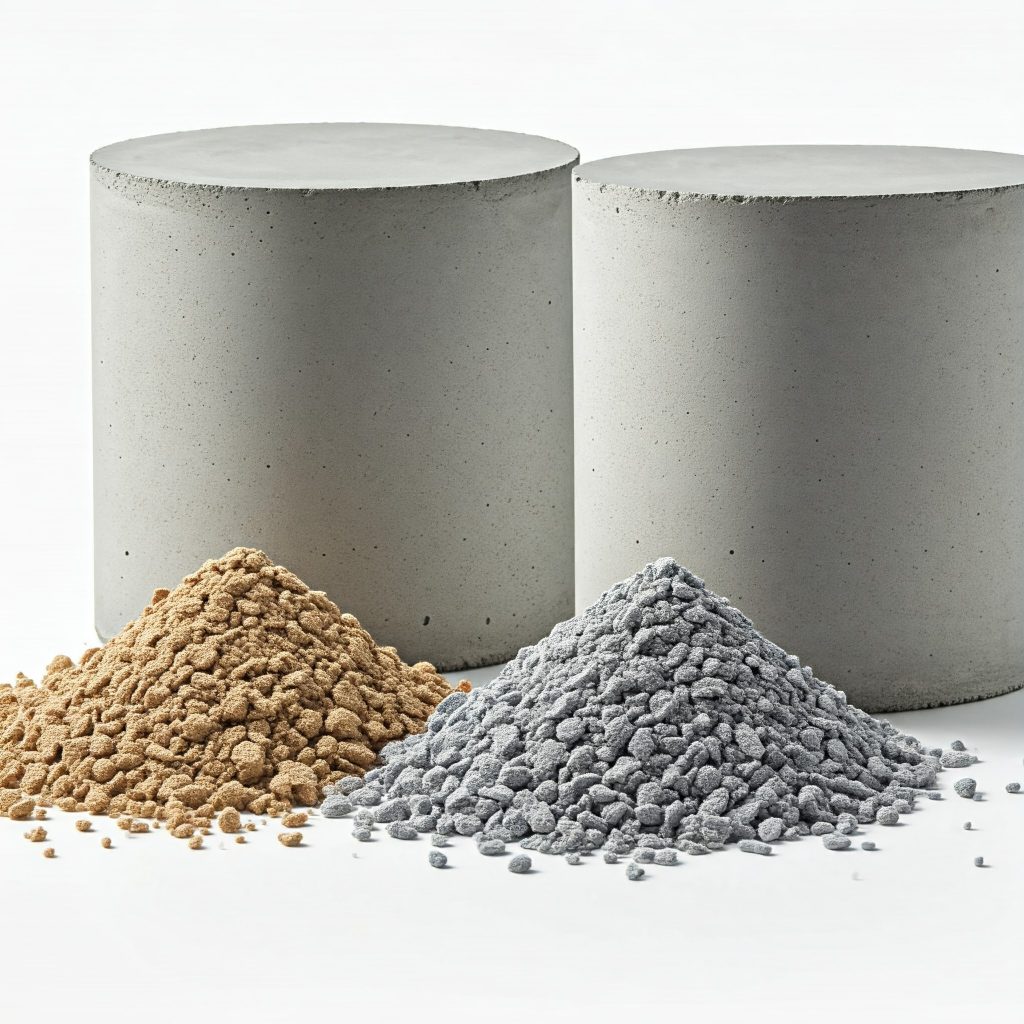
Concrete is classified into four categories based on its unit weight, which depends primarily on the type of aggregate used:
Ultra-lightweight concrete:
- Unit weight: Less than 1,200 kg/m³.
- Aggregates used: Ultra-lightweight aggregates, such as expanded polystyrene or perlite.
- Applications: Typically used for non-structural purposes, such as insulation or lightweight panels.
Lightweight concrete:
- Unit weight: Between 1,200 and 1,800 kg/m³.
- Aggregates used: Lightweight aggregates, such as pumice, scoria, or expanded clay.
- Applications: Suitable for both structural and non-structural components, depending on its composition.
Normal-weight concrete:
- Unit weight: Approximately 2,400 kg/m³.
- Aggregates used: Standard aggregates, such as crushed stone, gravel, or sand.
- Applications: Widely used for the construction of buildings and infrastructure.
Heavyweight concrete:
- Unit weight: Greater than 3,200 kg/m³.
- Aggregates used: Heavyweight aggregates, such as barite or magnetite.
- Applications: Utilized for specialized structures like laboratories, hospital examination rooms, and nuclear facilities to provide radiation protection.
Classification of Concrete Based on Compressive Strength
Concrete can also be classified according to its compressive strength, which determines its suitability for various construction purposes. The compressive strength of concrete is typically measured in megapascals (MPa) and is categorized into four types:
Low-strength concrete:
- Compressive strength: Less than 20 MPa.
- Applications: Primarily used in constructing mass concrete structures, road subgrades, and partitions where high load-bearing capacity is not required.
Moderate-strength concrete:
- Compressive strength: Between 20 and 50 MPa.
- Applications: The most commonly used concrete type, suitable for general construction projects such as buildings, bridges, and similar structures.
High-strength concrete:
- Compressive strength: Between 50 and 150 MPa.
- Applications: Utilized in the construction of tall building columns, bridge towers, and shear walls where superior strength is essential.
Ultra-high-strength concrete:
- Compressive strength: Greater than 150 MPa.
- Applications: Not yet widely adopted for structural constructions. However, it has been used in limited applications such as footbridges and specific structural elements like girders, where exceptional strength and durability are required.
Classification of Concrete Based on Additives

Concrete can also be classified according to the additives incorporated into the mixture beyond the basic components of cement, aggregate, and water. These additives are introduced to enhance specific properties of the concrete, tailoring it to specialized applications. Key classifications include:
Fiber-Reinforced Concrete (FRC):
- Additives: Various fibers such as steel, glass, polymeric materials, and carbon.
- Purpose: Enhances toughness, improves tensile properties, controls shrinkage, and can also serve decorative purposes.
Macro-Defect-Free (MDF) Concrete:
- Additives: A high amount of water-soluble polymers.
- Purpose: Developed to improve tensile and flexural properties, MDF concrete is manufactured using a twin-roll mixing process.
Densified with Small Particles (DSP) Concrete:
- Additives: A significant amount of silica fume, a fine mineral admixture.
- Purpose: Known for excellent abrasion resistance, DSP concrete is primarily used in producing machine tools and industrial molds.
Polymer Concrete:
- Additives: Polymers incorporated in various ways:
- As a binder to replace traditional cement.
- By impregnating Portland cement concrete with polymers.
- As an admixture within standard Portland cement concrete.
- Additives: Polymers incorporated in various ways:
These specialized types of concrete, enhanced with additives, offer improved mechanical properties, durability, and resistance for specific engineering applications.
Classification of Concrete in Accordance with Construction Methods
Concrete can also be classified based on the construction methods used in its application. These methods often result in specialized concrete types with unique properties tailored for specific requirements. Examples include 3D printable concrete, sprayable concrete, and roller-compacting concrete.
- 3D Printable Concrete (3DCP):
- Overview: A modern construction technology, 3D concrete printing employs a layer-by-layer deposition process based on computer-aided design (CAD).
- Advantages:
- Minimizes waste by eliminating the need for formwork.
- Requires less labor and increases efficiency through automation.
- Enables the creation of complex geometries and customized designs.
- Material Requirements:
- The fresh concrete must balance pumpability for smooth delivery and buildability to support the weight of printed structures.
- Rheological properties are carefully tailored to ensure the material is neither too stiff nor too soft.
- Applications: Cost-efficient and effective for intricate and innovative structural designs.

2. Sprayable Concrete (Shotcrete):
- Overview: This traditional method involves pumping concrete through a hose and projecting it at high velocity onto a substrate.
- Advantages:
- Suitable for vertical and overhead surfaces where casting is challenging.
- Reinforces tunnels, caves, and structures with defects.
- Enhances cohesion to prevent pressure-induced bleeding and improves adherence at the concrete-substrate interface.
- Applications: Commonly used in structural repairs, retrofitting, and as rock support in underground construction.

3. Roller-Compacting Concrete:
- Overview: A conventional method primarily used for road pavements, this process involves stiff concrete with minimal flowability.
- Advantages:
- Enhanced anti-abrasion properties for durability.
- Compacted using road rollers to ensure uniform distribution and leveling.
- Applications: Ideal for constructing durable and smooth road surfaces.

Classification of Concrete in Accordance with Non-Structural Functionality
While concrete is primarily valued for its structural properties, such as compressive strength, flexural strength, and elastic modulus, advancements in technology have expanded its applications to include non-structural functionalities. These multi-functional concretes cater to specific needs beyond load-bearing and have been developed with innovative designs and materials to enhance their versatility.
Decoration Function:
- Concrete is often used in spaces closely interacting with people, where aesthetics play a significant role.
- To transform plain, gray concrete into visually appealing decorative elements, specialized types like architectural concrete, colored concrete, polished concrete, stained concrete, and stamped concrete have been developed.
- These concretes enhance the appearance of buildings and public spaces while retaining structural integrity.
Abrasion-Resistant Function:
- Abrasion resistance is essential for structures exposed to constant wear, such as dams, diversion channels, water channels, collecting pipes, floors, and pavements.
- This functionality is achieved through:
- The use of binders with high calcium aluminate ferrite phases.
- Stronger fine and coarse aggregates.
- A carefully designed mix proportion.
Shielding Function:
- Concrete structures often require the ability to shield against environmental and operational factors, such as microwaves, radiation, acoustic noise, and heat.
- Shielding properties are achieved by optimizing density, pore structure, and composition, ensuring safety in environments like nuclear plants, medical facilities, and industrial settings.
Nanotechnology-Enhanced Functionalities:
- Recent developments in nanotechnology have introduced revolutionary enhancements in concrete.
- By incorporating nanomaterials like nano-TiO₂, nano-SiO₂, nano-CaCO₃, nanoclay, carbon nanotubes, and graphene, novel functionalities have been achieved, including:
- Photocatalysis: For environmental applications like air purification.
- Self-Cleaning: To reduce maintenance needs for exposed surfaces.
- Rheology Modification: For improved workability during construction.
- Heat Conduction: For thermal regulation in specialized applications.


