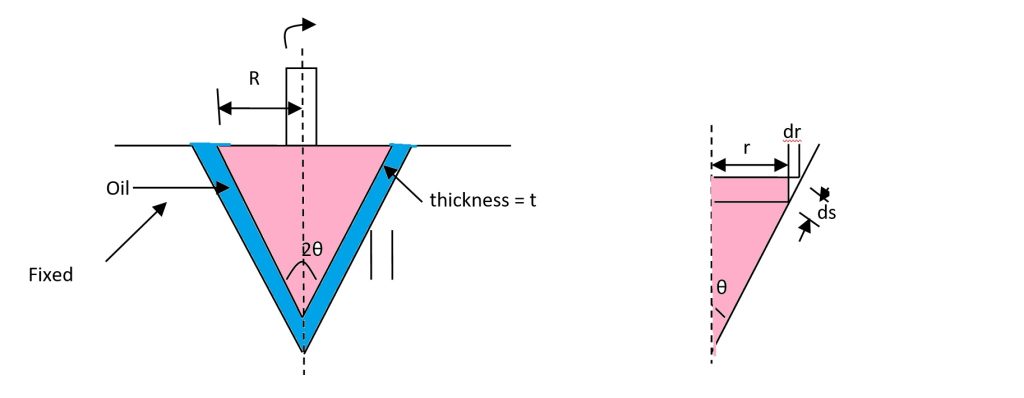
Problem Statement
A solid cone of maximum radius \( R \) and vertex angle \( \theta \) is to rotate at an angular velocity \( \omega \). An oil of viscosity \( \mu \) and thickness \( t \) fills the gap between the cone and the housing. Derive an expression for the torque required and the rate of heat dissipation in the bearing.
- Maximum radius of the cone: \( R \)
- Thickness of oil: \( t \)
- Angular velocity: \( \omega \)
- Viscosity of oil: \( \mu \)
Solution
Step-by-Step Derivation:
Consider an elementary area \( dA \) at radius \( r \) of the cone:
\( dA = 2\pi r \, dr \sin\theta \)
Shear force acting on the area:
\( \text{Shear force} = \tau \cdot dA = \mu \frac{u}{t} \cdot dA = \mu \frac{\omega r}{t} \cdot 2\pi r \, dr \sin\theta \)
Torque on the elemental area:
\( dT = \text{Shear force} \cdot r = \mu \frac{\omega r}{t} \cdot 2\pi r \, dr \sin\theta \cdot r = \frac{2\pi\mu\omega}{t\sin\theta} r^3 \, dr \)
Integrate over the radius of the cone from \( r = 0 \) to \( r = R \):
\( T = \int_0^R dT = \int_0^R \frac{2\pi\mu\omega}{t\sin\theta} r^3 \, dr \)
Evaluate the integral:
\( T = \frac{2\pi\mu\omega}{t\sin\theta} \int_0^R r^3 \, dr = \frac{2\pi\mu\omega}{t\sin\theta} \cdot \frac{R^4}{4} \)
Simplify:
\( T = \frac{\pi\mu\omega R^4}{2t\sin\theta} \)
The rate of heat dissipation is equal to the power utilized in overcoming resistance:
\( \text{Power} = T \cdot \omega \)
Substitute the expression for \( T \):
\( \text{Power} = \frac{\pi\mu\omega R^4}{2t\sin\theta} \cdot \omega = \frac{\pi\mu\omega^2 R^4}{2t\sin\theta} \)
Final Results:
- Torque required: \( T = \frac{\pi\mu\omega R^4}{2t\sin\theta} \)
- Rate of heat dissipation: \( \text{Power} = \frac{\pi\mu\omega^2 R^4}{2t\sin\theta} \)
Explanation
This derivation follows these principles:
- Shear stress and velocity gradient: The torque required to rotate the cone depends on the shear stress exerted by the oil layer, which is proportional to the velocity gradient (\( u/t \)) and the viscosity (\( \mu \)).
- Integration of torque: By considering the torque contribution from each infinitesimal area element and integrating over the radius of the cone, the total torque is obtained.
- Heat dissipation: The heat dissipation represents the power required to overcome the viscous resistance, calculated as the product of torque and angular velocity.
This analysis is critical in understanding fluid mechanics in rotating systems, such as bearings, where oil is used to reduce friction and dissipate heat effectively.