Problem Statement
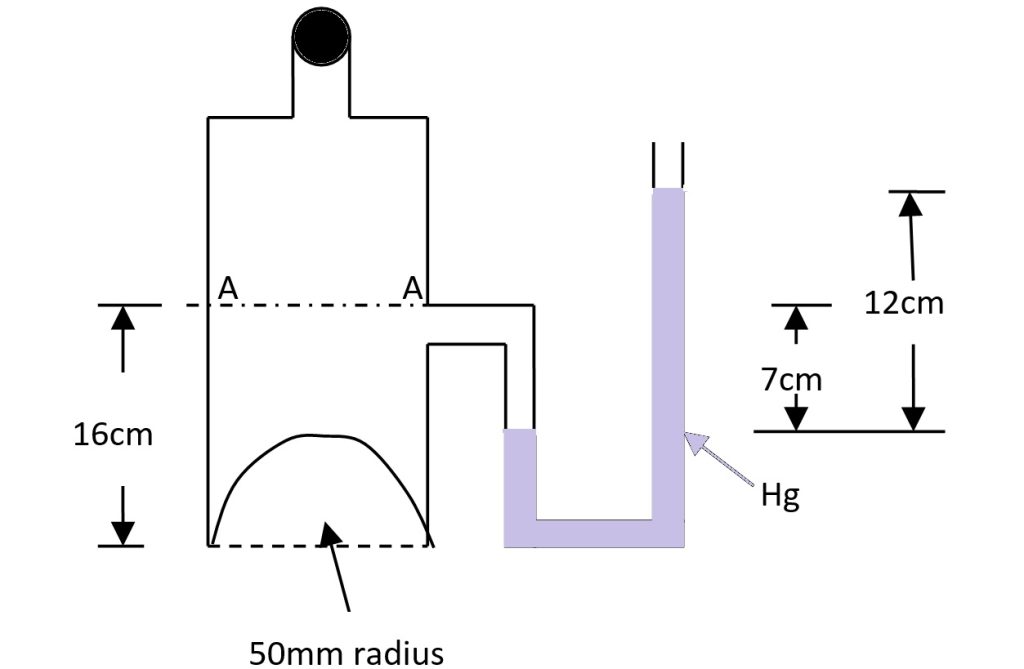
A closed tank is at \( 20°C \). If the pressure at point A is \( 96 \, \text{kPa} \) absolute, determine the absolute pressure at point B. Also, calculate the percent error if the specific weight of air is neglected. (Take \( \gamma_{\text{air}} = 0.0118 \, \text{kN/m}^3 \))
Solution
Given:
- \( \gamma_{\text{air}} = 0.0118 \, \text{kN/m}^3 \)
- \( \gamma_{\text{water}} = 9.81 \, \text{kN/m}^3 \)
- \( P_A = 96 \, \text{kPa} \)
- Distances:
- \( h_{AC} = 5 \, \text{m} \)
- \( h_{DC} = 2 \, \text{m} \)
- \( h_{DB} = 3 \, \text{m} \)
Pressure at Point B (\( P_B \)):
From the pressure balance equation starting from point A and considering the contributions of air and water:
The calculation incorporates the pressure contributions from air and water, with the tank maintained at 20°C.
Calculate the final value:
\( P_B = 96 + (0.0118 \times 5) – (9.81 \times 2) – (0.0118 \times 3) \)
Final Value:
\( P_B = 76.404 \, \text{kPa} \)
Neglecting Air:
Without considering the specific weight of air, the calculation simplifies:
\( P_B = 96 – (9.81 \times 2) \)
Final Value:
\( P_B = 76.38 \, \text{kPa} \)
Percent Error:
Calculate the percent error between the two results:
\( \text{Error} = \frac{76.404 – 76.38}{76.404} \times 100 \)
Final Value:
\( \text{Error} = 0.031\% \)
Explanation
This problem involves applying the principles of hydrostatics to determine the absolute pressure at point B:
- The absolute pressure at point B (\( P_B \)) is calculated by starting from point A (\( P_A \)) and considering the pressure contributions from the fluid columns above and below.
- The specific weight of air is small compared to that of water, making its contribution to pressure changes negligible in most cases.
- The problem highlights the effect of neglecting air’s specific weight by calculating the percent error. At 20°C, the air’s contribution is insignificant, resulting in a minimal error.
Physical Meaning
- Specific Weight (\( \gamma \)): This represents the weight per unit volume of a fluid. Air’s low specific weight means its impact on pressure is negligible compared to denser fluids like water.
- Pressure Difference: The difference in pressure between points A and B arises from the combined effects of air and water columns in the closed tank.
- Percent Error: The calculation shows that neglecting the specific weight of air introduces only a minor error, underscoring its relatively small effect on pressure calculations in hydrostatics.