
Problem Statement
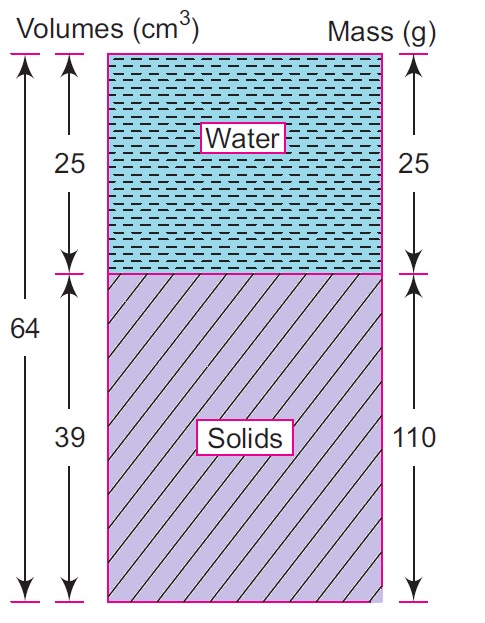
A cube of dried clay having sides 4 cm long has a mass of 110 g. The same cube of soil, when saturated at unchanged volume, has a mass of 135 g. Draw the soil element showing the volumes and weights of the constituents, and then determine the specific gravity of soil solids and the voids ratio.
Solution
1. Calculate the Volume of the Soil
Volume of the soil cube (before and after saturation):
2. Calculate the Mass of Water
Mass of water added during saturation:
3. Calculate the Volumes
Volume of voids:
Volume of solids:
4. Specific Gravity of Soil Solids
Using the formula:
Where \( \gamma_w = 1 \, \text{g/cm}^3 \):
5. Voids Ratio
Using the formula:
Substituting the values:
- Specific gravity of soil solids: \( G_s = 2.82 \)
- Voids ratio: \( e = 0.64 \)
Explanation
The specific gravity of soil solids \( G_s \) represents the ratio of the mass of soil solids to the mass of an equal volume of water. It is a critical parameter in soil mechanics that helps in determining other properties like unit weights and void ratios.
The voids ratio \( e \) is the ratio of the volume of voids to the volume of solids in a soil sample. It provides insight into the soil’s porosity and its ability to retain water. In this problem, the voids ratio remains constant before and after saturation as the total volume does not change.
Physical Meaning
This problem illustrates the relationship between the volume and mass of the soil’s constituents. When the soil becomes saturated, the voids are entirely filled with water, which allows for the calculation of the voids ratio and the specific gravity of soil solids.
Understanding these parameters is essential for geotechnical engineering applications such as foundation design, slope stability, and compaction control, where the soil’s ability to hold and transmit water is critical.

