
Problem Statement
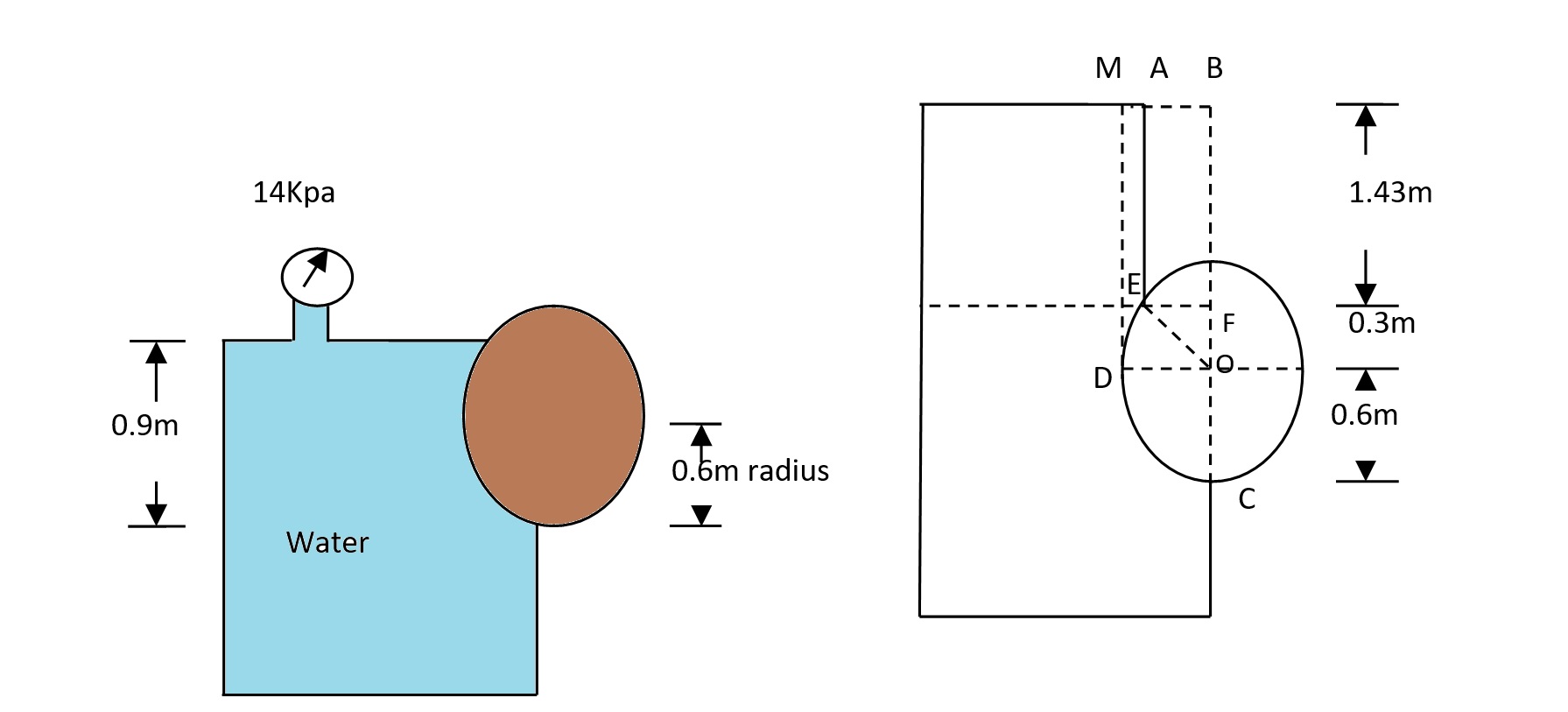
The tank whose cross-section is shown in the figure is 1.2m long and full of water under pressure. Find the components of the force required to keep the cylinder in position, neglecting the weight of the cylinder.
Solution
Pressure and Horizontal Force \( F_H \)
Pressure is given as:
\( P = 14 \, \text{kPa} \)Equivalent head of water:
\( h = \frac{P}{\gamma} = \frac{14000}{9810} = 1.43 \, \text{m} \)Add this head of water above the cylinder. Horizontal force is:
\( F_H = \gamma A \bar{y} = 9810 \cdot (0.9 \cdot 1.2) \cdot \left( 1.43 + \frac{0.9}{2} \right) = 19918 \, \text{N} = 19.918 \, \text{kN (right)} \)Vertical Force \( F_V \)
Vertical force is the weight of the imaginary volume of water above the cylinder:
\( F_V = \gamma \left[ \text{Volume}_{ABFE} + \text{Volume}_{\text{triangle EOF}} + \text{Volume}_{\text{sector EOD}} + \text{Volume}_{\text{quadrant COD}} \right] \)Substitute the values:
\( F_V = 9810 \cdot \left[ 0.52 \cdot 1.43 \cdot 1.2 + 0.5 \cdot 0.3 \cdot 0.52 \cdot 1.2 + \frac{30}{360} \cdot \pi \cdot (0.6)^2 \cdot 1.2 + \frac{1}{4} \cdot \pi \cdot (0.6)^2 \cdot 1.2 \right] \)Calculation:
\( F_V = 9810 \cdot (0.89 + 0.094 + 0.34 + 0.34) = 14110 \, \text{N} = 14.11 \, \text{kN (up)} \)Result:
- Horizontal Force: \( F_H = 19.918 \, \text{kN (right)} \)
- Vertical Force: \( F_V = 14.11 \, \text{kN (up)} \)
Explanation
- Horizontal Force: This is caused by the hydrostatic pressure acting on the vertical projection of the cylinder. The equivalent head of water is used to determine the force at the center of pressure.
- Vertical Force: The vertical force is the imaginary weight of water above the cylinder, calculated by summing the volumes of different geometric regions above it.
Physical Meaning
This problem demonstrates the application of hydrostatics to a submerged cylinder:
- Horizontal Force: Ensures the stability of the cylinder against lateral water pressure.
- Vertical Force: Balances the buoyant effect of water and maintains the cylinder in its static position.
- Applications: These calculations are essential in designing cylindrical tanks, gates, or structures submerged in fluids to withstand the forces exerted by the fluid.