
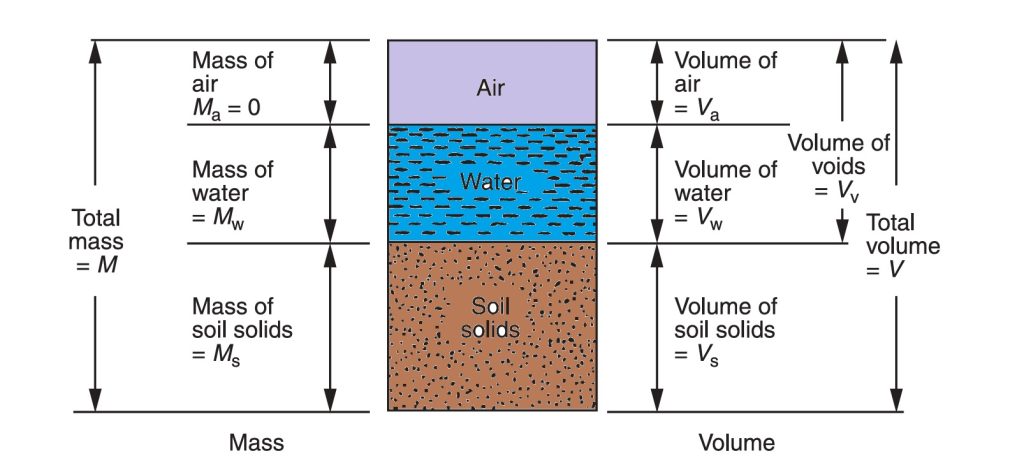
Volumetric Relationships in Soil Engineering
In soil engineering, five primary volumetric relationships are commonly used to analyze the properties and behavior of soils. These relationships are crucial for understanding soil density, saturation, and air content, among other characteristics. Below, each relationship is explained in detail:
1. Void Ratio (\(e\))
The void ratio is defined as the ratio of the volume of voids (\(V_v\)) to the volume of solids (\(V_s\)):
This value is expressed as a decimal (e.g., 0.4, 0.5) and typically ranges lower for coarse-grained soils compared to fine-grained soils. For some soils, the void ratio may exceed 1, indicating a significant proportion of voids compared to solids.
2. Porosity (\(n\))
Porosity is the ratio of the volume of voids (\(V_v\)) to the total volume (\(V\)) of the soil:
It is generally expressed as a percentage but used as a ratio in equations. Porosity cannot exceed 100%, as it would imply that voids occupy more space than the total volume. Porosity and void ratio are both measures of soil looseness or density. However, void ratio is preferred in soil engineering due to its convenience when volume changes occur.
The relationship between void ratio and porosity can be expressed as:
3. Degree of Saturation (\(S\))
The degree of saturation is the ratio of the volume of water (\(V_w\)) to the volume of voids (\(V_v\)):
It is expressed as a percentage and varies from 0% for completely dry soils to 100% for fully saturated soils. In equations, it is often used as a decimal. The degree of saturation provides insights into the moisture content of the soil mass.
4. Percentage Air Voids (\(n_a\))
The percentage air voids is defined as the ratio of the volume of air (\(V_a\)) to the total volume (\(V\)):
Like porosity, this is also expressed as a percentage. It becomes zero for fully saturated soils where no air voids are present.
5. Air Content (\(a_c\))
Air content refers to the ratio of the volume of air (\(V_a\)) to the volume of voids (\(V_v\)):
This is typically represented as a percentage. Both air content and percentage air voids become zero in saturated soils.
The relationship between air content and percentage air voids can be expressed as:
Conclusion
These volumetric relationships provide a foundation for analyzing soil behavior and designing geotechnical systems. Understanding how voids, water, and air interact within a soil mass is essential for various applications, including foundation design, slope stability, and compaction control.

