
Problem Statement
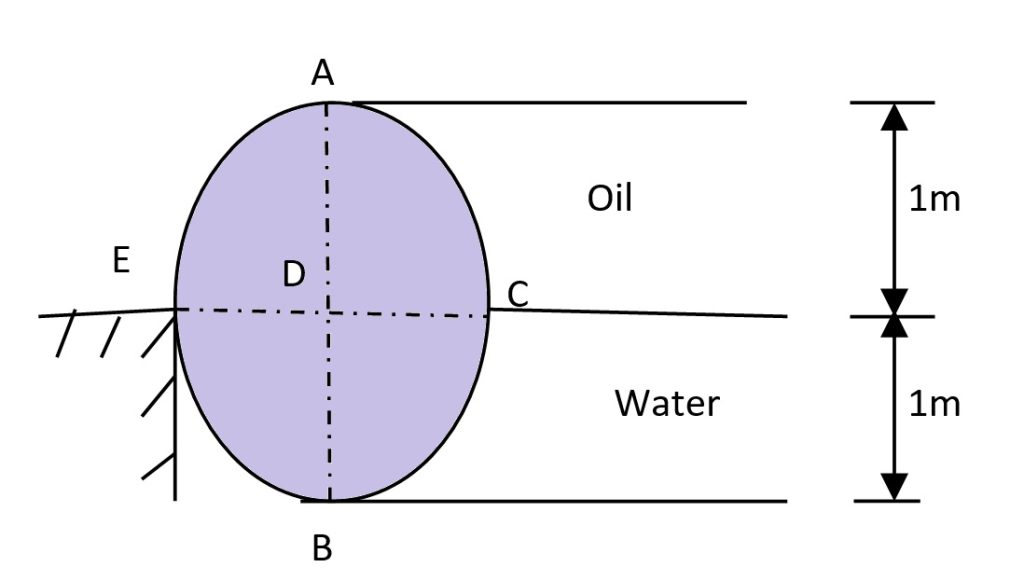
Find the weight of the cylinder (diameter = 2m) per meter length if it supports water and oil (specific gravity = 0.82) as shown in the figure. Assume frictionless contact with the wall.
Solution
1. Downward Force on AC Due to Oil (\( F_{VAC} \))
Weight of oil supported above curve AC:
\( F_{VAC} = \gamma_{\text{oil}} \times \left( \text{Volume}_{AFCD} – \text{Volume}_{\text{quadrant ACD}} \right) \)
Substituting values:
\( F_{VAC} = 0.82 \times 9810 \times \left( 1 \times 1 \times 1 – \frac{1}{4} \pi \times 1^2 \times 1 \right) = 1726 \, N \)
2. Equivalent Head of Water Due to Oil
Pressure at C due to 1m oil:
\( P = \gamma_{\text{oil}} \times 1 = 0.82 \times 9810 \times 1 = 8044.2 \, \text{Pa} \)
Equivalent head of water:
\( h = \frac{P}{\gamma} = \frac{8044.2}{9810} = 0.82 \, \text{m} \)
3. Upward Vertical Force on CBE (\( F_{VCBE} \))
Weight of water above CBE:
\( F_{VCBE} = \gamma \times \left( \text{Volume}_{\text{semi-circle CBE}} + \text{Volume}_{CMNE} \right) \)
Substituting values:
\( F_{VCBE} = 9810 \times \left( \frac{1}{2} \pi \times 1^2 \times 1 + 0.82 \times 2 \times 1 \right) = 31498 \, N \)
Result:
Weight of the cylinder:
\( W = F_{VCBE} – F_{VAC} = 31498 – 1726 = 29772 \, N \)
Explanation
- Downward Force: The oil exerts a downward force due to its weight, acting on the curved surface AC.
- Equivalent Water Head: The pressure at C due to oil is converted into an equivalent head of water to simplify calculations.
- Upward Force: Water exerts an upward force due to hydrostatic pressure acting on the submerged part of the cylinder.
- Weight of Cylinder: The net force required to keep the cylinder in equilibrium is given by the difference between the upward and downward forces.
Physical Meaning
This problem demonstrates the concept of buoyancy and hydrostatic pressure:
- Downward Force: Caused by the weight of the oil layer above the cylinder.
- Upward Force: Result of the buoyant force exerted by water.
- Equilibrium: The weight of the cylinder is determined by balancing these two forces.
- Applications: These principles are used in designing floating bodies, submerged structures, and fluid mechanics applications.