Pipe Flow Velocity and Discharge Calculation
Problem Statement
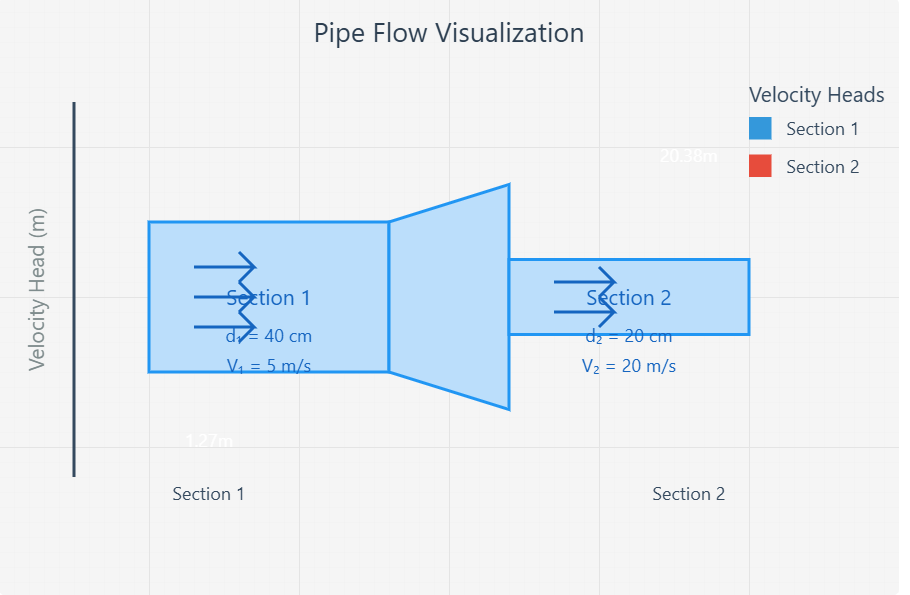
A pipe, through which water is flowing is having diameters 40cm and 20cm at sections 1 and 2 respectively. The velocity of water at section 1 is 5m/s. Find the velocity head at sections 1 and 2 and also compute discharge.
Given Data
| Diameter at section 1 (d₁) | 40 cm = 0.4 m |
| Diameter at section 2 (d₂) | 20 cm = 0.2 m |
| Velocity at section 1 (V₁) | 5 m/s |
| Acceleration due to gravity (g) | 9.81 m/s² |
1. Key Principles and Formulas
For this problem, we need to understand and apply two key principles:
In a pipe system with steady flow, the mass flow rate is constant throughout the system.
Q = A₁ × V₁ = A₂ × V₂
Where:
Q = Discharge or flow rate (m³/s)
A = Cross-sectional area (m²)
V = Velocity (m/s)
The velocity head represents the kinetic energy of the fluid per unit weight.
Velocity Head = V²/(2g)
Where:
V = Velocity (m/s)
g = Acceleration due to gravity (9.81 m/s²)
2. Calculating Cross-sectional Areas
The cross-sectional area of a circular pipe is calculated using the formula:
A = π × (d/2)²
Cross-sectional area at section 1:
A₁ = π × (d₁/2)² = π × (0.4/2)² = π × 0.04 = 0.1256 m²
Cross-sectional area at section 2:
A₂ = π × (d₂/2)² = π × (0.2/2)² = π × 0.01 = 0.0314 m²
3. Calculating the Discharge
Using the continuity equation, we can calculate the discharge:
Q = A₁ × V₁
Q = 0.1256 m² × 5 m/s
Q = 0.628 m³/s
4. Calculating Velocity at Section 2
From the continuity equation, we have:
Q = A₁ × V₁ = A₂ × V₂
Rearranging to find V₂:
V₂ = Q / A₂ = 0.628 m³/s / 0.0314 m²
V₂ = 20 m/s
5. Calculating Velocity Heads
Velocity head at section 1:
Velocity Head₁ = V₁²/(2g) = (5 m/s)²/(2 × 9.81 m/s²)
Velocity Head₁ = 25 m²/s² / 19.62 m/s²
Velocity Head₁ = 1.274 m
Velocity Head₂ = V₂²/(2g) = (20 m/s)²/(2 × 9.81 m/s²)
Velocity Head₂ = 400 m²/s² / 19.62 m/s²
Velocity Head₂ = 20.38 m
Visualization of Results
Physical Interpretation
The results of this problem demonstrate several important hydraulic principles:
- Conservation of Mass: The continuity equation shows that for incompressible flow, the product of area and velocity remains constant throughout the pipe. As the pipe narrows, the velocity must increase to maintain the same discharge.
- Velocity and Area Relationship: The velocity at section 2 (20 m/s) is exactly 4 times the velocity at section 1 (5 m/s), which corresponds to the ratio of areas (the area at section 1 is 4 times the area at section 2).
- Velocity Head Relationship: The velocity head is proportional to the square of the velocity. Since V₂ = 4 × V₁, the velocity head at section 2 is 16 times the velocity head at section 1 (20.38 ÷ 1.274 = 16).
- Energy Conversion: As the flow moves from section 1 to section 2, there is a significant increase in kinetic energy per unit weight (velocity head). According to Bernoulli's principle, this increase must be balanced by a decrease in pressure head, assuming negligible losses.
- Practical Implications: The dramatic increase in velocity and velocity head at the constriction has practical implications, such as increased erosion potential, greater friction losses, and the possibility of cavitation if the pressure drops below the vapor pressure of water.
Conclusion
We have successfully calculated:
- The discharge in the pipe: Q = 0.628 m³/s
- The velocity at section 2: V₂ = 20 m/s
- The velocity head at section 1: 1.274 m
- The velocity head at section 2: 20.38 m
These calculations illustrate the relationship between pipe diameter, flow velocity, and velocity head. The significant increase in velocity and velocity head at the constriction (section 2) demonstrates the conservation of mass principle and the conversion between pressure energy and kinetic energy in pipe flow systems.