
Head Loss Calculation Between Two Points in a Pipe
Problem Statement
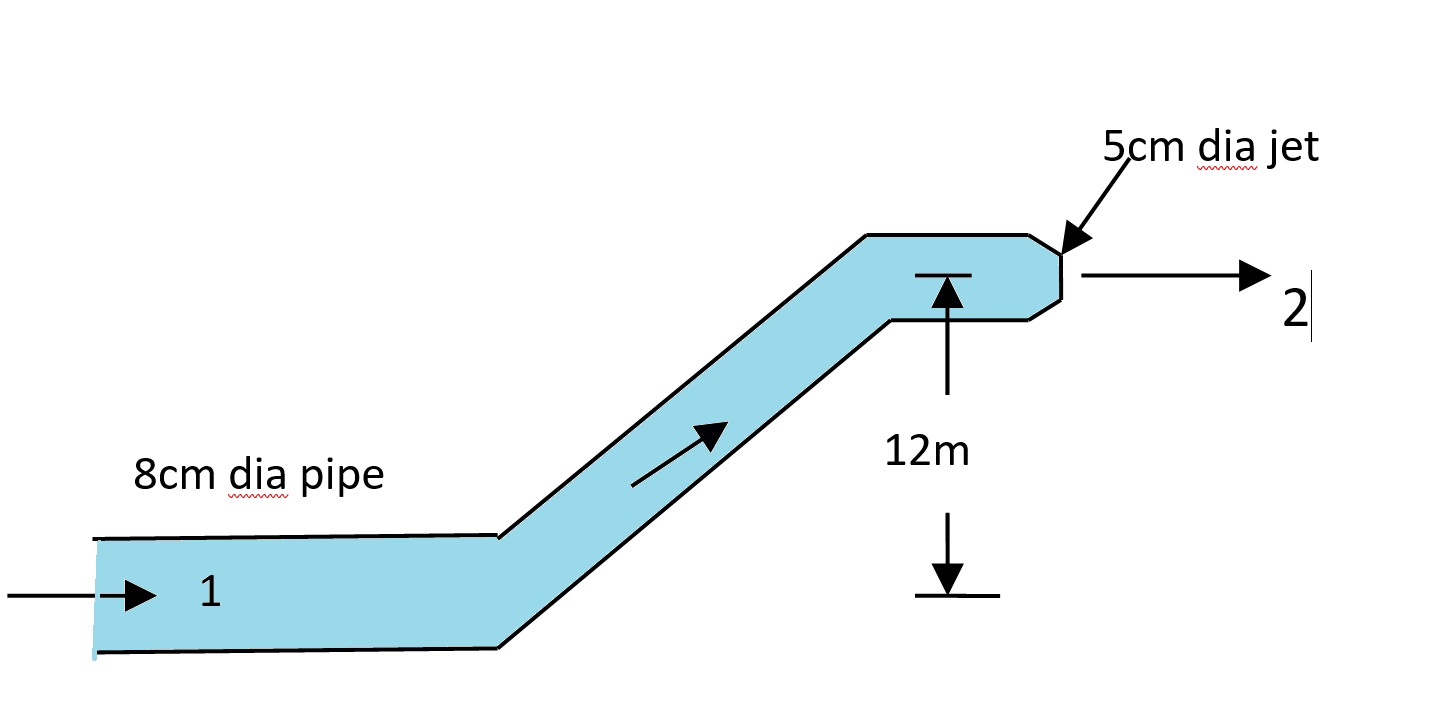
In the given system, water flows through a pipe with varying diameters. The pressure at point 1 is 180 kPa gauge. If the mass flux is 15 kg/s, determine the head loss between points 1 and 2.
Given Data
| Diameter at Point 1 (d₁) | 8 cm = 0.08 m |
| C/S Area at Point 1 (A₁) | A₁ = (π/4) × (0.08)² ≈ 0.00503 m² |
| Diameter at Point 2 (d₂) | 5 cm = 0.05 m |
| C/S Area at Point 2 (A₂) | A₂ = (π/4) × (0.05)² ≈ 0.00196 m² |
| Mass Flux (M) | 15 kg/s |
| Velocity at Point 1 (V₁) | V₁ = M / (ρA₁) = 15 / (1000 × 0.00503) ≈ 2.98 m/s |
| Velocity at Point 2 (V₂) | V₂ = M / (ρA₂) = 15 / (1000 × 0.00196) ≈ 7.65 m/s |
| Pressure at Point 1 (P₁) | 180 kPa (gauge) |
| Pressure at Point 2 (P₂) | 0 kPa (atmospheric) |
| Datum Head at Point 1 (Z₁) | 0 m |
| Datum Head at Point 2 (Z₂) | 12 m |
1. Applying Bernoulli’s Equation with Head Loss
For points 1 and 2, Bernoulli’s equation (including head loss) is given by:
P₁/γ + V₁²/(2g) + Z₁ = P₂/γ + V₂²/(2g) + Z₂ + hₗ
Here, γ (the specific weight of water) is approximately 9810 N/m³ and g is 9.81 m/s².
2. Substituting Known Values
From the given data:
- P₁/γ = 180,000 Pa / 9810 ≈ 18.35 m
- V₁²/(2g) = (2.98²) / (2×9.81) ≈ 0.45 m
- Z₁ = 0 m
- P₂/γ = 0 m (since P₂ is atmospheric)
- V₂²/(2g) = (7.65²) / (2×9.81) ≈ 2.99 m
- Z₂ = 12 m
Substituting into the equation:
18.35 + 0.45 + 0 = 0 + 2.99 + 12 + hₗ
3. Solving for Head Loss (hₗ)
Combining the terms:
18.80 = 14.99 + hₗ
Therefore, hₗ = 18.80 − 14.99 ≈ 3.81 m, which rounds to approximately 3.82 m.
Physical Interpretation
In this problem, we use Bernoulli’s equation to balance the different forms of energy acting on the water as it flows through pipes of different diameters. Here’s a closer look at the key aspects:
Pressure Head: The 180 kPa gauge pressure at point 1 contributes a significant pressure head (≈18.35 m). This energy is available to accelerate the water and overcome other energy demands.
Velocity Head: As water moves from the larger diameter at point 1 to the smaller diameter at point 2, its velocity increases (from 2.98 m/s to 7.65 m/s). This increase is captured by the kinetic energy terms V₁²/(2g) and V₂²/(2g).
Elevation Head: With an elevation increase of 12 m from point 1 (datum) to point 2, additional energy is required to lift the water.
Head Loss (hₗ): The head loss of approximately 3.82 m represents the energy dissipated due to friction, turbulence, and other losses within the pipe. This value quantifies how much of the available energy is “lost” in the system, ensuring that only the remaining energy contributes to the fluid’s motion.
Overall, the conversion of pressure energy into kinetic energy, adjusted for the rise in elevation and the losses in the system, illustrates the comprehensive energy balance that governs fluid flow in practical pipe systems.
Detailed Explanation for Students
Step 1: Understanding the Energy Components
Identify the energy contributions: the pressure head from a high gauge pressure at point 1, the kinetic energy represented by the velocity heads at both points, and the potential energy needed to overcome a 12 m elevation difference.
Step 2: Applying Bernoulli’s Equation
Bernoulli’s equation, modified to include a head loss term (hₗ), relates these energy components between two points. Since the pressure at point 2 is atmospheric, its pressure head becomes zero, simplifying the equation.
Step 3: Substituting the Values
Each term is computed as follows:
- Pressure Head at Point 1: P₁/γ = 180,000/9810 ≈ 18.35 m
- Velocity Head at Point 1: (2.98²)/(2×9.81) ≈ 0.45 m
- Velocity Head at Point 2: (7.65²)/(2×9.81) ≈ 2.99 m
- Elevation Head at Point 2: 12 m
Substituting these into the Bernoulli equation gives us an equation that balances the energy available at point 1 with that at point 2 plus the losses.
Step 4: Determining the Head Loss
By isolating hₗ, we determine that approximately 3.82 m of the energy is lost due to friction and turbulence. This value tells us how much of the energy is dissipated in the system, which is critical for designing efficient piping systems.
This step-by-step process helps to understand the energy conversion in the system and the practical impact of head loss in real-world fluid flow scenarios.