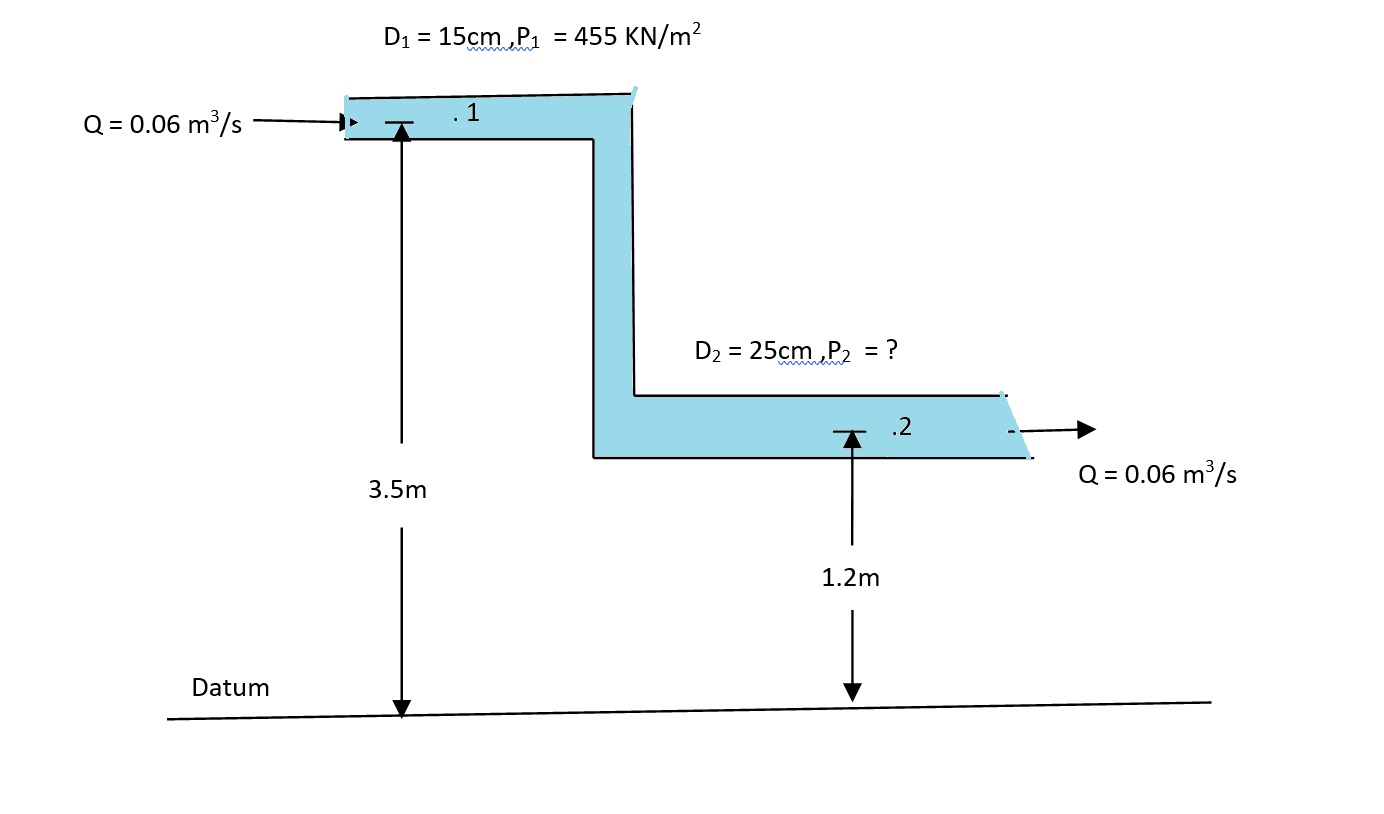

Pressure Calculation in a Two-Section Pipe
Problem Statement
Oil (sp. gr = 0.84) flows in a pipe where the diameter changes from section 1 to section 2. Given the conditions below and a total head loss of 0.9 m from point 1 to point 2, determine the pressure at point 2.
Given Data
| d₁ | 15 cm = 0.15 m |
| C/S Area at section 1 (A₁) | A₁ = (π/4)×(0.15)² = 0.0176 m² |
| d₂ | 25 cm = 0.25 m |
| C/S Area at section 2 (A₂) | A₂ = (π/4)×(0.25)² = 0.049 m² |
| Discharge (Q) | 0.06 m³/s |
| Velocity at point 1 (V₁) | Q/A₁ = 0.06/0.0176 ≈ 3.4 m/s |
| Velocity at point 2 (V₂) | Q/A₂ = 0.06/0.049 ≈ 1.22 m/s |
| Z₁ (Datum Head at 1) | 3.5 m |
| Z₂ (Datum Head at 2) | 1.2 m |
| Head loss (hₗ) | 0.9 m |
| Pressure at point 1 (P₁) | 455 kPa = 455,000 Pa |
| Oil specific gravity | 0.84 |
| Acceleration due to Gravity (g) | 9.81 m/s² |
1. Applying Bernoulli’s Equation
Bernoulli’s equation between points 1 and 2, including the head loss, is:
P₁/γ + V₁²/(2g) + Z₁ = P₂/γ + V₂²/(2g) + Z₂ + hₗ
where γ (the specific weight of oil) = sp. gr × 1000 × g.
2. Calculating Specific Weight (γ)
γ = 0.84 × 1000 × 9.81 ≈ 8240 N/m³
3. Substituting Known Values
Substituting into Bernoulli’s equation:
455000/8240 + (3.4²)/(2×9.81) + 3.5 = P₂/8240 + (1.22²)/(2×9.81) + 1.2 + 0.9
Evaluate each term:
Pressure head at 1: 455000/8240 ≈ 55.27 m
Velocity head at 1: (3.4²)/(2×9.81) = (11.56)/(19.62) ≈ 0.59 m
Velocity head at 2: (1.22²)/(2×9.81) = (1.49)/(19.62) ≈ 0.076 m
4. Solving for Pressure at Point 2 (P₂)
Rearranging the equation:
55.27 + 0.59 + 3.5 = (P₂/8240) + 0.076 + 1.2 + 0.9
Left side: 55.27 + 0.59 + 3.5 = 59.36 m
Right side: (P₂/8240) + 2.176 m
Thus:
P₂/8240 = 59.36 − 2.176 = 57.184 m
P₂ = 57.184 × 8240 ≈ 470767 Pa
Physical Interpretation
In this problem, Bernoulli’s equation is used to balance the energy between two points in the pipe. Here’s what the various terms represent:
Pressure Head (P/γ): This term converts the static pressure into an equivalent height of the fluid column. At point 1, the pressure head is high because the pressure is given as 455 kPa.
Velocity Head (V²/(2g)): This represents the kinetic energy of the fluid per unit weight. Notice that the velocity head at point 1 is higher (due to the smaller area and higher velocity) compared to point 2.
Elevation Head (Z): This term accounts for the potential energy due to elevation. The difference in datum heads (3.5 m at point 1 and 1.2 m at point 2) shows that point 1 is at a higher elevation.
Head Loss (hₗ): This accounts for energy losses (e.g., friction, turbulence) as the fluid flows from point 1 to point 2. In this case, a loss of 0.9 m is included.
By balancing these energy contributions, we find that the pressure at point 2 must adjust to satisfy the energy conservation. The result, approximately 470.76 kPa, reflects the combination of a lower velocity head and a lower elevation at point 2 along with the energy loss.
Detailed Explanation for Students
Step 1: Understanding Bernoulli's Equation – This fundamental equation in fluid mechanics balances pressure, kinetic, and potential energy. When energy is lost (due to friction or turbulence), a head loss term (hₗ) is added.
Step 2: Calculating Specific Weight – The specific weight of oil (γ) is calculated using its specific gravity. Here, 0.84 means oil is 84% as dense as water.
Step 3: Computing Heads at Point 1 – Divide the static pressure by γ to get the pressure head. Add the kinetic energy (velocity head) and the elevation head.
Step 4: Setting Up the Equation – Write Bernoulli's equation for both points. Include the head loss between the two points.
Step 5: Solving for Unknown Pressure – Rearrange the equation to solve for P₂. By comparing the energy levels at the two points and accounting for losses, you determine the new pressure.
This step-by-step approach shows how changes in velocity and elevation, together with losses, affect pressure. Understanding each term helps in visualizing the energy transformation in the pipe.