
Problem Statement
The resultant of two forces P and 30 N is 40 N inclined at 60° to the 30 N force. Find the magnitude and direction of P.
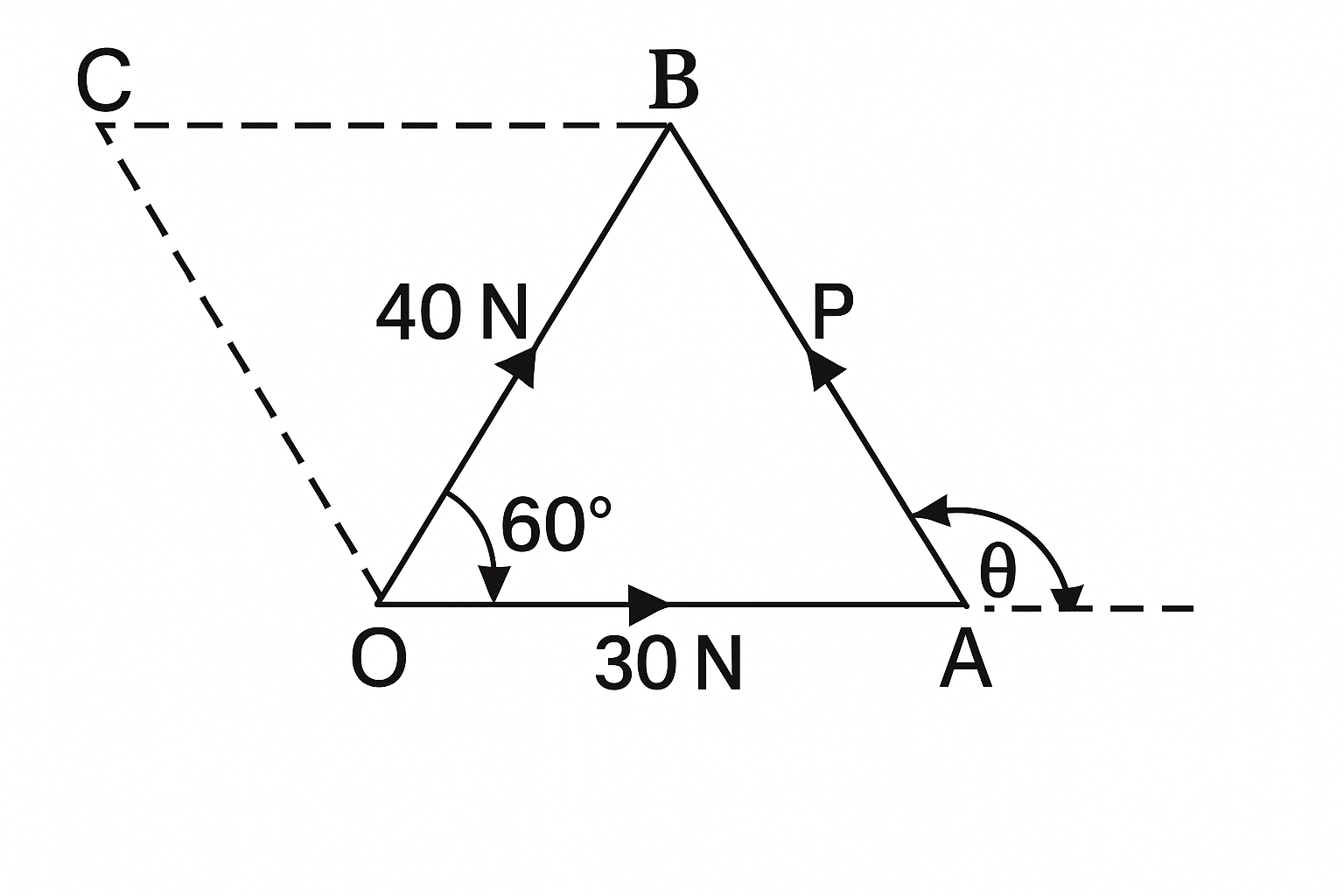
Given Data
Solution Approach
To find the magnitude and direction of force P, we will apply the law of cosines to determine the magnitude of P, and then use the law of sines to find its direction relative to the 30 N force.
Calculations
Step 1: Finding the Magnitude of Force P
Step 1.1: Apply the law of cosines to the triangle formed by the two forces and their resultant:
Step 1.2: Compute the value of cos(60°):
Step 1.3: Substitute this value and simplify:
Step 1.4: Take the square root to find P:
Step 2: Finding the Direction of Force P
Step 2.1: Apply the law of sines to find the angle θ:
Step 2.2: Substitute the value of sin(60°) and solve for sin(180° – θ):
Step 2.3: Find the value of (180° – θ):
Step 2.4: Solve for θ:
Magnitude of force P = 36.06 N
Direction of force P = 106°16′ from the 30 N force
Detailed Explanation
Vector Addition in Force Problems
When multiple forces act on a body, their combined effect is represented by their resultant. In this problem, we have two forces—one known (30 N) and one unknown (P)—with a known resultant (40 N) at a specified angle (60°) to the known force.
Law of Cosines
The law of cosines is a generalization of the Pythagorean theorem to any triangle. It relates the square of one side of a triangle to the squares of the other two sides and the cosine of the included angle.
In vector terms, if we have forces A and B with a resultant R, and the angle between A and B is θ, then:
$$R^2 = A^2 + B^2 – 2AB\cos(\theta)$$
In our problem, we used this formula to find the magnitude of force P by substituting the known values.
Law of Sines
The law of sines relates the sides of a triangle to the sines of the opposite angles. It states that:
$$\frac{a}{\sin(A)} = \frac{b}{\sin(B)} = \frac{c}{\sin(C)}$$
where a, b, and c are the lengths of the sides of the triangle, and A, B, and C are the angles opposite to those sides.
We used this law to find the direction of force P relative to the 30 N force.
Vector Representation
In this problem, we visualized the forces as vectors forming a triangle. The closed triangle represents the vector addition of the forces P and 30 N resulting in the 40 N force.
Engineering Applications
This type of problem is fundamental in various engineering fields:
- Structural engineering: Analyzing forces in trusses and beams
- Mechanical engineering: Designing mechanical systems and linkages
- Civil engineering: Calculating resultant forces on structures
- Aerospace engineering: Analyzing forces on aircraft components
Verification
We can verify our solution by checking that the horizontal and vertical components of the forces P and 30 N add up to give the correct components of the 40 N resultant force.
The solution shows that P = 36.06 N at an angle of 106°16′ from the 30 N force is consistent with the given conditions, confirming the accuracy of our calculations.


