Problem Statement
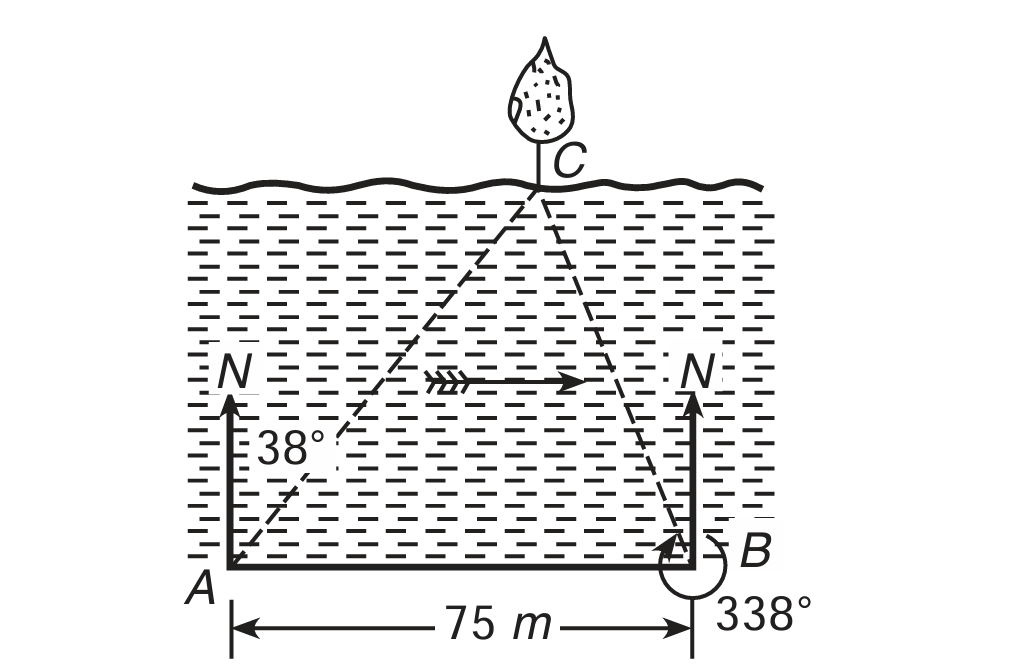
A river flows from west to east. To determine its width, two points, A and B, are selected on the southern bank, 75 metres apart. Point A is to the west of point B. The bearings of a prominent tree, C, located on the northern bank, are measured from A and B. The bearing of C from A is 38°, and the bearing of C from B is 338°. Calculate the width of the river.
Step-by-Step Solution
Key Information
- Points A and B are on the southern river bank.
- Distance AB = 75 m (Baseline).
- Point A is west of point B.
- Point C (Tree) is on the northern river bank.
- Bearing of C from A = 38°.
- Bearing of C from B = 338°.
- Goal: Find the width of the river (perpendicular distance between banks).
Step 1: Calculate Internal Angles of Triangle ABC
We need to find the angles inside the triangle ABC formed by the two points on the southern bank and the tree on the northern bank.
Angle CAB (at point A): The bearing of C from A is 38° (N 38° E). Assuming the line AB runs roughly East-West, the angle between North and the line AB (pointing East) at A is 90°. Therefore, the internal angle ∠CAB is the difference:
∠CAB = 90° – Bearing from A = 90° – 38°
∠CAB = 52°
Angle CBA (at point B): The bearing of C from B is 338° (N 22° W, since 360°-338°=22°). The line BA points West from B, which is 270° clockwise from North. The internal angle ∠CBA is the difference between the bearing of C and the direction of West:
∠CBA = Bearing from B – Bearing of West = 338° – 270°
∠CBA = 68°
Angle ACB (at point C): The sum of angles in a triangle is 180°.
∠ACB = 180° – (∠CAB + ∠CBA)
∠ACB = 180° – (52° + 68°)
∠ACB = 180° – 120°
∠ACB = 60°
Step 2: Apply Sine Rule to find AC and BC
Using the Sine Rule in triangle ABC: AC / sin(∠CBA) = BC / sin(∠CAB) = AB / sin(∠ACB)
Calculate AC:
AC = AB * sin(∠CBA) / sin(∠ACB)
AC = 75 m * sin(68°) / sin(60°)
AC ≈ 75 * 0.92718 / 0.866025
AC ≈ 69.5385 / 0.866025
AC ≈ 80.30 m
Calculate BC:
BC = AB * sin(∠CAB) / sin(∠ACB)
BC = 75 m * sin(52°) / sin(60°)
BC ≈ 75 * 0.78801 / 0.866025
BC ≈ 59.1008 / 0.866025
BC ≈ 68.24 m
Step 3: Calculate the Width of the River
The width of the river is the perpendicular distance from point C (on the northern bank) to the line containing the baseline AB (on the southern bank). This corresponds to the altitude of triangle ABC from vertex C to the base AB.
The altitude (Width) can be calculated using either AC or BC:
Width = AC * sin(∠CAB) OR Width = BC * sin(∠CBA)
Using AC:
Width ≈ 80.30 m * sin(52°)
Width ≈ 80.30 * 0.78801
Width ≈ 63.27 m
Using BC (for verification):
Width ≈ 68.24 m * sin(68°)
Width ≈ 68.24 * 0.92718
Width ≈ 63.27 m
Both calculations yield the same result.
Final Result
Conceptual Explanation & Applications
Core Concepts:
- Bearings: Standard method in navigation and surveying to specify direction as an angle measured clockwise from North (0° or 360°).
- Baseline Measurement: Establishing a line of known length (AB=75m) on accessible ground.
- Triangulation: Determining the position of, or distances to, a point by forming a triangle and using angle measurements.
- Calculating Internal Angles: Deriving the angles within the triangle (∠CAB, ∠CBA) from the measured bearings relative to North and the baseline orientation.
- Sine Rule: A trigonometric law used to find unknown sides or angles in non-right-angled triangles when certain sides and angles are known. (a/sin A = b/sin B = c/sin C).
- Altitude of a Triangle: The perpendicular distance from a vertex to the opposite side (or the line containing the opposite side). In this context, it represents the river width.
Real-World Applications:
- Measuring the width of rivers, canyons, or other inaccessible features.
- Coastal navigation and determining distances to offshore objects.
- Topographic mapping and positioning landmarks.
- Setting out points for construction projects across obstacles.
Why It Works:
This surveying technique relies on fundamental geometric and trigonometric principles. By measuring a baseline (AB) on one side of the obstacle (river) and observing the bearings to a fixed point (C) on the other side from both ends of the baseline, a triangle (ABC) is defined. The measured bearings allow the calculation of the internal angles of this triangle. With one side (AB) and all three angles known, the Sine Rule can be applied to determine the lengths of the other two sides (AC and BC). The river width, defined as the perpendicular distance from C to the line AB, can then be calculated as the altitude of the triangle using the formula: Altitude = Side * sin(Adjacent Angle). For example, Width = AC * sin(∠CAB) or Width = BC * sin(∠CBA). This method provides an accurate way to measure the width without needing to physically cross the river.