Overpass vs Flyover: Understanding the Key Differences
A Comprehensive Guide to Transportation Infrastructure in Civil Engineering

When it comes to modern transportation infrastructure, terms like "overpass" and "flyover" are often used interchangeably, leading to confusion among both professionals and the general public. While these structures serve similar purposes in facilitating smooth traffic flow, there are distinct differences between overpasses and flyovers that every civil engineer and urban planner should understand.
🎯 What You'll Learn in This Guide
- Technical definitions and characteristics of overpasses and flyovers
- Cost implications and construction considerations
- Regional terminology differences and applications
- Engineering specifications and design requirements
- Future trends in transportation infrastructure
🌉 What is an Overpass?
An overpass is a bridge-like structure that carries one roadway over another roadway, railway, or waterway. The primary purpose of an overpass is to allow traffic to cross over an obstacle without interruption, eliminating the need for at-grade intersections that can cause traffic delays and safety concerns.

Key Characteristics of Overpasses
- Simple design: Typically features a straightforward bridge structure
- Local traffic focus: Primarily serves local or regional traffic needs
- Shorter span: Generally covers shorter distances
- Cost-effective: More economical to construct compared to complex flyover systems
- Minimal approach roads: Requires less extensive entry and exit infrastructure
Common Applications of Overpasses
🛣️ Highway Crossings
Highway crossings over local roads and intersections
🚶♂️ Pedestrian Bridges
Pedestrian bridges over busy streets and highways
🚂 Railroad Crossings
Railroad crossings over roadways and intersections
🌊 Water Crossings
Crossings over waterways, canals, and drainage systems
🏗️ What is a Flyover?
A flyover is a more complex transportation structure that typically involves multiple levels and sophisticated engineering to manage high-volume traffic flow. Flyovers are designed to handle heavy traffic loads and often feature multiple lanes, complex interchange systems, and extensive approach roads.

Key Characteristics of Flyovers
- Complex design: Features multi-level structures with intricate engineering
- High-capacity traffic: Designed for heavy traffic volumes and high-speed travel
- Longer spans: Covers greater distances with multiple support structures
- Expensive construction: Requires significant investment in materials and engineering
- Extensive infrastructure: Includes elaborate approach roads, ramps, and interchange systems
⚖️ Primary Differences Between Overpass and Flyover
| Aspect | Overpass | Flyover |
|---|---|---|
| Structural Complexity | Simple bridge construction with basic support systems | Multi-level structures with sophisticated engineering |
| Traffic Capacity | Moderate traffic volumes, local traffic focus | High-volume traffic flow, major transportation networks |
| Construction Cost | Cost-effective, shorter construction time | Significantly expensive, extended construction periods |
| Geographic Usage | Common in North America (US, Canada) | Predominantly used in UK, India, Commonwealth countries |
| Design Specifications | Single-level crossings, standard bridge specs | Multi-level designs, advanced specifications |
🔧 Engineering Considerations
Load-Bearing Requirements
Both structures must meet strict engineering standards, but flyovers typically require more robust load-bearing calculations due to their size, traffic volume, and structural complexity. Engineers must consider factors such as:
Structure weight
Traffic & pedestrian loads
Wind, seismic activity
Moving vehicles

Material Selection
Overpass Construction Materials
- Standard concrete and steel materials
- Conventional reinforcement techniques
- Basic weathering steel for durability
- Standard concrete mixtures
Flyover Construction Materials
- Specialized high-strength materials
- Advanced concrete mixtures
- Post-tensioned cables and frameworks
- Sophisticated steel frameworks
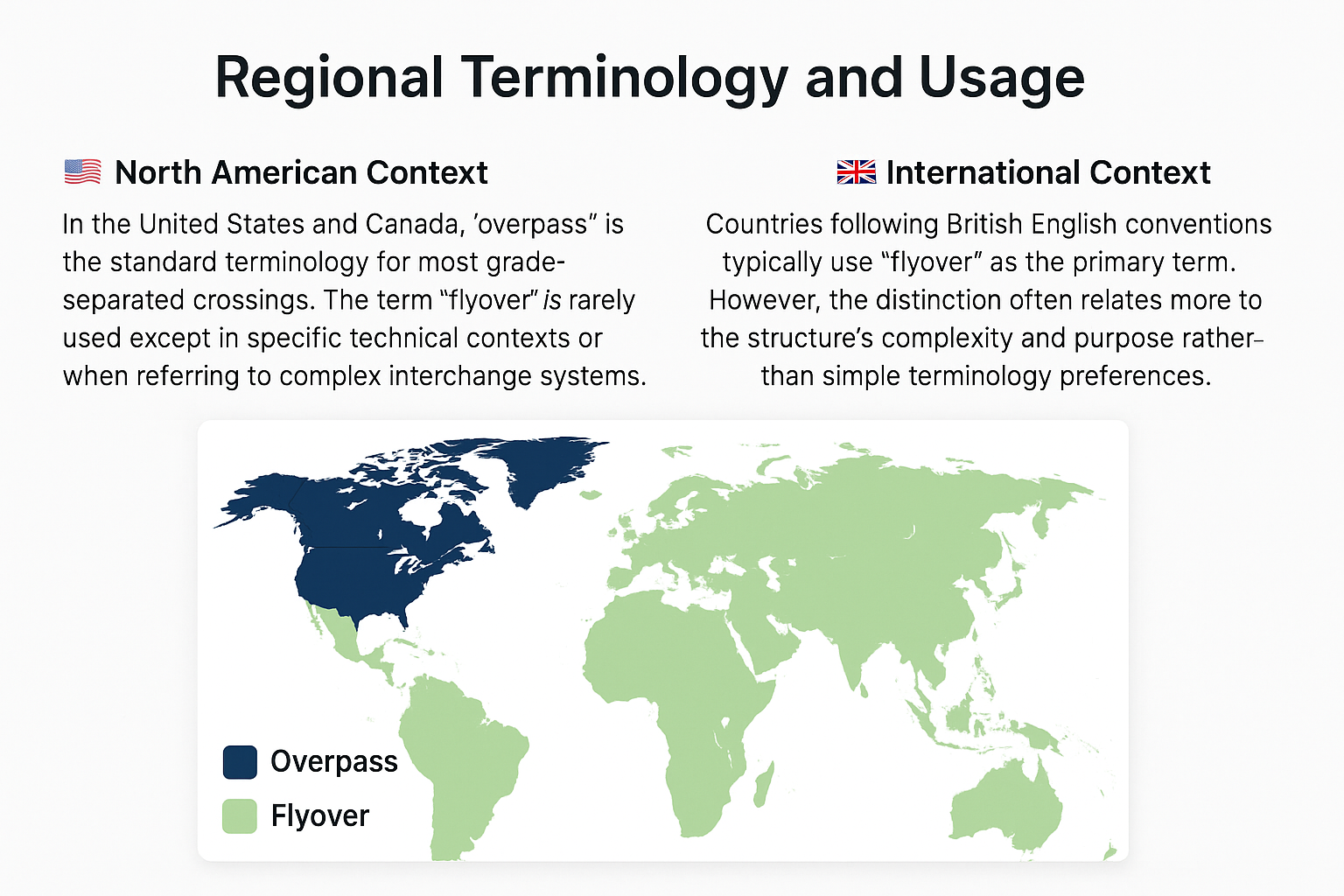
🌍 Regional Terminology and Usage
🇺🇸 North American Context
In the United States and Canada, "overpass" is the standard terminology for most grade-separated crossings. The term "flyover" is rarely used except in specific technical contexts or when referring to complex interchange systems.
🇬🇧 International Context
Countries following British English conventions typically use "flyover" as the primary term. However, the distinction often relates more to the structure's complexity and purpose rather than simple terminology preferences.
📋 Planning and Design Process
Overpass Planning
- Traffic analysis: Assessing current and projected traffic volumes
- Site evaluation: Examining topographical and geological conditions
- Cost-benefit analysis: Comparing construction costs with traffic improvement benefits
- Environmental assessment: Evaluating potential environmental impacts
- Public consultation: Engaging with local communities and stakeholders
Flyover Planning
- Comprehensive traffic modeling: Advanced analysis of complex traffic patterns
- Multi-disciplinary engineering: Coordination between structural, traffic, and environmental engineers
- Economic impact assessment: Analyzing broader economic implications
- Extended environmental review: Comprehensive evaluation of environmental effects
- Stakeholder coordination: Extensive consultation with multiple agencies

🚀 Future Trends and Innovations
Smart Infrastructure Integration
Modern overpasses and flyovers increasingly incorporate smart technology features:
📊 Traffic Monitoring
Real-time traffic flow analysis and management systems
🌱 Environmental Sensors
Air quality and noise monitoring systems
🔍 Health Monitoring
Advanced sensors for structural integrity assessment
💡 LED Systems
Energy-efficient and adaptive lighting solutions
Sustainable Design Approaches
🌿 Green Infrastructure Trends
- Eco-friendly materials: Use of recycled and sustainable construction materials
- Green infrastructure: Integration of vegetation and natural elements
- Energy efficiency: Solar panels and renewable energy integration
- Wildlife corridors: Design features accommodating local wildlife movement
📝 Conclusion
Understanding the differences between overpasses and flyovers is crucial for civil engineers, urban planners, and transportation professionals. While both structures serve the fundamental purpose of facilitating smooth traffic flow by eliminating at-grade intersections, their applications, complexity, and design requirements vary significantly.
Overpasses offer cost-effective solutions for simple crossing needs and moderate traffic volumes, making them ideal for local infrastructure projects. Flyovers, with their complex engineering and high-capacity design, serve as critical components in major transportation networks and urban expressway systems.
The choice between an overpass and flyover ultimately depends on factors such as traffic volume, available budget, geographic constraints, and long-term transportation planning objectives. As transportation infrastructure continues to evolve with smart technology integration and sustainable design principles, both overpasses and flyovers will play essential roles in creating efficient, safe, and environmentally responsible transportation networks.