Table of Contents
ToggleNecessity of a Transition Curve
When a moving vehicle approaches a curve, it experiences centrifugal force, which tends to push the vehicle outward and can lead to overturning. A sudden shift from a straight path to a curved one, without a gradual change in curvature, causes abrupt lurching, resulting in significant discomfort for passengers. This force can be counteracted by raising the outer edge of the track, a practice known as superelevation or cant. The degree of superelevation depends on both the speed of the vehicle and the radius of the curve. For railways, the maximum allowable superelevation is generally limited to 15 cm.
Applying this maximum superelevation immediately at the start of the curve is impractical and potentially hazardous. To mitigate these effects, a transition curve is introduced between the straight section and the circular curve. This allows for a gradual increase in curvature and a smoother transition in superelevation, providing the following advantages:
- Superelevation can be gradually introduced, corresponding to the rate of curvature change.
- The risk of derailment at the curve’s start is minimized by avoiding the sudden application of full superelevation.
- The likelihood of overturning and side slipping of the vehicle is reduced.
- Passengers experience a smoother and more comfortable ride when negotiating the curve.
This gradual transition makes the journey safer and more comfortable for both railways and road vehicles.
Types of Transition Curves
Transition curves are essential elements in road and railway design, providing a smooth transition between straight sections and circular curves. There are primarily three types of transition curves:
- Cubical Spiral
- Cubic Parabola
- Lemniscate Curve
While the Cubical Spiral and Cubic Parabolic transition curves are commonly used in railway design, the Lemniscate Curve is preferred in highway design for its ability to smoothly adjust to changes in curvature. Each curve type is selected based on the geometric and practical requirements of the design project.
1. Cubical Spiral
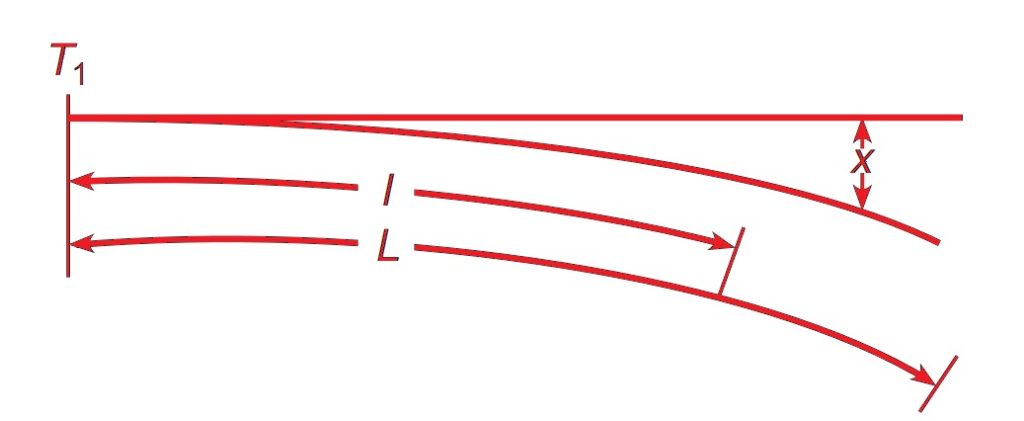
The Cubical Spiral is widely applied in railway design due to its simplicity and its ability to offer gradual change in curvature over a transition distance. The standard equation for a Cubical Spiral is given as:
x = l³ / (6RL)
Where:
- x = perpendicular offset from the tangent
- l = distance measured along the curve
- L = total length of the transition curve
- R = radius of the circular curve
This equation provides the offset distance (x) from the tangent as a function of the curve length (l) and radius of the main circular curve (R). The gradual increase in curvature ensures smoother transitions and minimizes discomfort or strain, especially in high-speed railway applications.
Key features of Cubical Spiral
- Provides a smooth transition of centrifugal force
- Allows for gradual superelevation introduction
- Ensures constant rate of change of centrifugal acceleration
2. Cubic Parabola
The Cubic Parabola is another commonly used transition curve, particularly suited for railway and road alignments. This curve allows for a gradual transition from a straight path to a curved one, ensuring smooth motion and comfort, especially at higher speeds.
The standard equation for a cubic parabola is:
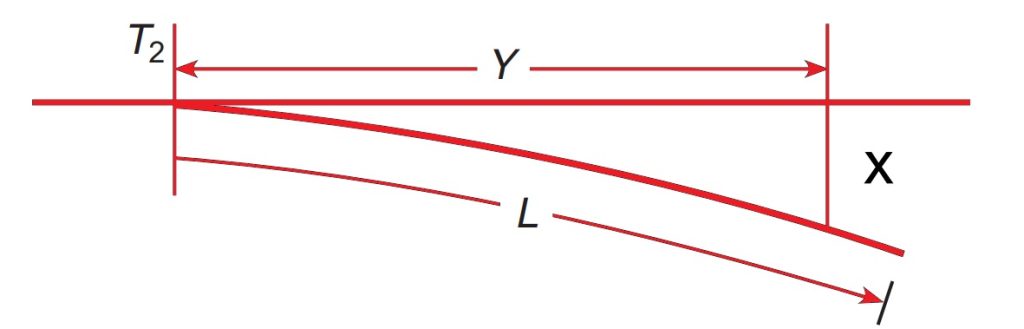
x = y³ / (6RL)
Where:
- x = Perpendicular offset from the tangent
- y = Distance measured along the tangent from the point of transition
- R = Radius of the circular curve
- L = Total length of the transition curve
This equation represents the relationship between the distance along the tangent and the offset to the curve. As the distance y increases, the perpendicular offset x grows cubically, which means the curvature increases gradually, preventing sharp or sudden changes. This gradual transition is crucial in reducing lateral forces on moving vehicles, thereby improving safety and comfort.
Cubic parabolic curves are especially advantageous in areas where the design requires smooth entry and exit into circular curves, minimizing abrupt changes that could affect vehicle stability, particularly in high-speed railway systems.
Key features of Cubical Parabola
- Provides a smooth transition between straight and curved sections
- Easier to set out in the field compared to the cubical spiral
- Allows for gradual introduction of superelevation and lateral acceleration
3. The Lemniscate curve
The Lemniscate Curve is commonly used in highway design as a transition curve. Its primary advantage lies in its ability to provide a smooth and continuous transition between tangents and circular curves, which is crucial for vehicles traveling at varying speeds.
The standard equation of a lemniscate curve is:
r = ρ /(3sin 2α)
Where:
- r = Radius of curvature at any given point on the curve
- ρ = Polar ray of any point on the curve (distance from the center to the point)
- α = Polar deflection angle (the angle between the polar ray and the straight tangent)
Key features of The Lemniscate curve
- Shape resembles a figure-eight, providing a natural transition for vehicular movement
- Well-suited for highway curves, especially at higher speeds
- Offers a gradual change in curvature, enhancing safety and comfort
Comparison of Transition Curves
| Basis of Comparison | Cubical Spiral | Cubic Parabola | Lemniscate Curve |
|---|---|---|---|
| Standard Equation | x = l³ / (6RL) | x = y³ / (6RL) | r = ρ /(3sin 2α) |
| Coordinate System | Cartesian | Cartesian | Polar |
| Primary Application | Railway curves | Railway curves | Highway curves |
| Ease of Field Layout | Moderate | Easier | More challenging |
| Rate of Change of Curvature | Constant | Nearly constant | Variable, but suitable for higher speeds |
| Length Measurement | Along the curve (l) | Along the tangent (y) | Polar ray (ρ) |
| Shape | Spiral | Parabolic | Figure-eight (partial) |
| Superelevation Transition | Gradual, ideal for railways | Gradual, suitable for railways | Smooth, ideal for highways |
| Computational Complexity | Moderate | Simpler | More complex |
Frequently Asked Questions
A transition curve is a curve with a gradually changing radius that provides a smooth transition between a straight section and a circular curve in roads or railways. It allows for a gradual change in curvature and superelevation, improving safety and comfort for vehicles.
The ideal transition curve depends on the specific requirements of the project. However, the most commonly used transition curves are the clothoid (or spiral curve), cubic parabola, and lemniscate. Each has its advantages, but the clothoid is often considered ideal as it provides a linear rate of change of curvature.
Shift in a transition curve refers to the lateral displacement between the circular curve and the tangent line at the point where they would meet without a transition curve. This shift is necessary to maintain the correct alignment and ensure a smooth transition between the straight and curved sections.
Transition curves are provided for several reasons:
- To gradually introduce centrifugal force, improving passenger comfort
- To allow for a gradual application of superelevation
- To reduce wear and tear on vehicles and infrastructure
- To improve safety by providing a more natural path for vehicles to follow
- To enhance the aesthetic appearance of the road or railway
A transition curve allows for a gradual change in lateral acceleration as a vehicle enters or exits a curve. This gradual change reduces the sudden jerk experienced by passengers, improves vehicle stability, and decreases the risk of accidents, especially at high speeds.
The main types of transition curves are:
- Clothoid or spiral curve
- Cubic parabola
- Lemniscate
- Sine curve
- Bloss curve (used in some railway applications)