The highest central wedge-shaped block of an arch is called:
Try it first: pick an option, then read the explanation.
Deconstructing the Arch: A Detailed Look at its Parts
An arch is a marvel of structural engineering that works by transferring loads into compressive stresses. Understanding its individual components is crucial to appreciating how it functions.
(D) Key-stone: The Lynchpin of the Arch
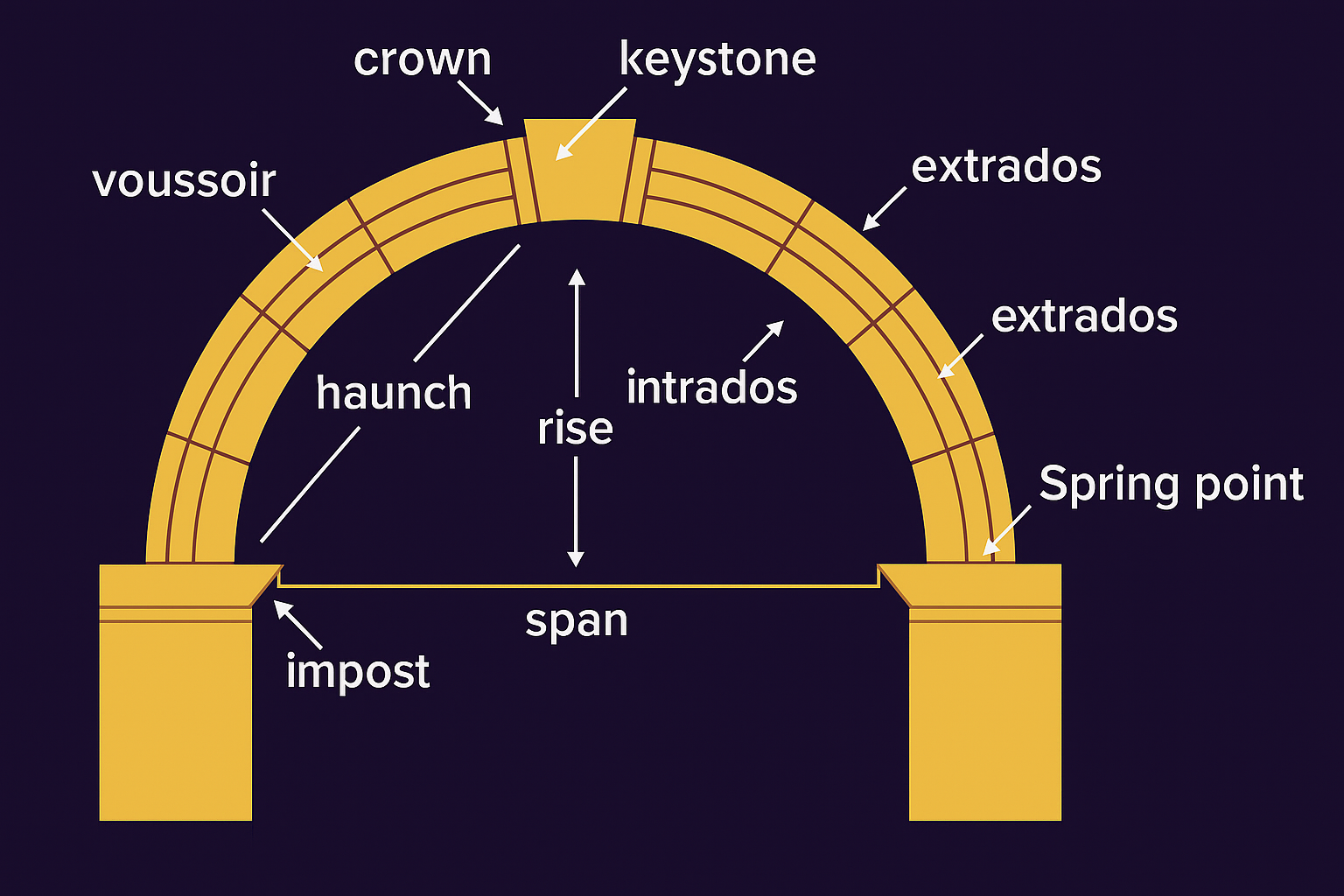
The Key-stone (or keystone) is the correct answer. It is the final, central, wedge-shaped stone placed at the apex (the highest point) of an arch. Its primary role is to lock all the other stones (voussoirs) into position, creating a state of compression throughout the structure and making the arch self-supporting. The keystone is the first point of load distribution, channeling the weight from above down through the sides of the arch to the supporting columns or abutments.
(A) Haunch: The Point of Maximum Thrust
The Haunch is not a single stone, but a section of the arch's curve. It is the part of the arch that is roughly midway between the springing line (the support) and the keystone. This area is where the outward horizontal force, or "arch thrust," is at its greatest. Because it is a high-stress area, engineers pay close attention to the haunches to ensure the supports are strong enough to resist being pushed outward.
(B) Skew back: The Sloping Support
A Skew back is the sloping surface or stone that forms the abutment for the arch to rest upon. It is cut at an angle to receive the thrust from the arch and transfer it to the vertical support. It marks the point where the curve of the arch begins, also known as the springing line.
(C) Spandrel: The In-fill Area
The Spandrel is the triangular space created between the outer curve of the arch (the extrados), a horizontal line from its crown, and a vertical line from its support. Essentially, it's the area that fills the corner between the arch's curve and a rectangular frame. This space is often filled with masonry to create a flat wall or, on bridges, may be left open or decorated.
Visual Diagram of Arch Components
This diagram helps to visualize where each component is located on a typical arch structure.
How an Arch is Built
Visualizing the construction process helps to understand the role of each part:
- A temporary wooden support called Centering is built in the shape of the desired arch.
- Wedge-shaped stones called Voussoirs are laid from the supports (abutments) upwards on top of the centering, starting from the Skew back.
- This continues from both sides until only a single gap remains at the very top.
- The Key-stone is then carefully lowered and tapped into this final gap.
- Once the keystone is in place, the centering can be removed, and the arch becomes self-supporting, transferring all loads to the ground through compression.