
The vernier scale in which 10 divisions of the vernier scale is equal to 9 divisions of the main scale is called _______.
📝 Detailed Explanation: The Direct Vernier
A direct vernier is the most common type of vernier scale used on surveying instruments. Its defining characteristic is the relationship between its divisions and the divisions of the main scale.
Key Features of a Direct Vernier
- Same Direction Calibration: The graduations on the vernier scale increase in the same direction as the graduations on the main scale.
- Division Length: A single division on the vernier scale is slightly shorter than a single division on the main scale. This small difference is what allows for precise measurements.
- Formula: The relationship is defined by the formula `n VSD = (n - 1) MSD`, where `VSD` is Vernier Scale Division and `MSD` is Main Scale Division.
In this question, we have 10 divisions on the vernier scale (`n=10`) equal to 9 divisions on the main scale (`n-1=9`). This perfectly matches the definition of a direct vernier.
⚙️ Comparison of Vernier Types
To understand why the other options are incorrect, it's helpful to compare the formulas for each vernier type:
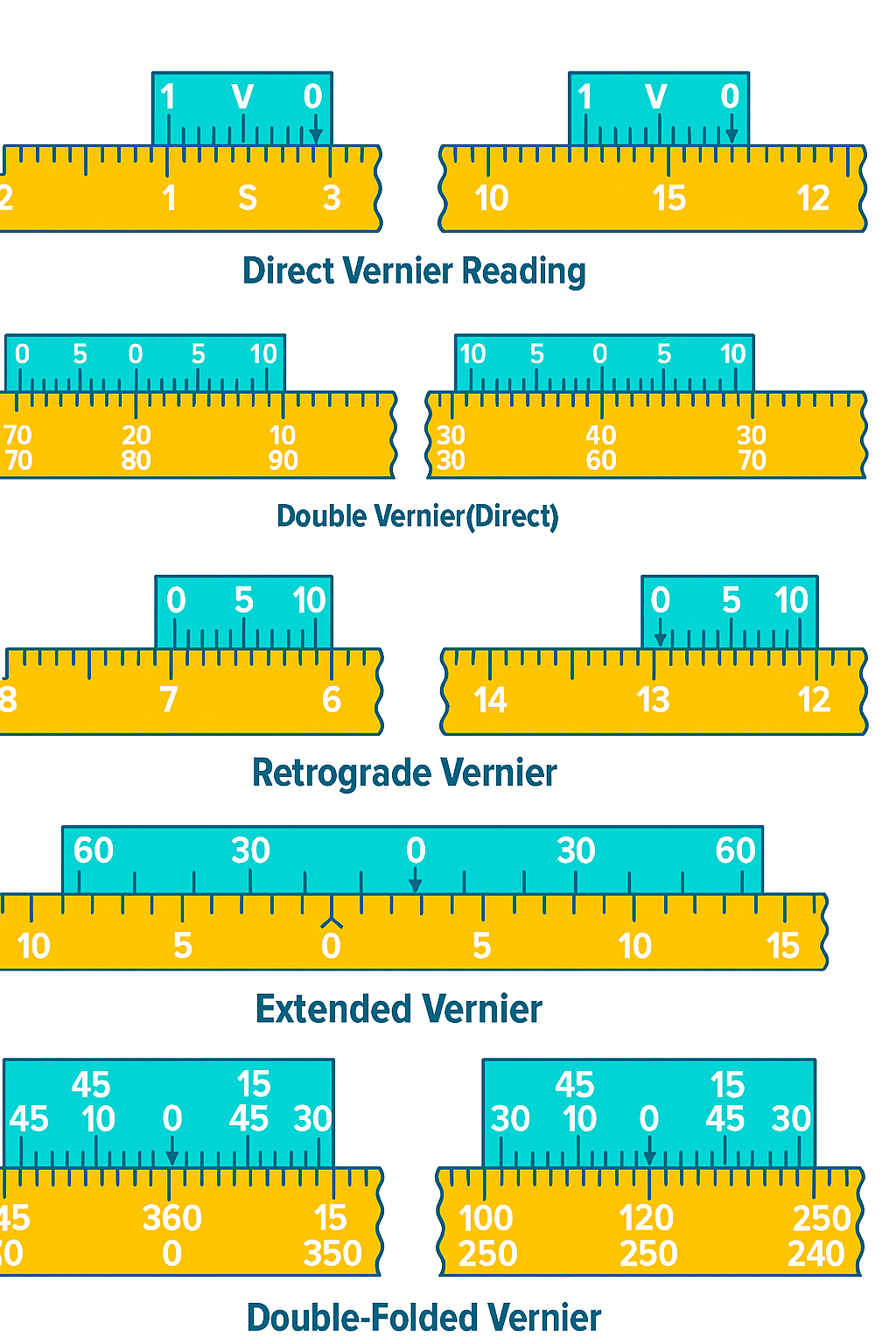
| Type of Vernier | Divisions on Vernier Scale (n) | Equal to Divisions on Main Scale | Direction of Graduation |
|---|---|---|---|
| Direct Vernier | n | n - 1 | Same as main scale |
| Retrograde Vernier | n | n + 1 | Opposite to main scale |
| Extended Vernier | n | 2n - 1 | Same as main scale |
A double vernier consists of two vernier scales (one on each side of the central index) that allow for readings in both clockwise and anti-clockwise directions.