Problem Statement
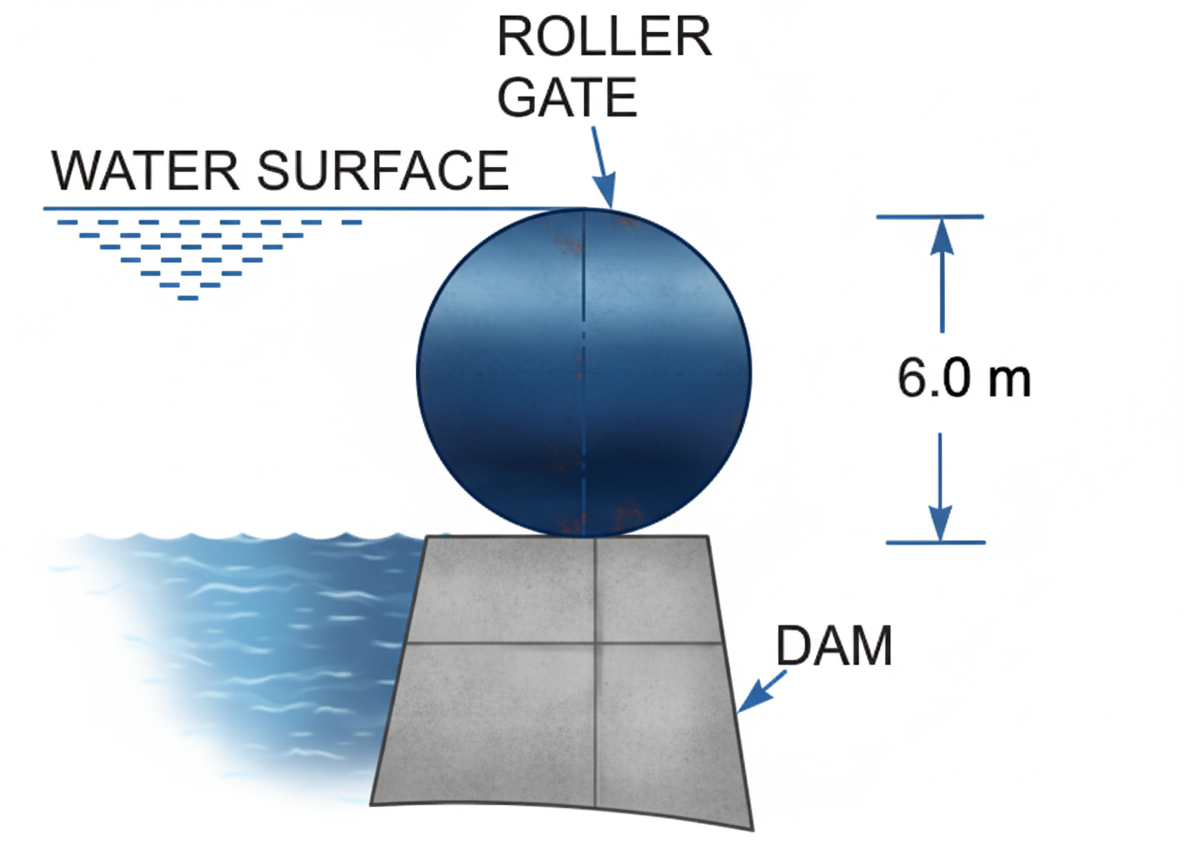
A roller gate is in cylindrical form of 6.0 m diameter. It is placed on the dam. Find the magnitude and direction of the resultant force due to water acting on the gate when the water is just going to spill. The length of the gate is given as 10 m.
Given Data
- Diameter of gate, \( D = 6 \, \text{m} \) (Radius, \( R = 3 \, \text{m} \))
- Length of gate, \( b = 10 \, \text{m} \)
- Fluid is water, \( \rho = 1000 \, \text{kg/m}^3 \)
Diagram of the Gate
Solution
Since the water is just about to spill, the water surface is at the top of the cylindrical gate. We will find the resultant force by calculating the horizontal and vertical components on the wetted semi-circular surface.
1. Horizontal Force (\(F_x\))
The horizontal force is the total pressure on the vertical projection of the curved surface. This projection is a rectangle of height D = 6 m.
$$ A_x = D \times b $$ $$ A_x = 6 \times 10 = 60 \, \text{m}^2 $$The depth of the centroid of this projected area is:
$$ \bar{h}_x = \frac{D}{2} $$ $$ \bar{h}_x = \frac{6}{2} = 3 \, \text{m} $$Now, calculate the horizontal force component.
$$ F_x = \rho g A_x \bar{h}_x $$ $$ F_x = 1000 \times 9.81 \times 60 \times 3 $$ $$ F_x = 1765800 \, \text{N} $$2. Vertical Force (\(F_y\))
The vertical force is the weight of the water in the volume directly above the curved semi-circular surface. This volume is an imaginary semi-cylinder.
$$ V = \left( \frac{\pi R^2}{2} \right) \times b $$ $$ V = \left( \frac{\pi \times 3^2}{2} \right) \times 10 $$ $$ V = 45\pi \approx 141.37 \, \text{m}^3 $$Now, calculate the vertical force component. This force acts upwards.
$$ F_y = \rho g V $$ $$ F_y = 1000 \times 9.81 \times 141.37 $$ $$ F_y \approx 1386839 \, \text{N} $$3. Resultant Force (\(F\))
The resultant force is the vector sum of the components.
$$ F = \sqrt{F_x^2 + F_y^2} $$ $$ F = \sqrt{(1765800)^2 + (1386839)^2} $$ $$ F \approx \sqrt{3.118 \times 10^{12} + 1.923 \times 10^{12}} $$ $$ F = \sqrt{5.041 \times 10^{12}} $$ $$ F \approx 2245217 \, \text{N} $$4. Angle of Action (\(\theta\))
The angle the resultant force makes with the horizontal is found using trigonometry.
$$ \tan \theta = \frac{F_y}{F_x} $$ $$ \tan \theta = \frac{1386839}{1765800} $$ $$ \tan \theta \approx 0.7854 $$ $$ \theta = \tan^{-1}(0.7854) $$ $$ \theta \approx 38.15^\circ $$Resultant Force: \( F \approx 2.245 \, \text{MN} \).
Angle of action with horizontal: \( \theta \approx 38.15^\circ \).
Explanation of Concepts
Horizontal Component (\(F_x\)): The horizontal force on the semi-circular gate is equal to the force that would be exerted on its vertical projection. For this gate, the projection is a rectangle with a height equal to the gate's diameter.
Vertical Component (\(F_y\)): The vertical force is equal to the weight of the fluid that would occupy the volume of the semi-cylindrical gate. This is an application of Archimedes' principle, representing the buoyant force on the gate. This force acts vertically upwards through the centroid of the displaced volume.
Resultant Force: Since the horizontal and vertical forces are perpendicular, the total resultant force can be found using the Pythagorean theorem, and its direction can be determined with basic trigonometry.