
Problem Statement
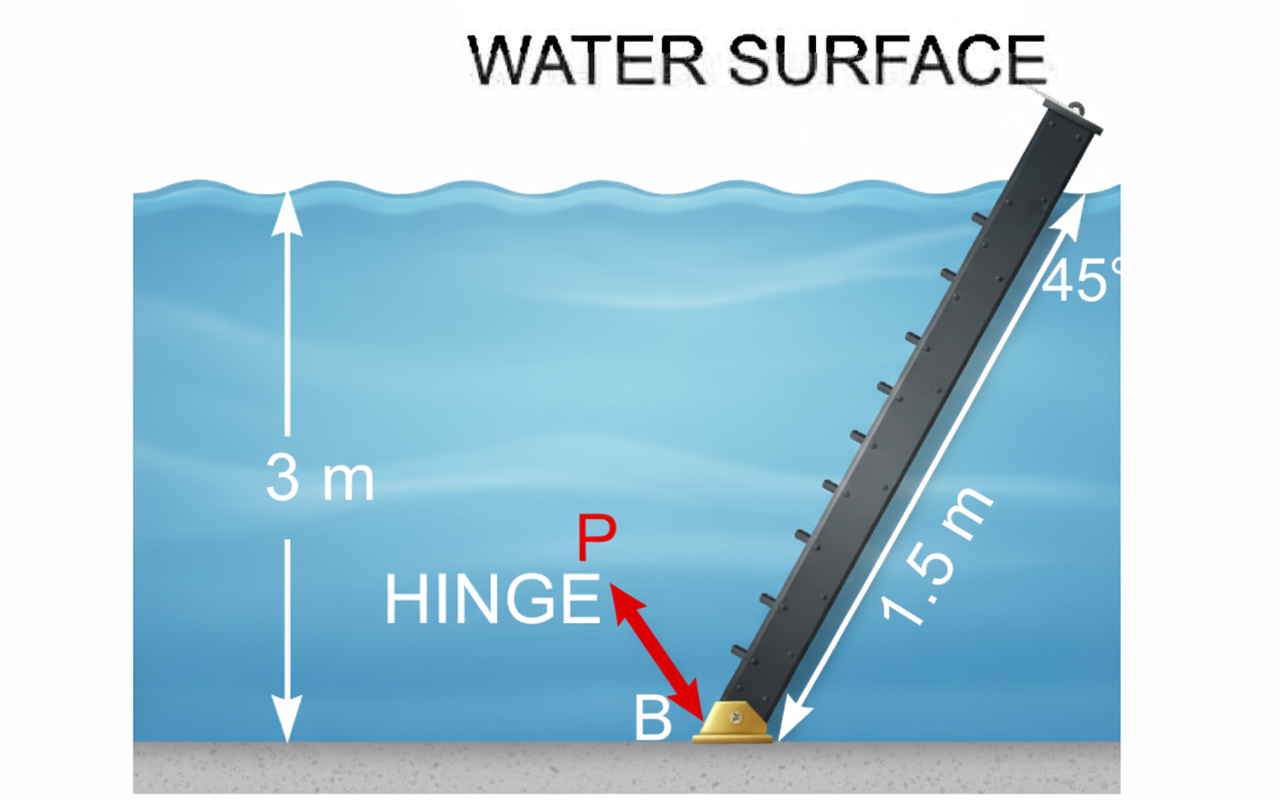
An inclined rectangular gate of width 5 m and depth 1.5 m is installed to control the discharge of water as shown. The end A is hinged. Determine the force normal to the gate applied at B to open it.
Given Data
- Gate width, \( b = 5 \, \text{m} \)
- Gate depth (length), \( d = 1.5 \, \text{m} \)
- Angle with vertical, \( \alpha = 45^\circ \), so angle with horizontal, \( \theta = 45^\circ \)
- Vertical depth of hinge A from free surface = 3 m
Diagram of the Gate
Solution
To open the gate, the moment created by the applied force at B (\(F_B\)) must equal the moment created by the hydrostatic force (\(F_H\)) about the hinge A.
1. Hydrostatic Force (\(F_H\))
First, we find the area of the gate and the vertical depth to its centroid (\(\bar{h}\)).
Now, calculate the total hydrostatic force.
2. Position of Centre of Pressure and Lever Arm
The hydrostatic force acts at the centre of pressure. We need to find its distance from the hinge A, along the gate.
First, find the distance of the centroid from the free surface, measured along the incline (\(\bar{y}\)).
The lever arm for the hydrostatic force about the hinge A is the distance from A to the centre of pressure.
3. Equating Moments to find \(F_B\)
The moment from the hydrostatic force about hinge A must be balanced by the moment from the applied force at B.
The force normal to the gate applied at B to open it is \( F_B \approx 136.35 \, \text{kN} \).
Explanation of Concepts
Principle of Moments: To initiate movement (opening the gate), the moment applied by the force at B must overcome the opposing moment created by the water pressure. A moment is a turning effect calculated as Force × Perpendicular Distance from the pivot (hinge A).
Hydrostatic Force and Centre of Pressure: The total force from the water pressure (\(F_H\)) doesn't act at the gate's geometric center (centroid). Instead, it acts at a lower point called the centre of pressure. Finding the exact location of this point is crucial for calculating the correct moment. The distance from the hinge A to this centre of pressure is the lever arm for the hydrostatic force.
Equilibrium Equation: The problem is solved by setting the moment from the applied force equal to the moment from the hydrostatic force (\(M_B = M_H\)). This creates an equation where the only unknown is the applied force \(F_B\), allowing us to solve for it.


