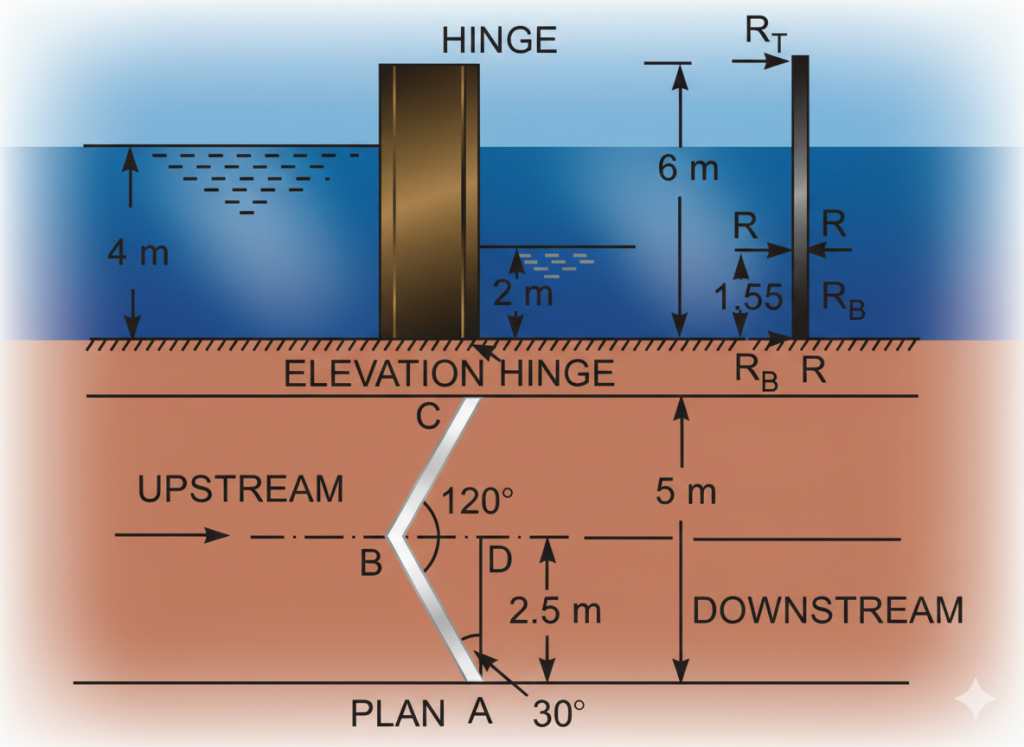
Problem Statement
The opening in a dam is 3 m wide and 2 m high. A vertical sluice gate is used to cover the opening. On the upstream of the gate, the liquid of sp. gr. 1.5, lies up to a height of 2.0 m above the top of the gate, whereas on the downstream side, the water is available up to the height of the top of the gate. Find the resultant force acting on the gate and the position of the centre of pressure.
Given Data
- Gate width, \( b = 3 \, \text{m} \)
- Gate height, \( d = 2 \, \text{m} \)
- Upstream liquid S.G. = 1.5, \( \rho_1 = 1500 \, \text{kg/m}^3 \)
- Upstream liquid height above gate = 2 m
- Downstream liquid is water, \( \rho_2 = 1000 \, \text{kg/m}^3 \)
- Downstream water height is up to the top of the gate.
Solution
We will calculate the forces and centres of pressure for the upstream and downstream sides separately, then combine them to find the resultant force and its point of action.
1. Upstream Side
The depth of the centre of pressure for the upstream side (\(h_1^*\)) is:
2. Downstream Side
The depth of the centre of pressure for the downstream side (\(h_2^*\)) from its own surface is:
3. Resultant Force and Centre of Pressure
The resultant force is the difference between the two forces.
To find the position of the resultant centre of pressure (\(h_R^*\)), we take moments about the upstream water surface.
where \(h_{2,ref}^*\) is the depth of \(F_2\) from the upstream surface.
$$ h_{2,ref}^* = (\text{Height difference}) + h_2^* = 2 + 1.333 = 3.333 \, \text{m} $$ $$ 206010 \times h_R^* = (264870 \times 3.111) - (58860 \times 3.333) $$ $$ 206010 \times h_R^* \approx 823971 - 196180 = 627791 $$ $$ h_R^* = \frac{627791}{206010} \approx 3.047 \, \text{m} $$This depth is measured from the upstream free surface. To find its position relative to the bottom of the gate (hinge), we first find the depth of the hinge.
Resultant Force on Gate: \( F_R \approx 206.01 \, \text{kN} \).
Position of Centre of Pressure: \( \approx 0.953 \, \text{m} \) above the bottom hinge.
Explanation of Concepts
Forces on a Submerged Gate: When a gate has fluid on both sides, it experiences a hydrostatic force from each side. Each force is calculated independently based on the fluid's density, the gate's area, and the depth of the gate's centroid relative to that fluid's free surface.
Resultant Force: The net or resultant force on the gate is the vector sum of the forces from both sides. Since they act in opposite horizontal directions, the resultant force is simply the difference between the larger (upstream) force and the smaller (downstream) force.
Resultant Centre of Pressure: The individual forces (\(F_1\) and \(F_2\)) act at their respective centres of pressure (\(h_1^*\) and \(h_2^*\)). To find the single point where the resultant force (\(F_R\)) acts, we use the principle of moments. By summing the moments of the individual forces about a common reference point (like the upstream free surface), we can find the location (\(h_R^*\)) of the resultant force. This final position can then be referenced to any physical point on the structure, such as the bottom hinge, for practical engineering applications.