
Problem Statement
A circular plate 3.0 m diameter is immersed in water in such a way that its greatest and least depth below the free surface are 4 m and 1.5 m respectively. Determine the total pressure on one face of the plate and position of the centre of pressure.
Given Data
- Diameter of plate, \( d = 3.0 \, \text{m}\)
- Greatest depth (bottom edge), \( h_{max} = 4.0 \, \text{m}\)
- Least depth (top edge), \( h_{min} = 1.5 \, \text{m}\)
- Density of water, \( \rho = 1000 \, \text{kg/m}^3 \)
Diagram
Illustration of the inclined circular plate submerged in water.

Solution
First, we determine the inclination of the plate. The vertical distance between the top and bottom edges is \(4.0 - 1.5 = 2.5\) m. This distance is related to the plate's diameter (3.0 m) by the sine of the inclination angle \(\theta\).
The depth of the plate's centroid (\(\bar{h}\)) is the average of the greatest and least depths.
(i) Total Pressure Force (\(F\))
The total pressure force is \( F = \rho g A \bar{h} \). First, we calculate the area \(A\):
Now, calculate the total force:
(ii) Centre of Pressure (\(h^*\))
The vertical depth to the centre of pressure, \(h^*\), is given by:
The moment of inertia \(I_G\) for a circular area is:
Now, substitute the values into the formula for \(h^*\):
Total Pressure Force: \( F \approx 190.62 \, \text{kN} \)
Position of Centre of Pressure: \( h^* \approx 2.892 \, \text{m} \) below the free surface
Problem Statement
If in the above problem, the given circular plate is having a concentric circular hole of diameter 1.5 m, then calculate the total pressure and position of the centre of pressure on one face of the plate.
Given Data
- Outer Diameter of plate, \( d_o = 3.0 \, \text{m}\)
- Inner Diameter of hole, \( d_i = 1.5 \, \text{m}\)
- Geometric properties (\(\bar{h}\) and \(\sin\theta\)) remain the same as Part 1.
- \( \bar{h} = 2.75 \, \text{m} \)
- \( \sin\theta \approx 0.8333 \)
Diagram
Illustration of the inclined circular plate with a concentric hole.
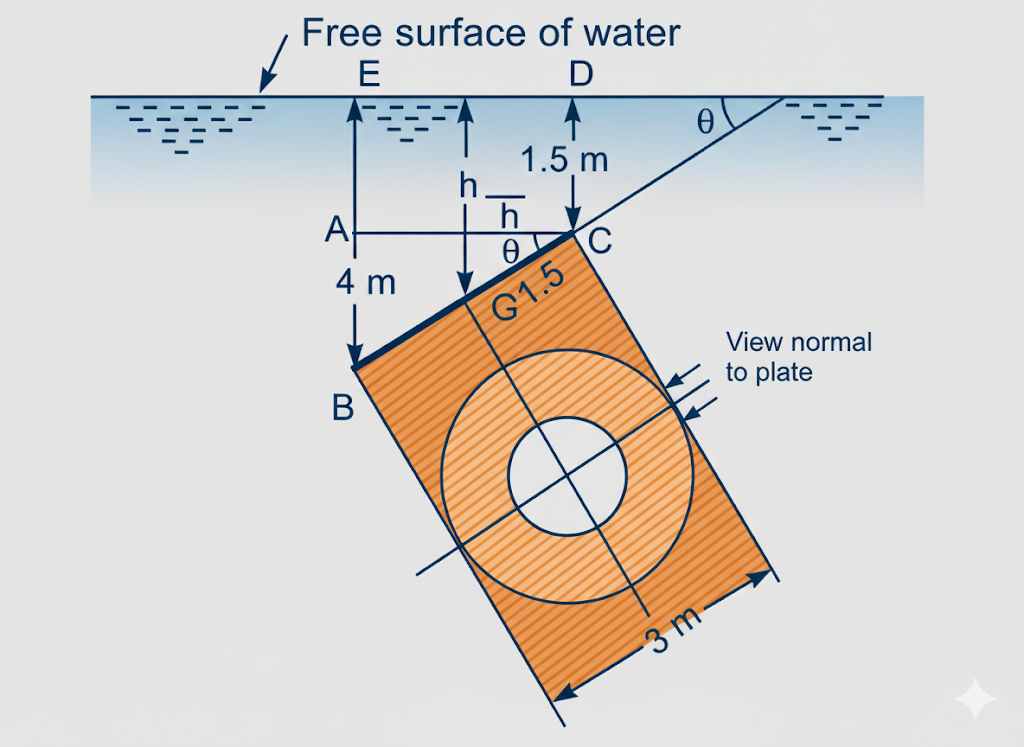
Solution
The centroid depth (\(\bar{h}\)) and inclination (\(\sin\theta\)) are unchanged because the hole is concentric.
(i) Total Pressure Force (\(F\))
We first need to calculate the new area of the plate (annulus).
Now, calculate the new total force:
(ii) Centre of Pressure (\(h^*\))
We need the moment of inertia \(I_G\) for the hollow circular area (annulus).
Now, we can find the new centre of pressure \(h^*\):
Total Pressure Force: \( F \approx 143.02 \, \text{kN} \)
Position of Centre of Pressure: \( h^* \approx 2.927 \, \text{m} \) below the free surface
Explanation of Concepts
Effect of the Hole on Total Force: The total force is directly proportional to the area of the surface. By cutting a hole, we reduce the surface area, which results in a proportionally lower total pressure force. The force decreased from 190.6 kN to 143.0 kN.
Effect of the Hole on Centre of Pressure: The centre of pressure's location depends on both the area and the moment of inertia. Removing the central part of the plate removes area that was closer to the centroid. This shifts the "average" location of the remaining area slightly further from the centroidal axis. As a result, the centre of pressure moves slightly deeper, from 2.892 m to 2.927 m.

