
Problem Statement
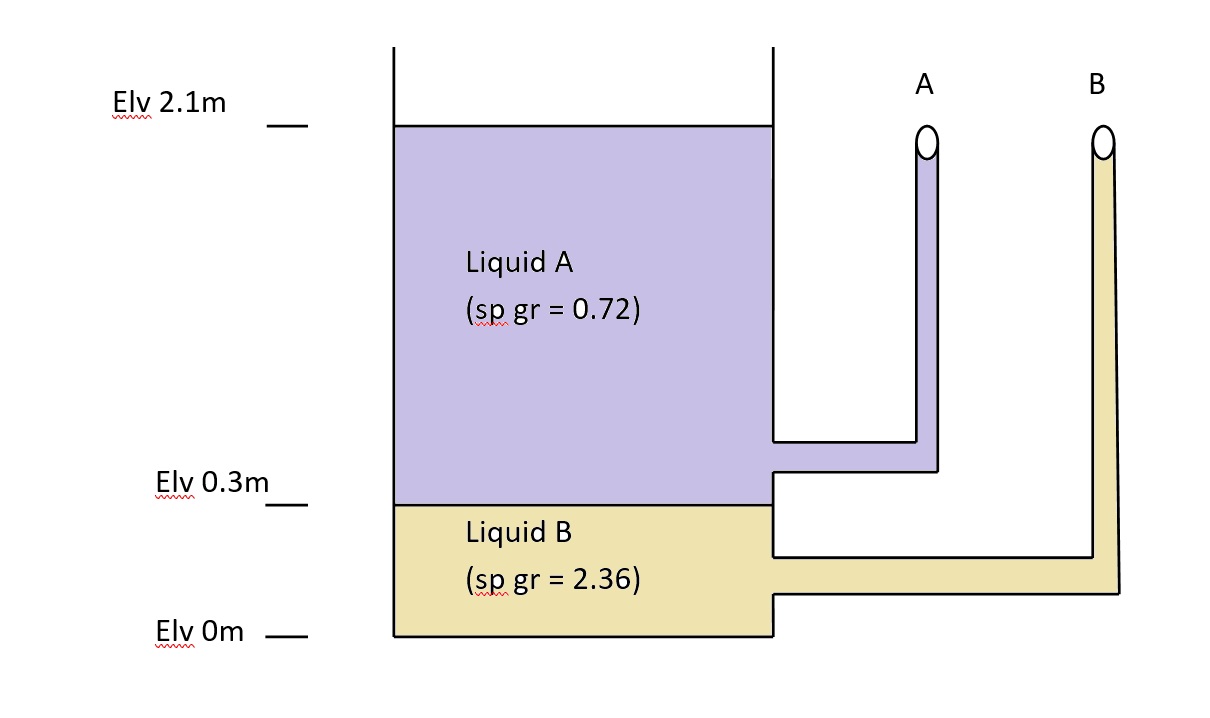
For the open tank, with piezometers attached on the side, containing two different immiscible liquids as shown in the figure, find:
- (a) the elevation of liquid surface in piezometer A
- (b) the elevation of liquid surface in piezometer B
- (c) the total pressure at the bottom of the tank
Solution
Given:
- Specific weight of liquid A (\( \gamma_A \)) = \( 0.72 \times 9810 = 7063.2 \, \text{N/m}^3 \)
- Specific weight of liquid B (\( \gamma_B \)) = \( 2.36 \times 9810 = 23151.6 \, \text{N/m}^3 \)
(a) Elevation of Liquid Surface in Piezometer A:
The elevation of the liquid surface in piezometer A is equal to the elevation of liquid A in the tank:
Elevation = \( 2.1 \, \text{m} \)
(b) Elevation of Liquid Surface in Piezometer B:
Pressure due to liquid A at the interface:
\( P_A = \gamma_A \cdot h_{\text{liquid A}} \)
Substitute the values:
\( P_A = 7063.2 \times (2.1 - 0.3) \)
\( P_A = 12713.8 \, \text{N/m}^2 \)
Equivalent head for liquid B due to \( P_A \):
\( h_A = \frac{P_A}{\gamma_B} \)
Substitute the values:
\( h_A = \frac{12713.8}{23151.6} \)
\( h_A = 0.55 \, \text{m} \)
Elevation of the liquid surface in piezometer B:
Elevation = Elevation of liquid B + \( h_A \)
Elevation = \( 0.3 + 0.55 \)
Elevation = \( 0.85 \, \text{m} \)
(c) Total Pressure at the Bottom of the Tank:
The total pressure at the bottom is the sum of the pressures due to liquids A and B:
\( P_{\text{total}} = \gamma_A \cdot h_{\text{liquid A}} + \gamma_B \cdot h_{\text{liquid B}} \)
Substitute the values:
\( P_{\text{total}} = 7063.2 \cdot (2.1 - 0.3) + 23151.6 \cdot 0.3 \)
\( P_{\text{total}} = 19659 \, \text{N/m}^2 \)
Explanation
This problem involves calculating the elevation of liquids in piezometers and the total pressure at the bottom of a tank containing immiscible liquids:
- The elevation in piezometer A reflects the height of liquid A in the tank.
- The elevation in piezometer B accounts for the pressure at the interface and converts it to an equivalent height of liquid B.
- The total pressure at the bottom is the sum of the contributions from the two liquids, based on their respective heights and specific weights.
Physical Meaning
- Piezometer Elevations: The elevations indicate the hydrostatic pressure at specific points, converted into equivalent liquid heights.
- Specific Weights: The specific weights of the liquids determine the pressure contributions for given heights.
- Total Pressure: The pressure at the bottom reflects the combined effects of the two immiscible liquids, providing a measure of the force per unit area.