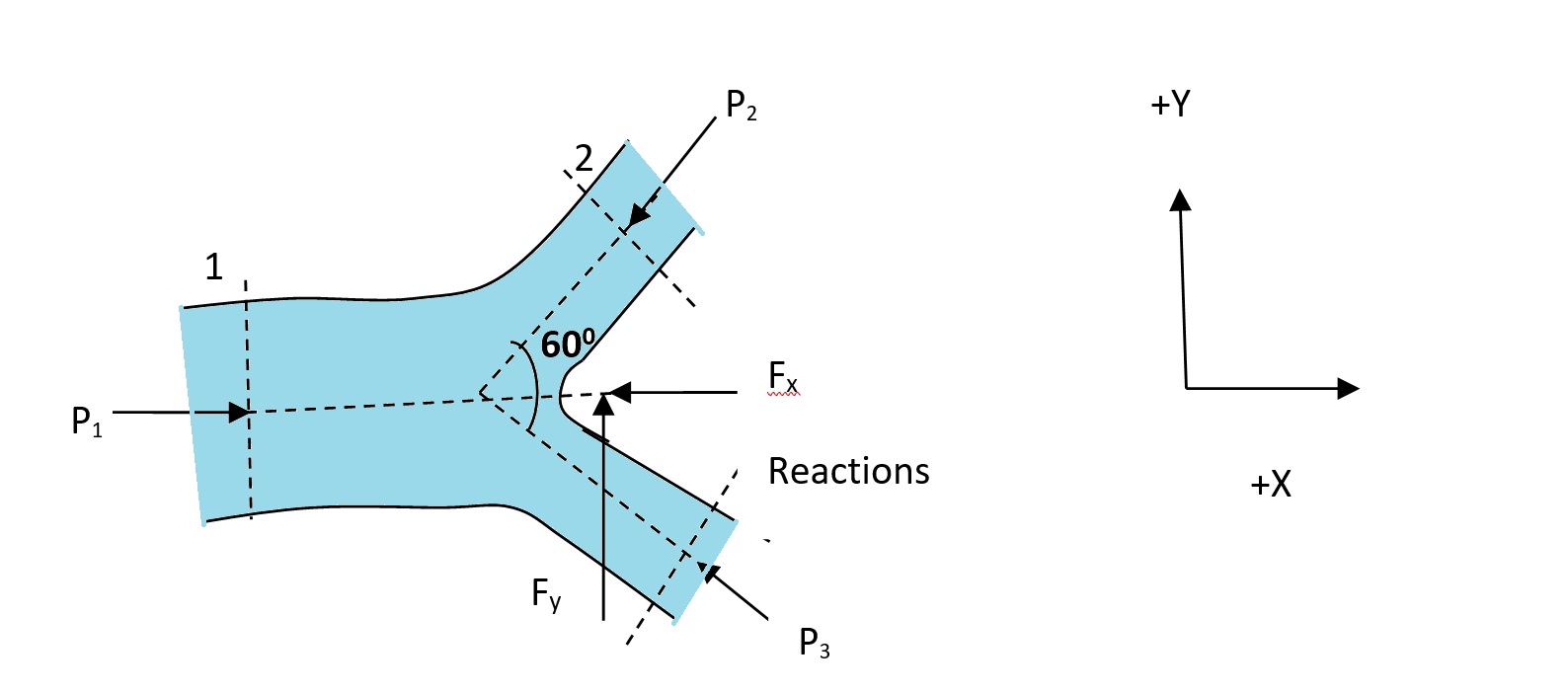
Pipe Branch Force Calculation
Fluid Mechanics Problem SolutionProblem Statement
A main pipe of diameter 500mm branches in two pipes of diameter 300mm each in the horizontal plane. Angle between the branches is 60°, which is symmetrical with respect to the main pipe. Flow discharge through the main pipe is 1.0 m³/s, which is equally divided into the branch pipes. If the pressure intensity at the main pipe is 400 kPa, find the magnitude and direction of resultant force in the bend. Assume no loss of energy due to branch junction and in pipe sections.
Given Data
Solution Approach
To find the resultant force exerted on the pipe branch, we need to:
- Calculate the cross-sectional areas and velocities in all pipes
- Determine the pressures at outlet sections using Bernoulli's equation
- Apply the momentum equation to determine the forces in both X and Y directions
- Calculate the resultant force and its direction
Preliminary Calculations
Step 1: Calculate the cross-sectional areas:
A₁ = π/4 × d₁² = π/4 × 0.5² = 0.19635 m² A₂ = A₃ = π/4 × d₂² = π/4 × 0.3² = 0.07068 m²Step 2: Calculate the velocities:
V₁ = Q₁/A₁ = 1.0/0.19635 = 5.09 m/s V₂ = V₃ = Q₂/A₂ = 0.5/0.07068 = 7.07 m/sPressure Determination
Step 1: Apply Bernoulli's equation between sections 1 and 2:
P₁/ρg + V₁²/2g + Z₁ = P₂/ρg + V₂²/2g + Z₂Since the pipes are in a horizontal plane, Z₁ = Z₂:
400000/(1000×9.81) + 5.09²/(2×9.81) = P₂/(1000×9.81) + 7.07²/(2×9.81) 40.8 + 1.32 = P₂/(1000×9.81) + 2.55 P₂ = (40.8 + 1.32 - 2.55) × 1000 × 9.81 = 387,962 N/m²Step 2: Similarly, apply Bernoulli's equation between sections 1 and 3:
P₁/ρg + V₁²/2g + Z₁ = P₃/ρg + V₃²/2g + Z₃Since conditions for pipe 3 are identical to pipe 2:
P₃ = 387,962 N/m²Force in X-Direction
Step 1: Apply the momentum equation in the X-direction:
∑Forces in X direction = Rate of change of momentum in X direction (P₁A₁ - P₂Cosθ×A₂ - P₃Cosθ×A₃) - Fx = ρ[(Q₂V₂x + Q₃V₃x) - Q₁V₁x]Step 2: At section 1, the velocity is entirely in the X-direction (V₁x = V₁). At sections 2 and 3, the X-components of velocity are (V₂x = V₂Cosθ and V₃x = V₃Cosθ).
(P₁A₁ - P₂A₂Cosθ - P₃A₃Cosθ) - Fx = ρ[(Q₂V₂Cosθ + Q₃V₃Cosθ) - Q₁V₁]Step 3: Solve for Fx:
Fx = (P₁A₁ - P₂A₂Cosθ - P₃A₃Cosθ) + ρ[Q₁V₁ - (Q₂V₂Cosθ + Q₃V₃Cosθ)] Fx = (400000×0.19635 - 387962×0.07068×Cos30° - 387962×0.07068×Cos30°) + 1000[1×5.09 - (0.5×7.07×Cos30° + 0.5×7.07×Cos30°)] Fx = (78540 - 23502 - 23502) + 1000[5.09 - (3.06 + 3.06)] Fx = 31536 - 1030 = 30506 NForce in Y-Direction
Step 1: Apply the momentum equation in the Y-direction:
∑Forces in Y direction = Rate of change of momentum in Y direction Fy - P₂Sinθ×A₂ + P₃Sinθ×A₃ = ρ[(Q₂V₂y + Q₃V₃y) - Q₁V₁y]Step 2: At section 1, there is no Y-component of velocity (V₁y = 0). At section 2, the Y-component is positive (V₂y = V₂Sinθ). At section 3, the Y-component is negative (V₃y = -V₃Sinθ) due to the symmetry.
Fy - P₂A₂Sinθ + P₃A₃Sinθ = ρ[(Q₂V₂Sinθ - Q₃V₃Sinθ) - 0]Step 3: Solve for Fy:
Fy = (P₂A₂Sinθ - P₃A₃Sinθ) + ρ(Q₂V₂Sinθ - Q₃V₃Sinθ) Fy = (387962×0.07068×Sin30° - 387962×0.07068×Sin30°) + 1000×(0.5×7.07×Sin30° - 0.5×7.07×Sin30°) Fy = (13573 - 13573) + 1000×(1.77 - 1.77) = 0 NThe Y-component of force is zero due to the symmetrical arrangement of the branch pipes.
Resultant Force Calculation
Step 1: Calculate the magnitude of the resultant force:
FR = √(Fx² + Fy²) FR = √(30506² + 0²) FR = 30,506 N ≈ 30.5 kNStep 2: Calculate the direction of the resultant force:
θ = tan⁻¹(Fy/Fx) = tan⁻¹(0/30506) = 0°Summary
- The fluid velocities in the pipes were calculated:
- Main pipe velocity (V₁) = 5.09 m/s
- Branch pipe velocities (V₂ = V₃) = 7.07 m/s
- The pressures at branch outlets were determined using Bernoulli's equation:
- P₂ = P₃ = 387,962 Pa ≈ 388 kPa
- The force components were calculated using the momentum equation:
- X-direction force: Fx = 30,506 N
- Y-direction force: Fy = 0 N (due to symmetry)
- The resultant force on the pipe branch:
- Magnitude: 30.5 kN
- Direction: 0° (along the main pipe axis)
This problem demonstrates the application of the momentum equation in fluid mechanics to determine forces on pipe branches. The force is significant due to both the pressure forces and the momentum change of the fluid as it divides and changes direction. The symmetrical arrangement of the branch pipes results in a net force that acts only in the axial direction of the main pipe, with no lateral component.