
Problem Statement
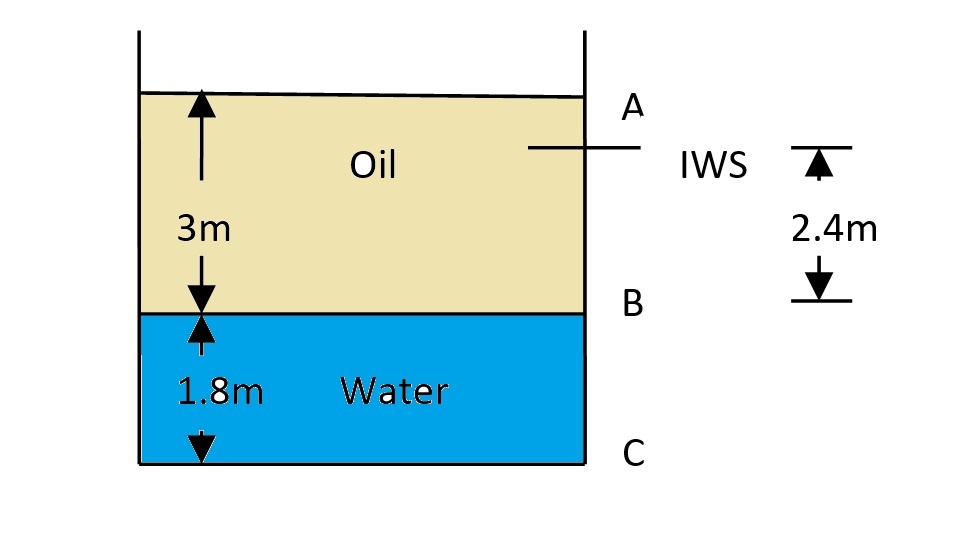
The tank in the figure contains oil (specific gravity = 0.8) and water as shown. Find the resultant force on side ABC and its point of application. ABC is 1.2 m wide.
Solution
1. Specific Weight of Oil
The specific weight of oil is:
2. Area of Sections
The area of section AB (oil side) is:
The area of section BC (water side) is:
3. Location of Center of Gravity (CG)
The location of CG for section AB is:
4. Force on Section AB
The hydrostatic force on section AB is:
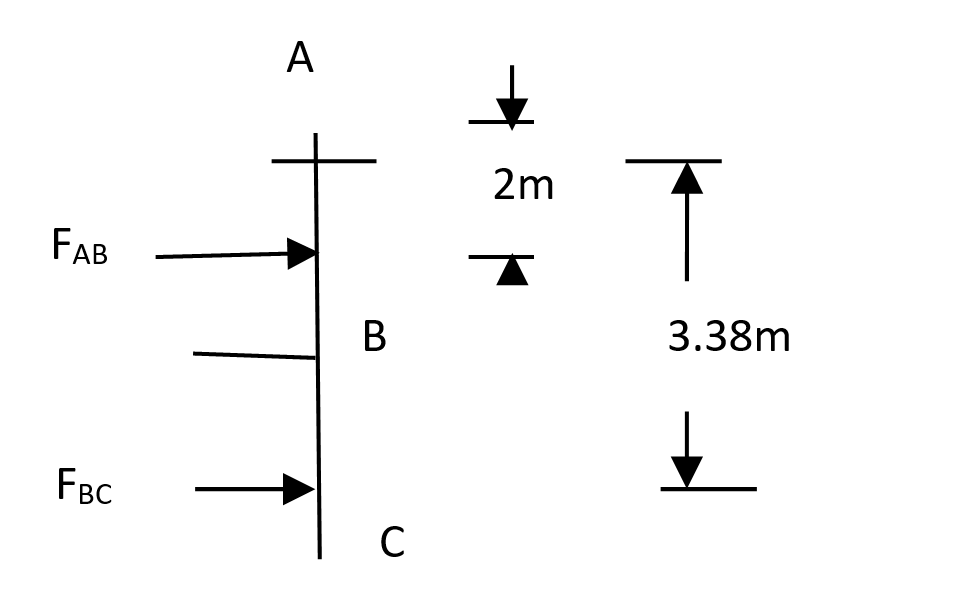
The point of application of \( F_{AB} \) is:
5. Force on Section BC
Water acts on BC, and the equivalent depth of water for 3 m of oil is:
The location of CG for the imaginary water surface (IWS) is:
The hydrostatic force on section BC is:
The point of application of \( F_{BC} \) from A is:
Adding the depth from oil:
6. Total Force on Side ABC
The total force is:
Taking moments about A:
The resultant force acts at 3.23 m below A.
- Total Force on Side ABC: \( F = 112.304 \, \text{kN} \)
- Point of Application: \( y = 3.23 \, \text{m below A} \)
Explanation
- Oil and Water: The specific weights and depths of oil and water are used to compute the hydrostatic forces.
- CG Location: The CG locations are determined based on the dimensions and the depth of the sections.
- Force Calculation: Hydrostatic forces are computed separately for oil and water sections, and their points of application are calculated.
- Total Force: The total force is the sum of forces on sections AB and BC, with moments taken about point A to find the line of action.
Physical Meaning
This problem illustrates the calculation of hydrostatic forces on a submerged surface composed of two different fluids. The principles are critical in designing and analyzing tanks and fluid systems subjected to multiple fluid layers.

