
A survey line provided to verify the accuracy of the framework is known as?
Correct Answer:
D. Check line
🎯 Understanding the Survey Framework
The fundamental principle of chain surveying is triangulation. The area to be surveyed is divided into a network of triangles, which forms a rigid framework. The accuracy of the entire survey depends on the accuracy of this framework. Various types of survey lines are used to build and verify this structure.
🔬 Analysis of Survey Lines
Each type of survey line has a distinct purpose:
- Base Line: This is the longest and most important line in the survey. It forms the foundation of the entire framework and is measured with the highest possible precision.
- Tie Line: This line joins two fixed points (tie stations) on the main survey lines. Its primary purpose is to help locate interior details of the area and to avoid long, inaccurate offsets.
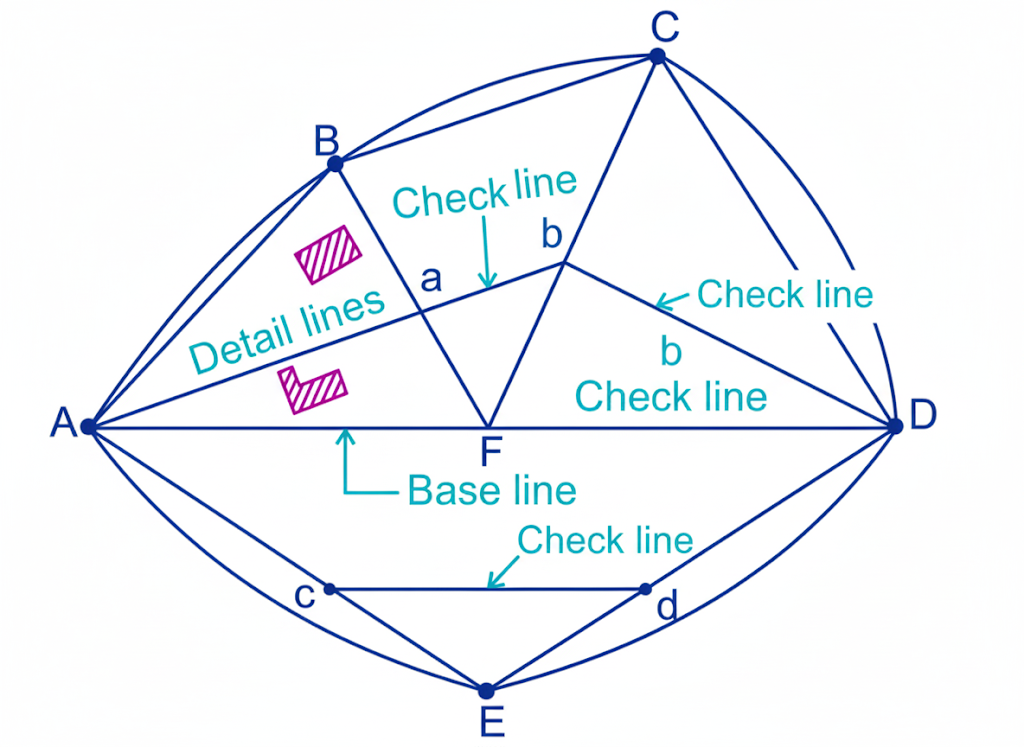
- Check Line (or Proof Line): This line is measured on the ground after the main framework is complete. Its sole purpose is to verify the accuracy of the plotted work. The measured length of the check line on the ground must match its scaled length on the map. If they match, the framework is accurate.
Therefore, the line used specifically to verify accuracy is the check line.
🗺️ Visualizing the Framework
In a typical survey framework, the base line forms the main spine, tie lines help capture details, and check lines cut across the triangles to prove the accuracy of the plot.
📊 Summary of Survey Lines
| Line Type | Primary Purpose | Key Characteristic |
|---|---|---|
| Base Line | Foundation | Longest line, measured with highest accuracy. |
| Tie Line | Locating Details | Joins main lines to avoid long offsets. |
| Check Line | Verification / Proof | Ground measurement is compared to map measurement. |