Ashok Sapkota

Ashok Sapkota is a dedicated engineer currently serving at the Department of Water Resources and Irrigation in Nepal. With a strong educational background, Ashok completed his Bachelor's degree from the Institute of Engineering (IOE), Pulchowk Campus, Nepal. He is currently pursuing a Master's degree in Construction Management at the same prestigious institution.

Ashok's professional expertise lies in water resources and irrigation engineering, where he applies his knowledge to contribute to Nepal's water management and agricultural development.

Beyond his professional commitments, Ashok is passionate about sharing his engineering insights. He regularly writes blogs on various engineering topics, aiming to educate and inspire others in the field.

With a combination of practical experience, ongoing advanced education, and a drive to share knowledge, Ashok Sapkota represents the new generation of engineers working to shape Nepal's future.

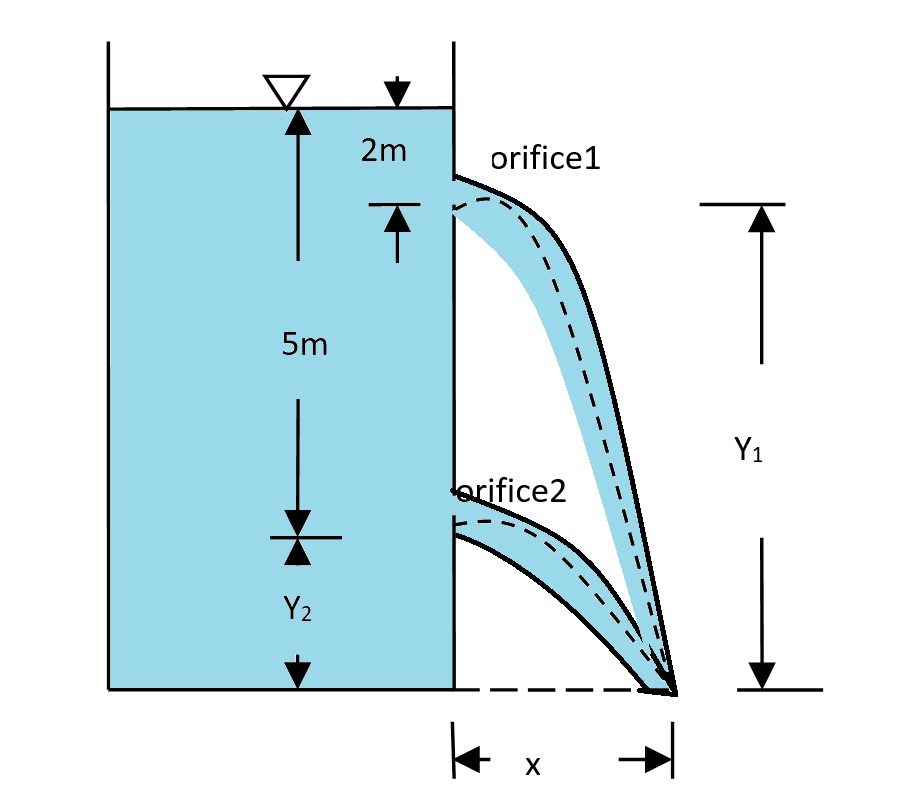
A vessel has two identical orifices provided in one of its sides as shown in the figure. Locate the point of intersection of two jets. Take Cv =0.98 for both orifices.

A vessel has two identical orifices provided in one of its sides as shown in the figure. Locate the point of intersection of the two jets. Take Cv = 0.98 for both orifices.

Intersection of Two Jets Analysis Intersection of Two Jets Analysis Problem Statement A vessel has two identical orifices provided in […]

A vessel has two identical orifices provided in one of its sides as shown in the figure. Locate the point of intersection of the two jets. Take Cv = 0.98 for both orifices. Read More »

A jet of water issuing from 5mm diameter orifice working under a head of 2.0m, was found to travel horizontal and vertical distances of 2.772m and 1m respectively. If CC = 0.61, determine discharge.

Orifice Jet Analysis Analysis of Water Jet from an Orifice Problem Statement A jet of water issuing from 5mm diameter

A jet of water issuing from 5mm diameter orifice working under a head of 2.0m, was found to travel horizontal and vertical distances of 2.772m and 1m respectively. If CC = 0.61, determine discharge. Read More »

A 2.5m long pipeline tapers uniformly from 10cm diameter to 20cm diameter at its upper end. The pipe centerline slopes upwards at an angle of 300 to the horizontal and the flow direction is from smaller to bigger cross-section. If the pressure at lower and upper ends of the pipe are 2bar and 2.4bar respectively, determine the flow rate and the pressure at the mid-length of the pipeline. Assume no energy losses

A 2.5m long pipeline tapers uniformly from 10cm diameter to 20cm diameter at its upper end. The pipe centerline slopes upwards at an angle of 300 to the horizontal and the flow direction is from smaller to bigger cross-section. If the pressure at lower and upper ends of the pipe are 2bar and 2.4bar respectively, determine the flow rate and the pressure at the mid-length of the pipeline. Assume no energy losses.

Tapered Pipeline Analysis Analysis of Tapered Pipeline with Upward Slope Problem Statement A 2.5m long pipeline tapers uniformly from 10cm

A 2.5m long pipeline tapers uniformly from 10cm diameter to 20cm diameter at its upper end. The pipe centerline slopes upwards at an angle of 300 to the horizontal and the flow direction is from smaller to bigger cross-section. If the pressure at lower and upper ends of the pipe are 2bar and 2.4bar respectively, determine the flow rate and the pressure at the mid-length of the pipeline. Assume no energy losses. Read More »

The figure below shows a pipe connecting a reservoir to a turbine which discharges water to the tailrace through another pipe. The head loss between the reservoir and the turbine is 8 times kinetic head in the pipe and that from the turbine to tailrace is 0.4 times the kinetic head in the pipe. The rate of flow is 1.36m3/s and the pipe diameter in both cases is 1m. Determine (a) the pressure at inlet and exit of turbine, and (b) the power generated by the turbine.

The figure below shows a pipe connecting a reservoir to a turbine which discharges water to the tailrace through another pipe. The head loss between the reservoir and the turbine is 8 times kinetic head in the pipe and that from the turbine to tailrace is 0.4 times the kinetic head in the pipe. The rate of flow is 1.36m3/s and the pipe diameter in both cases is 1m. Determine (a) the pressure at inlet and exit of turbine, and (b) the power generated by the turbine.

Turbine System Analysis Analysis of Turbine System with Reservoir and Tailrace Problem Statement A pipe connects a reservoir to a

The figure below shows a pipe connecting a reservoir to a turbine which discharges water to the tailrace through another pipe. The head loss between the reservoir and the turbine is 8 times kinetic head in the pipe and that from the turbine to tailrace is 0.4 times the kinetic head in the pipe. The rate of flow is 1.36m3/s and the pipe diameter in both cases is 1m. Determine (a) the pressure at inlet and exit of turbine, and (b) the power generated by the turbine. Read More »

The figure below shows a pump P pumping 90 lps of water from a tank. (a) What will be the pressure at points B and C when the pump delivers 14.5KW of power to the flow? Assume the losses in the system to be negligible. (b) What will be the pressure at C when the loss in the in the inlet to the pump is negligible and between the pump and the point C, a loss equal to 2 times the velocity head at B takes place.

The figure below shows a pump P pumping 90 lps of water from a tank. (a) What will be the pressure at points B and C when the pump delivers 14.5KW of power to the flow? Assume the losses in the system to be negligible. (b) What will be the pressure at C when the loss in the in the inlet to the pump is negligible and between the pump and the point C, a loss equal to 2 times the velocity head at B takes place.

Pump System Analysis Analysis of Pump System with 90 LPS Water Flow Problem Statement A pump P is pumping 90

The figure below shows a pump P pumping 90 lps of water from a tank. (a) What will be the pressure at points B and C when the pump delivers 14.5KW of power to the flow? Assume the losses in the system to be negligible. (b) What will be the pressure at C when the loss in the in the inlet to the pump is negligible and between the pump and the point C, a loss equal to 2 times the velocity head at B takes place. Read More »

The head extracted by turbine CR in the fig. is 60m and the pressure at T is 505 KN/m2. For losses of 2V22/2g between W and R and 3V12/2g between C and T, determine (a) how much water is flowing and (b) the pressure head at R. Draw the energy gradient line and hydraulic gradient line.

The head extracted by turbine CR in the fig. is 60m and the pressure at T is 505 KN/m2.  For losses of 2V2/2g between W and R and 3V2/2g between C and T, determine (a) how much water is flowing and (b) the pressure head at R. Draw the energy gradient line and hydraulic gradient line.

Turbine Flow Analysis and Gradient Lines Problem Statement The head extracted by turbine CR in the figure is 60m and

The head extracted by turbine CR in the fig. is 60m and the pressure at T is 505 KN/m2.  For losses of 2V2/2g between W and R and 3V2/2g between C and T, determine (a) how much water is flowing and (b) the pressure head at R. Draw the energy gradient line and hydraulic gradient line. Read More »

The pipe flow in the figure is driven by a pump. Determine the gauge pressure that must be supplied by the pump to provide a water flow rate of Q = 60 m³/h. Neglect the head loss from A to B. The head loss from C to D is given by 30(VCD²)/(2g) and from D to E by 20(VCD²)/(2g). The diameters are: dAB = dCD = 5 cm and dDE = 2 cm. (VCD is the velocity in pipe CD.)

The pipe flow in the figure is driven by the pump. What gauge pressure is needed to be supplied by the pump to provide water flow rate of Q = 60m3/h? Neglect head loss from A to B. Head loss from C to D = 30 (V_CD^2)/2g; Head loss from D to E = 20 (V_CD^2)/2g; dAB (diameter of pipe AB) = dCD = 5cm; dDE = 2cm. where VCD = velocity in pipe CD and VDE = velocity in pipe DE.

Determining Pump Gauge Pressure for Given Flow Rate Problem Statement The pipe flow in the figure is driven by the

The pipe flow in the figure is driven by the pump. What gauge pressure is needed to be supplied by the pump to provide water flow rate of Q = 60m3/h? Neglect head loss from A to B. Head loss from C to D = 30 (V_CD^2)/2g; Head loss from D to E = 20 (V_CD^2)/2g; dAB (diameter of pipe AB) = dCD = 5cm; dDE = 2cm. where VCD = velocity in pipe CD and VDE = velocity in pipe DE. Read More »

A jet of water coming out from 50mm diameter rounded nozzle attached to 100mm diameter pipe is directed vertically downwards. If the pressure in the 100mm diameter pipe 0.2m above the nozzle is 200 Kpa gauge, determine the diameter of jet 5m below the nozzle level.

A jet of water coming out from 50mm diameter rounded nozzle attached to 100mm diameter pipe is directed vertically downwards. If the pressure in the 100mm diameter pipe 0.2m above the nozzle is 200 Kpa gauge, determine the diameter of jet 5m below the nozzle level.

Determination of Jet Diameter 5m Below the Nozzle Problem Statement A jet of water is coming out from a 50mm

A jet of water coming out from 50mm diameter rounded nozzle attached to 100mm diameter pipe is directed vertically downwards. If the pressure in the 100mm diameter pipe 0.2m above the nozzle is 200 Kpa gauge, determine the diameter of jet 5m below the nozzle level. Read More »

The pipe flow in the figure is driven by a pump. Determine the gauge pressure that must be supplied by the pump to provide a water flow rate of Q = 60 m³/h. Neglect the head loss from A to B. The head loss from C to D is given by 30(VCD²)/(2g) and from D to E by 20(VCD²)/(2g). The diameters are: dAB = dCD = 5 cm and dDE = 2 cm. (VCD is the velocity in pipe CD.)

The pipe flow in the figure is driven by a pump. Determine the gauge pressure that must be supplied by the pump to provide a water flow rate of Q = 60 m³/h. Neglect the head loss from A to B. The head loss from C to D is given by 30(VCD²)/(2g) and from D to E by 20(VCD²)/(2g). The diameters are: dAB = dCD = 5 cm and dDE = 2 cm. (VCD is the velocity in pipe CD.)

Required Pump Gauge Pressure for a Pipe Flow System Required Pump Gauge Pressure for a Pipe Flow System Problem Statement

The pipe flow in the figure is driven by a pump. Determine the gauge pressure that must be supplied by the pump to provide a water flow rate of Q = 60 m³/h. Neglect the head loss from A to B. The head loss from C to D is given by 30(VCD²)/(2g) and from D to E by 20(VCD²)/(2g). The diameters are: dAB = dCD = 5 cm and dDE = 2 cm. (VCD is the velocity in pipe CD.) Read More »

A jet of water issues vertically upwards from 0.2m high nozzle whose inlet and outlet diameters are 100mm and 40mm respectively. If the pressure at the inlet is 20 Kpa above the atmospheric pressure, determine the discharge and the height to which the jet will rise. Assume no friction.

A jet of water issues vertically upwards from 0.2m high nozzle whose inlet and outlet diameters are 100mm and 40mm respectively. If the pressure at the inlet is 20 Kpa above the atmospheric pressure, determine the discharge and the height to which the jet will rise. Assume no friction.

Discharge and Jet Height from a Nozzle Discharge and Jet Height from a Nozzle Problem Statement A jet of water

A jet of water issues vertically upwards from 0.2m high nozzle whose inlet and outlet diameters are 100mm and 40mm respectively. If the pressure at the inlet is 20 Kpa above the atmospheric pressure, determine the discharge and the height to which the jet will rise. Assume no friction. Read More »

Scroll to Top