Ashok Sapkota

Ashok Sapkota is a dedicated engineer currently serving at the Department of Water Resources and Irrigation in Nepal. With a strong educational background, Ashok completed his Bachelor's degree from the Institute of Engineering (IOE), Pulchowk Campus, Nepal. He is currently pursuing a Master's degree in Construction Management at the same prestigious institution.

Ashok's professional expertise lies in water resources and irrigation engineering, where he applies his knowledge to contribute to Nepal's water management and agricultural development.

Beyond his professional commitments, Ashok is passionate about sharing his engineering insights. He regularly writes blogs on various engineering topics, aiming to educate and inspire others in the field.

With a combination of practical experience, ongoing advanced education, and a drive to share knowledge, Ashok Sapkota represents the new generation of engineers working to shape Nepal's future.

Water is pumped from a reservoir through 150mm diameter pipe and is delivered at a height of 15m from the centerline of pump through a 100mm nozzle connected to 150mm discharge line as shown in the figure. If the pressure at the pump inlet is 210 KN/m2 absolute, inlet velocity of 5m/s and the jet is discharged into atmosphere, determine the energy supplied by the pump. Take atmospheric pressure = 101.3 KN/m2 and assume no friction.

Water is pumped from a reservoir through 150mm diameter pipe and is delivered at a height of 15m from the centerline of pump through a 100mm nozzle connected to 150mm discharge line as shown in the figure. If the pressure at the pump inlet is 210 KN/m2 absolute, inlet velocity of 5m/s and the jet is discharged into atmosphere, determine the energy supplied by the pump. Take atmospheric pressure = 101.3 KN/m2 and assume no friction.

Energy Supplied by the Pump in a Reservoir-Pipe-Nozzle System Energy Supplied by the Pump in a Reservoir-Pipe-Nozzle System Problem Statement […]

Water is pumped from a reservoir through 150mm diameter pipe and is delivered at a height of 15m from the centerline of pump through a 100mm nozzle connected to 150mm discharge line as shown in the figure. If the pressure at the pump inlet is 210 KN/m2 absolute, inlet velocity of 5m/s and the jet is discharged into atmosphere, determine the energy supplied by the pump. Take atmospheric pressure = 101.3 KN/m2 and assume no friction. Read More »

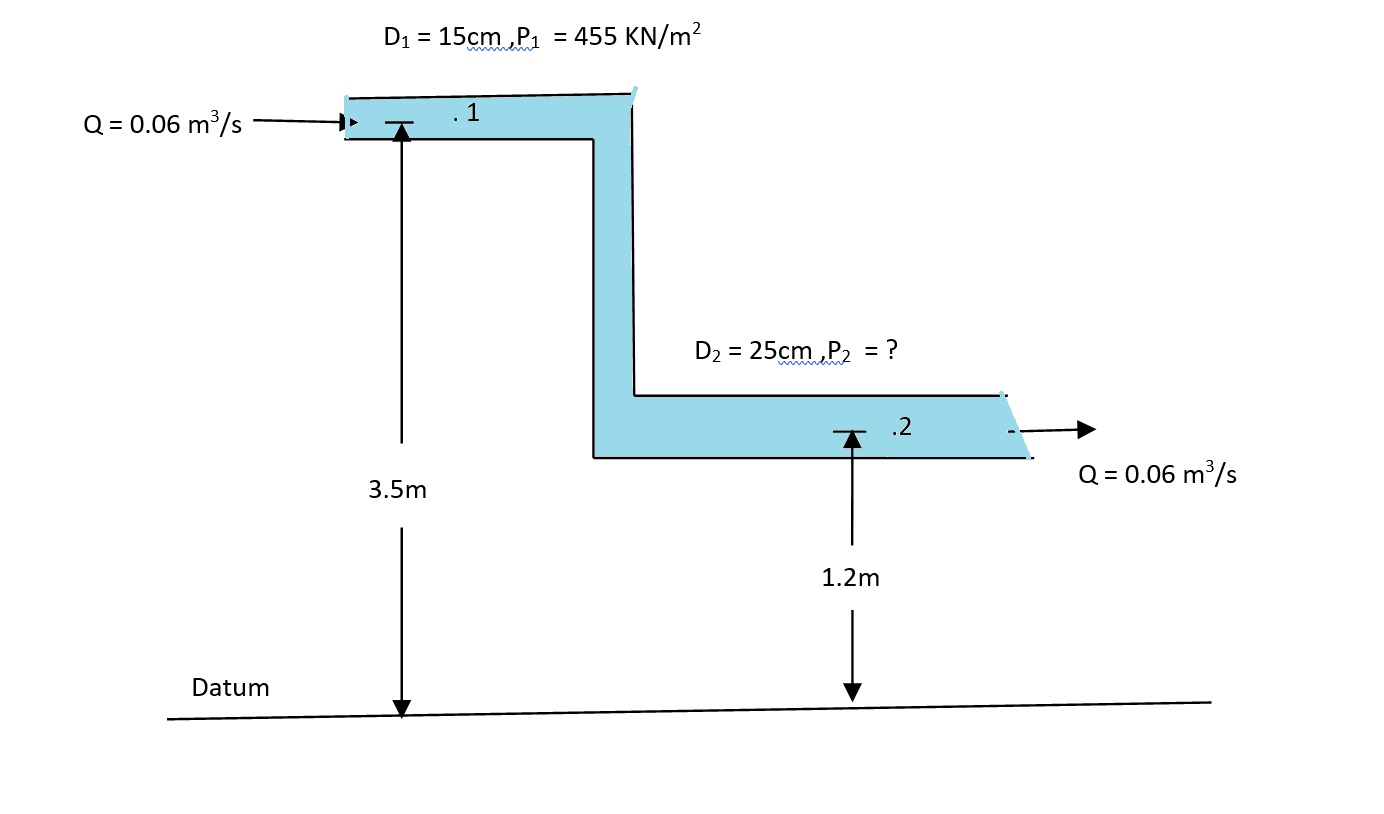
A 15cm diameter pipe is expanded to 25cm diameter suddenly at a section. The head loss at a sudden expansion from section 1 to 2 is given by hL = (V1-V2)2/2g.  For a discharge of 45 lps, calculate the manometer reading h.

A 15cm diameter pipe is expanded to 25cm diameter suddenly at a section. The head loss at a sudden expansion from section 1 to 2 is given by hL = (V1-V2)2/2g.  For a discharge of 45 lps, calculate the manometer reading h.

Manometer Reading in a Sudden Pipe Expansion Manometer Reading in a Sudden Expansion of a Pipe Problem Statement A 15

A 15cm diameter pipe is expanded to 25cm diameter suddenly at a section. The head loss at a sudden expansion from section 1 to 2 is given by hL = (V1-V2)2/2g.  For a discharge of 45 lps, calculate the manometer reading h. Read More »

A pipeline connected to a reservoir discharges water to the atmosphere. The loss of head is 1 times velocity head from A to B, 1.5 times velocity head from B to C and 0.5 times velocity head from C to D. If the pipe is 150mm in diameter, calculate the pressure heads at B and C. Also compute discharge.

A pipeline connected to a reservoir discharges water to the atmosphere. The loss of head is 1 times velocity head from A to B, 1.5 times velocity head from B to C and 0.5 times velocity head from C to D. If the pipe is 150mm in diameter, calculate the pressure heads at B and C. Also compute discharge.

Pipeline Discharge and Pressure Head Calculation Pipeline Discharge and Pressure Head Calculation Problem Statement A pipeline connected to a reservoir

A pipeline connected to a reservoir discharges water to the atmosphere. The loss of head is 1 times velocity head from A to B, 1.5 times velocity head from B to C and 0.5 times velocity head from C to D. If the pipe is 150mm in diameter, calculate the pressure heads at B and C. Also compute discharge. Read More »

In the fig., the fluid is water and the pressure at point 1 is 180Kpa gage. If the mass flux is 15kg/s, what is the head loss between 1 and 2? (flux = flow rate)

In the fig., the fluid is water and the pressure at point 1 is 180Kpa gage. If the mass flux is 15kg/s, what is the head loss between 1 and 2? (flux =  flow rate)

Head Loss Calculation in a Pipe with Varying Diameters Head Loss Calculation Between Two Points in a Pipe Problem Statement

In the fig., the fluid is water and the pressure at point 1 is 180Kpa gage. If the mass flux is 15kg/s, what is the head loss between 1 and 2? (flux =  flow rate) Read More »

In the fig., one end of a U-tube is oriented directly into the flow so that the velocity of the stream is zero at this point (stagnation point). Neglecting friction, determine the flow of water in the pipe.

Flow Rate Determination in a U-Tube Flow Rate Determination in a U-Tube Problem Statement In the figure, one end of

In the fig., one end of a U-tube is oriented directly into the flow so that the velocity of the stream is zero at this point (stagnation point). Neglecting friction, determine the flow of water in the pipe. Read More »

Oil flows from a tank through 140m of 15cm diameter pipe and then discharge into air as shown in the fig. If the head loss from point 1 to point 2 is 0.55m of oil, determine the pressure needed at point 1 to cause 0.02 m3/s of oil to flow.

Oil flows from a tank through 140m of 15cm diameter pipe and then discharge into air as shown in the fig. If the head loss from point 1 to point 2 is 0.55m of oil, determine the pressure needed at point 1 to cause 0.02 m3/s of oil to flow.

Pressure Calculation for Oil Flow in a Pipe Pressure Calculation for Oil Flow in a Pipe Problem Statement Oil flows

Oil flows from a tank through 140m of 15cm diameter pipe and then discharge into air as shown in the fig. If the head loss from point 1 to point 2 is 0.55m of oil, determine the pressure needed at point 1 to cause 0.02 m3/s of oil to flow. Read More »

A 20cm diameter horizontal pipe is attached to a reservoir as shown in fig. If the total head loss between the water surface in the reservoir and the water jet at the end of the pipe is 1.8m, what are the velocity and flow rate of water being discharged from the pipe?

A 20cm diameter horizontal pipe is attached to a reservoir as shown in fig. If the total head loss between the water surface in the reservoir and the water jet at the end of the pipe is 1.8m, what are the velocity and flow rate of water being discharged from the pipe?

Velocity and Flow Rate from a Horizontal Pipe Velocity and Flow Rate from a Horizontal Pipe Problem Statement A 20

A 20cm diameter horizontal pipe is attached to a reservoir as shown in fig. If the total head loss between the water surface in the reservoir and the water jet at the end of the pipe is 1.8m, what are the velocity and flow rate of water being discharged from the pipe? Read More »

A 100mm diameter suction pipe leading to a pump carries a discharge of 0.03 m3/s of oil (sp gr = 0.85). If the pressure at point A in the suction pipe is a vacuum of 180mmHg, find the total energy head at point A w.r.t a datum at the pump.

Oil Suction Pipe Energy Analysis Energy Analysis of a Suction Pipe Problem Statement A 100 mm diameter suction pipe leading

A 100mm diameter suction pipe leading to a pump carries a discharge of 0.03 m3/s of oil (sp gr = 0.85). If the pressure at point A in the suction pipe is a vacuum of 180mmHg, find the total energy head at point A w.r.t a datum at the pump. Read More »

Oil (sp gr = 0.84) is flowing in a pipe under the conditions shown in the fig. If the total head loss from point 1 to point 2 is 0.9m, find the pressure at point 2.

Oil (sp gr = 0.84) is flowing in a pipe under the conditions shown in the fig. If the total head loss from point 1 to point 2 is 0.9m, find the pressure at point 2.

Pressure Calculation in a Two-Section Pipe Pressure Calculation in a Two-Section Pipe Problem Statement Oil (sp. gr = 0.84) flows

Oil (sp gr = 0.84) is flowing in a pipe under the conditions shown in the fig. If the total head loss from point 1 to point 2 is 0.9m, find the pressure at point 2. Read More »

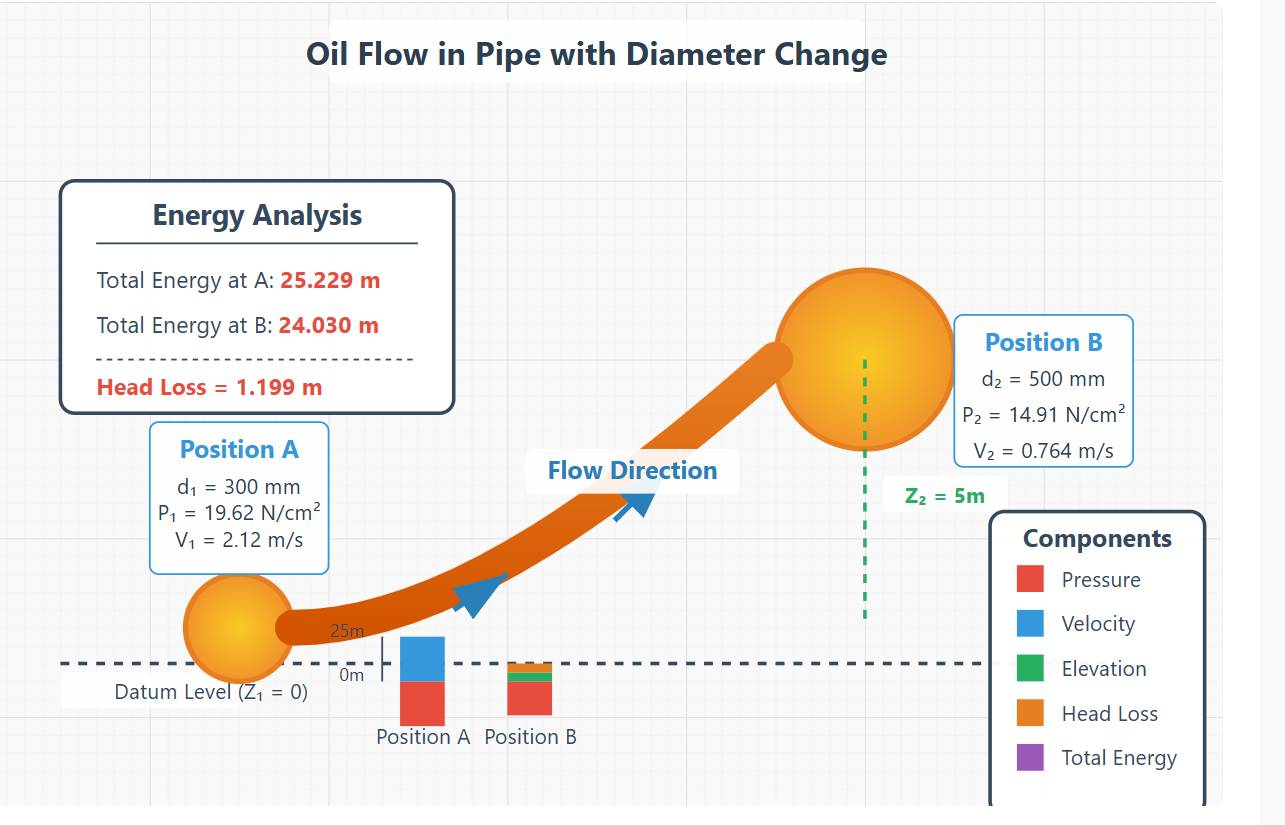
A pipe line carrying oil of sp.gr. 0.8, changes in diameter from 300mm at a position A to 500mm at position B which is 5m at a higher level. If the pressures at A and B are 19.62 N/cm2 and 14.91 N/cm2 respectively, and the discharge is 150 lps, determine the loss of head and the direction of flow.

A pipe line carrying oil of sp.gr. 0.8, changes in diameter from 300mm at a position A to 500mm at position B which is 5m at a higher level. If the pressures at A and B are 19.62 N/cm2 and 14.91 N/cm2 respectively, and the discharge is 150 lps, determine the loss of head and the direction of flow.

Oil Flow in a Pipe with Diameter Change Oil Flow Analysis in a Pipe with Diameter Change Problem Statement A

A pipe line carrying oil of sp.gr. 0.8, changes in diameter from 300mm at a position A to 500mm at position B which is 5m at a higher level. If the pressures at A and B are 19.62 N/cm2 and 14.91 N/cm2 respectively, and the discharge is 150 lps, determine the loss of head and the direction of flow. Read More »

The water is flowing through a taper pipe of length 50m having diameters 40cm at the upper end and 20cm at the lower end, at the rate of 60 lps. The pipe has a slope of 1 in 40. Find the pressure at the lower end if the pressure at the higher level is 24.525 N/cm2 (a) assuming no loss of energy (b) a loss of 0.2m.

The water is flowing through a taper pipe of length 50m having diameters 40cm at the upper end and 20cm at the lower end, at the rate of 60 lps. The pipe has a slope of 1 in 40. Find the pressure at the lower end if the pressure at the higher level is 24.525 N/cm2 (a) assuming no loss of energy (b) a loss of 0.2m.

Pressure Calculation in Tapered Pipe Flow Pressure Calculation in Tapered Pipe with Energy Considerations Problem Statement The water is flowing

The water is flowing through a taper pipe of length 50m having diameters 40cm at the upper end and 20cm at the lower end, at the rate of 60 lps. The pipe has a slope of 1 in 40. Find the pressure at the lower end if the pressure at the higher level is 24.525 N/cm2 (a) assuming no loss of energy (b) a loss of 0.2m. Read More »

Scroll to Top