Fluid Dynamics

A 2.5m long pipeline tapers uniformly from 10cm diameter to 20cm diameter at its upper end. The pipe centerline slopes upwards at an angle of 300 to the horizontal and the flow direction is from smaller to bigger cross-section. If the pressure at lower and upper ends of the pipe are 2bar and 2.4bar respectively, determine the flow rate and the pressure at the mid-length of the pipeline. Assume no energy losses

A 2.5m long pipeline tapers uniformly from 10cm diameter to 20cm diameter at its upper end. The pipe centerline slopes upwards at an angle of 300 to the horizontal and the flow direction is from smaller to bigger cross-section. If the pressure at lower and upper ends of the pipe are 2bar and 2.4bar respectively, determine the flow rate and the pressure at the mid-length of the pipeline. Assume no energy losses.

Tapered Pipeline Analysis Analysis of Tapered Pipeline with Upward Slope Problem Statement A 2.5m long pipeline tapers uniformly from 10cm […]
A 2.5m long pipeline tapers uniformly from 10cm diameter to 20cm diameter at its upper end. The pipe centerline slopes upwards at an angle of 300 to the horizontal and the flow direction is from smaller to bigger cross-section. If the pressure at lower and upper ends of the pipe are 2bar and 2.4bar respectively, determine the flow rate and the pressure at the mid-length of the pipeline. Assume no energy losses. Read More »

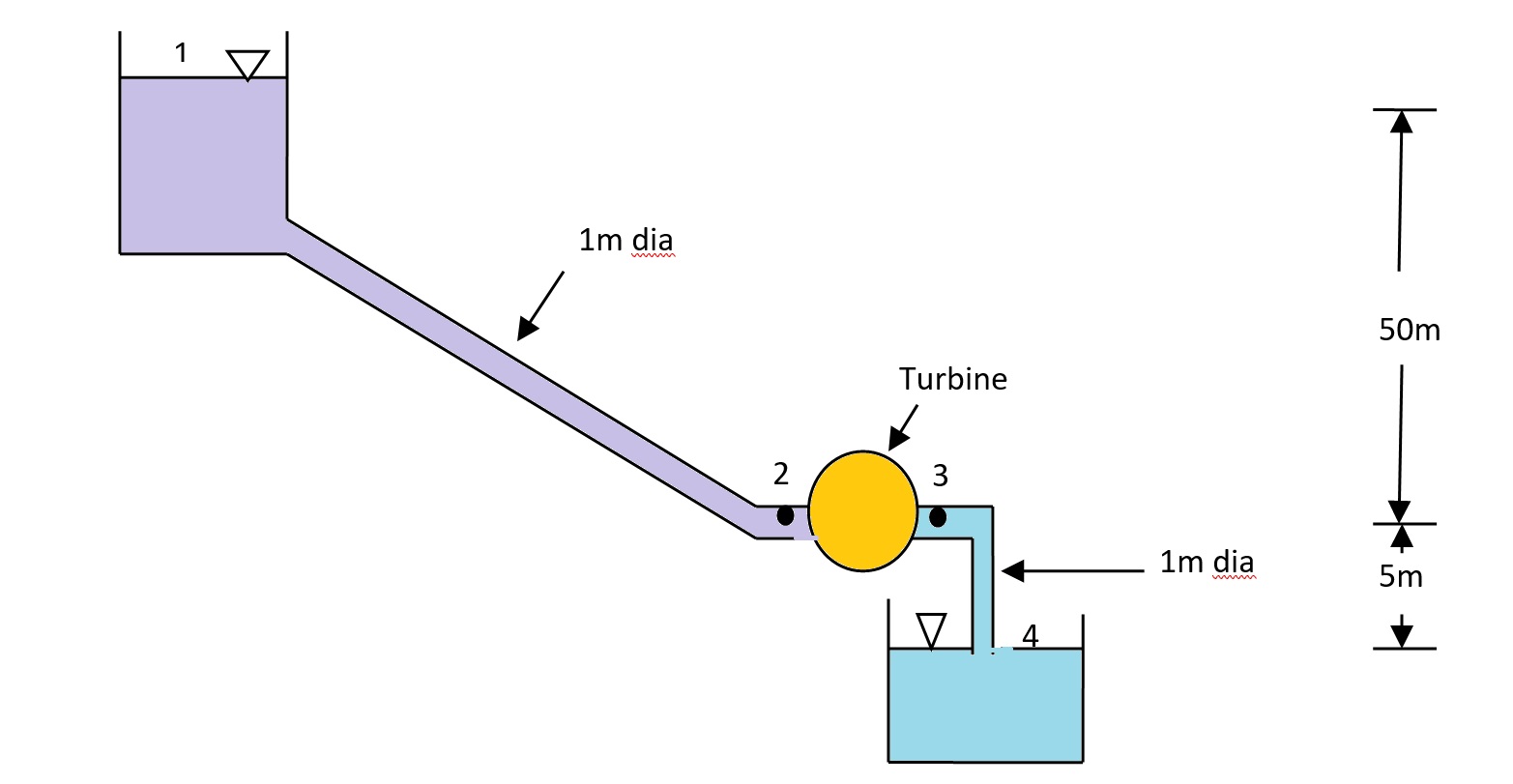
The figure below shows a pipe connecting a reservoir to a turbine which discharges water to the tailrace through another pipe. The head loss between the reservoir and the turbine is 8 times kinetic head in the pipe and that from the turbine to tailrace is 0.4 times the kinetic head in the pipe. The rate of flow is 1.36m3/s and the pipe diameter in both cases is 1m. Determine (a) the pressure at inlet and exit of turbine, and (b) the power generated by the turbine.

The figure below shows a pipe connecting a reservoir to a turbine which discharges water to the tailrace through another pipe. The head loss between the reservoir and the turbine is 8 times kinetic head in the pipe and that from the turbine to tailrace is 0.4 times the kinetic head in the pipe. The rate of flow is 1.36m3/s and the pipe diameter in both cases is 1m. Determine (a) the pressure at inlet and exit of turbine, and (b) the power generated by the turbine.

Turbine System Analysis Analysis of Turbine System with Reservoir and Tailrace Problem Statement A pipe connects a reservoir to a

The figure below shows a pipe connecting a reservoir to a turbine which discharges water to the tailrace through another pipe. The head loss between the reservoir and the turbine is 8 times kinetic head in the pipe and that from the turbine to tailrace is 0.4 times the kinetic head in the pipe. The rate of flow is 1.36m3/s and the pipe diameter in both cases is 1m. Determine (a) the pressure at inlet and exit of turbine, and (b) the power generated by the turbine. Read More »

The figure below shows a pump P pumping 90 lps of water from a tank. (a) What will be the pressure at points B and C when the pump delivers 14.5KW of power to the flow? Assume the losses in the system to be negligible. (b) What will be the pressure at C when the loss in the in the inlet to the pump is negligible and between the pump and the point C, a loss equal to 2 times the velocity head at B takes place.

The figure below shows a pump P pumping 90 lps of water from a tank. (a) What will be the pressure at points B and C when the pump delivers 14.5KW of power to the flow? Assume the losses in the system to be negligible. (b) What will be the pressure at C when the loss in the in the inlet to the pump is negligible and between the pump and the point C, a loss equal to 2 times the velocity head at B takes place.

Pump System Analysis Analysis of Pump System with 90 LPS Water Flow Problem Statement A pump P is pumping 90

The figure below shows a pump P pumping 90 lps of water from a tank. (a) What will be the pressure at points B and C when the pump delivers 14.5KW of power to the flow? Assume the losses in the system to be negligible. (b) What will be the pressure at C when the loss in the in the inlet to the pump is negligible and between the pump and the point C, a loss equal to 2 times the velocity head at B takes place. Read More »

The head extracted by turbine CR in the fig. is 60m and the pressure at T is 505 KN/m2. For losses of 2V22/2g between W and R and 3V12/2g between C and T, determine (a) how much water is flowing and (b) the pressure head at R. Draw the energy gradient line and hydraulic gradient line.

The head extracted by turbine CR in the fig. is 60m and the pressure at T is 505 KN/m2.  For losses of 2V2/2g between W and R and 3V2/2g between C and T, determine (a) how much water is flowing and (b) the pressure head at R. Draw the energy gradient line and hydraulic gradient line.

Turbine Flow Analysis and Gradient Lines Problem Statement The head extracted by turbine CR in the figure is 60m and

The head extracted by turbine CR in the fig. is 60m and the pressure at T is 505 KN/m2.  For losses of 2V2/2g between W and R and 3V2/2g between C and T, determine (a) how much water is flowing and (b) the pressure head at R. Draw the energy gradient line and hydraulic gradient line. Read More »

The pipe flow in the figure is driven by a pump. Determine the gauge pressure that must be supplied by the pump to provide a water flow rate of Q = 60 m³/h. Neglect the head loss from A to B. The head loss from C to D is given by 30(VCD²)/(2g) and from D to E by 20(VCD²)/(2g). The diameters are: dAB = dCD = 5 cm and dDE = 2 cm. (VCD is the velocity in pipe CD.)

The pipe flow in the figure is driven by the pump. What gauge pressure is needed to be supplied by the pump to provide water flow rate of Q = 60m3/h? Neglect head loss from A to B. Head loss from C to D = 30 (V_CD^2)/2g; Head loss from D to E = 20 (V_CD^2)/2g; dAB (diameter of pipe AB) = dCD = 5cm; dDE = 2cm. where VCD = velocity in pipe CD and VDE = velocity in pipe DE.

Determining Pump Gauge Pressure for Given Flow Rate Problem Statement The pipe flow in the figure is driven by the

The pipe flow in the figure is driven by the pump. What gauge pressure is needed to be supplied by the pump to provide water flow rate of Q = 60m3/h? Neglect head loss from A to B. Head loss from C to D = 30 (V_CD^2)/2g; Head loss from D to E = 20 (V_CD^2)/2g; dAB (diameter of pipe AB) = dCD = 5cm; dDE = 2cm. where VCD = velocity in pipe CD and VDE = velocity in pipe DE. Read More »

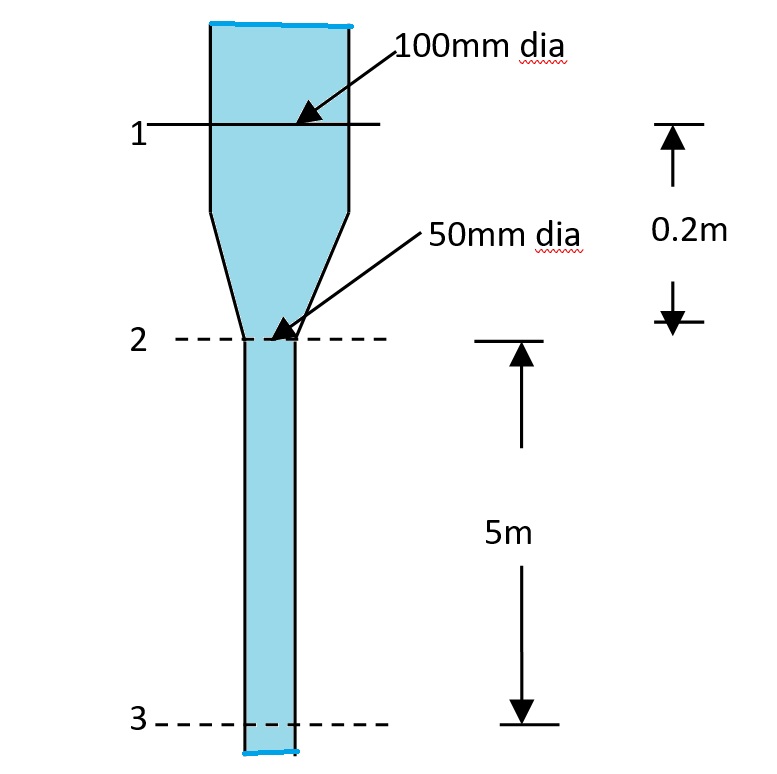
A jet of water coming out from 50mm diameter rounded nozzle attached to 100mm diameter pipe is directed vertically downwards. If the pressure in the 100mm diameter pipe 0.2m above the nozzle is 200 Kpa gauge, determine the diameter of jet 5m below the nozzle level.

A jet of water coming out from 50mm diameter rounded nozzle attached to 100mm diameter pipe is directed vertically downwards. If the pressure in the 100mm diameter pipe 0.2m above the nozzle is 200 Kpa gauge, determine the diameter of jet 5m below the nozzle level.

Determination of Jet Diameter 5m Below the Nozzle Problem Statement A jet of water is coming out from a 50mm

A jet of water coming out from 50mm diameter rounded nozzle attached to 100mm diameter pipe is directed vertically downwards. If the pressure in the 100mm diameter pipe 0.2m above the nozzle is 200 Kpa gauge, determine the diameter of jet 5m below the nozzle level. Read More »

The pipe flow in the figure is driven by a pump. Determine the gauge pressure that must be supplied by the pump to provide a water flow rate of Q = 60 m³/h. Neglect the head loss from A to B. The head loss from C to D is given by 30(VCD²)/(2g) and from D to E by 20(VCD²)/(2g). The diameters are: dAB = dCD = 5 cm and dDE = 2 cm. (VCD is the velocity in pipe CD.)

The pipe flow in the figure is driven by a pump. Determine the gauge pressure that must be supplied by the pump to provide a water flow rate of Q = 60 m³/h. Neglect the head loss from A to B. The head loss from C to D is given by 30(VCD²)/(2g) and from D to E by 20(VCD²)/(2g). The diameters are: dAB = dCD = 5 cm and dDE = 2 cm. (VCD is the velocity in pipe CD.)

Required Pump Gauge Pressure for a Pipe Flow System Required Pump Gauge Pressure for a Pipe Flow System Problem Statement

The pipe flow in the figure is driven by a pump. Determine the gauge pressure that must be supplied by the pump to provide a water flow rate of Q = 60 m³/h. Neglect the head loss from A to B. The head loss from C to D is given by 30(VCD²)/(2g) and from D to E by 20(VCD²)/(2g). The diameters are: dAB = dCD = 5 cm and dDE = 2 cm. (VCD is the velocity in pipe CD.) Read More »

A jet of water issues vertically upwards from 0.2m high nozzle whose inlet and outlet diameters are 100mm and 40mm respectively. If the pressure at the inlet is 20 Kpa above the atmospheric pressure, determine the discharge and the height to which the jet will rise. Assume no friction.

A jet of water issues vertically upwards from 0.2m high nozzle whose inlet and outlet diameters are 100mm and 40mm respectively. If the pressure at the inlet is 20 Kpa above the atmospheric pressure, determine the discharge and the height to which the jet will rise. Assume no friction.

Discharge and Jet Height from a Nozzle Discharge and Jet Height from a Nozzle Problem Statement A jet of water

A jet of water issues vertically upwards from 0.2m high nozzle whose inlet and outlet diameters are 100mm and 40mm respectively. If the pressure at the inlet is 20 Kpa above the atmospheric pressure, determine the discharge and the height to which the jet will rise. Assume no friction. Read More »

Water is pumped from a reservoir through 150mm diameter pipe and is delivered at a height of 15m from the centerline of pump through a 100mm nozzle connected to 150mm discharge line as shown in the figure. If the pressure at the pump inlet is 210 KN/m2 absolute, inlet velocity of 5m/s and the jet is discharged into atmosphere, determine the energy supplied by the pump. Take atmospheric pressure = 101.3 KN/m2 and assume no friction.

Water is pumped from a reservoir through 150mm diameter pipe and is delivered at a height of 15m from the centerline of pump through a 100mm nozzle connected to 150mm discharge line as shown in the figure. If the pressure at the pump inlet is 210 KN/m2 absolute, inlet velocity of 5m/s and the jet is discharged into atmosphere, determine the energy supplied by the pump. Take atmospheric pressure = 101.3 KN/m2 and assume no friction.

Energy Supplied by the Pump in a Reservoir-Pipe-Nozzle System Energy Supplied by the Pump in a Reservoir-Pipe-Nozzle System Problem Statement

Water is pumped from a reservoir through 150mm diameter pipe and is delivered at a height of 15m from the centerline of pump through a 100mm nozzle connected to 150mm discharge line as shown in the figure. If the pressure at the pump inlet is 210 KN/m2 absolute, inlet velocity of 5m/s and the jet is discharged into atmosphere, determine the energy supplied by the pump. Take atmospheric pressure = 101.3 KN/m2 and assume no friction. Read More »

A 15cm diameter pipe is expanded to 25cm diameter suddenly at a section. The head loss at a sudden expansion from section 1 to 2 is given by hL = (V1-V2)2/2g.  For a discharge of 45 lps, calculate the manometer reading h.

A 15cm diameter pipe is expanded to 25cm diameter suddenly at a section. The head loss at a sudden expansion from section 1 to 2 is given by hL = (V1-V2)2/2g.  For a discharge of 45 lps, calculate the manometer reading h.

Manometer Reading in a Sudden Pipe Expansion Manometer Reading in a Sudden Expansion of a Pipe Problem Statement A 15

A 15cm diameter pipe is expanded to 25cm diameter suddenly at a section. The head loss at a sudden expansion from section 1 to 2 is given by hL = (V1-V2)2/2g.  For a discharge of 45 lps, calculate the manometer reading h. Read More »

A pipeline connected to a reservoir discharges water to the atmosphere. The loss of head is 1 times velocity head from A to B, 1.5 times velocity head from B to C and 0.5 times velocity head from C to D. If the pipe is 150mm in diameter, calculate the pressure heads at B and C. Also compute discharge.

A pipeline connected to a reservoir discharges water to the atmosphere. The loss of head is 1 times velocity head from A to B, 1.5 times velocity head from B to C and 0.5 times velocity head from C to D. If the pipe is 150mm in diameter, calculate the pressure heads at B and C. Also compute discharge.

Pipeline Discharge and Pressure Head Calculation Pipeline Discharge and Pressure Head Calculation Problem Statement A pipeline connected to a reservoir

A pipeline connected to a reservoir discharges water to the atmosphere. The loss of head is 1 times velocity head from A to B, 1.5 times velocity head from B to C and 0.5 times velocity head from C to D. If the pipe is 150mm in diameter, calculate the pressure heads at B and C. Also compute discharge. Read More »

Scroll to Top