Numerical (Water)

What is the bulk modulus of elasticity of a liquid which is compressed in a cylinder from a volume of 0.0125 m3 at 80 N/cm2 pressure to a volume of 0.0124 m3 at 150 N/cm2 pressure ?

Bulk Modulus of Elasticity Calculation Problem Statement What is the bulk modulus of elasticity of a liquid which is compressed

What is the bulk modulus of elasticity of a liquid which is compressed in a cylinder from a volume of 0.0125 m3 at 80 N/cm2 pressure to a volume of 0.0124 m3 at 150 N/cm2 pressure ? Read More »

Determine the bulk modulus of elasticity of a liquid if the pressure of the liquid is increased from 70 N/cm² to 130 N/cm². The volume of the liquid decreases by 0.15 percent.

Bulk Modulus of Elasticity Calculation Problem Statement Determine the bulk modulus of elasticity of a liquid if the pressure of

Determine the bulk modulus of elasticity of a liquid if the pressure of the liquid is increased from 70 N/cm² to 130 N/cm². The volume of the liquid decreases by 0.15 percent. Read More »

Calculate the pressure exerted by 5 kg of nitrogen gas at a temperature of 10°C if the volume is 0.4 m3. Molecular weight of nitrogen is 28. Assume, ideal gas laws are applicable.

Pressure of Nitrogen Gas Calculation Problem Statement Calculate the pressure exerted by 5 kg of nitrogen gas at a temperature

Calculate the pressure exerted by 5 kg of nitrogen gas at a temperature of 10°C if the volume is 0.4 m3. Molecular weight of nitrogen is 28. Assume, ideal gas laws are applicable. Read More »

A cylinder of 0.6 m3 in volume contains air at 50°C and 0.3 N/mm absolute pressure. The air is compressed to 0.3 m. Find (i) pressure inside the cylinder assuming isothermal process and (ii) pressure and temperature assuming adiabatic process. 

Air Compression Analysis (Isothermal & Adiabatic) Problem Statement A cylinder of 0.6 m(^3) in volume contains air at 50°C and

A cylinder of 0.6 m3 in volume contains air at 50°C and 0.3 N/mm absolute pressure. The air is compressed to 0.3 m. Find (i) pressure inside the cylinder assuming isothermal process and (ii) pressure and temperature assuming adiabatic process.  Read More »

A vertical gap 2.2 cm wide of infinite extent contains a fluid of viscosity 2.0 N s/m² and specific gravity 0.9. A metallic plate 1.2 m × 1.2 m × 0.2 cm is to be lifted up with a constant velocity of 0.15 m/s through the gap. If the plate is in the middle of the gap, find the force required. The weight of the plate is 40 N.

Force to Lift a Plate in Viscous Fluid Problem Statement A vertical gap 2.2 cm wide of infinite extent contains

A vertical gap 2.2 cm wide of infinite extent contains a fluid of viscosity 2.0 N s/m² and specific gravity 0.9. A metallic plate 1.2 m × 1.2 m × 0.2 cm is to be lifted up with a constant velocity of 0.15 m/s through the gap. If the plate is in the middle of the gap, find the force required. The weight of the plate is 40 N. Read More »

Two large plane surfaces are 2.4 cm apart. The space between the surfaces is filled with glycerine. What force is required to drag a very thin plate of surface area 0.5 square metre between the two large plane surfaces at a speed of 0.6 m/s,

Force Required to Drag a Plate in Glycerine Problem Statement Two large plane surfaces are 2.4 cm apart. The space

Two large plane surfaces are 2.4 cm apart. The space between the surfaces is filled with glycerine. What force is required to drag a very thin plate of surface area 0.5 square metre between the two large plane surfaces at a speed of 0.6 m/s, Read More »

A Newtonian fluid is filled in the clearance between a shaft and a concentric sleeve. The sleeve attains a speed of 50 cm/s when a force of 40 N is applied to the sleeve parallel to the shaft. Determine the speed if a force of 200 N is applied.

Newtonian Fluid Analysis Problem Statement A Newtonian fluid is filled in the clearance between a shaft and a concentric sleeve.

A Newtonian fluid is filled in the clearance between a shaft and a concentric sleeve. The sleeve attains a speed of 50 cm/s when a force of 40 N is applied to the sleeve parallel to the shaft. Determine the speed if a force of 200 N is applied. Read More »

A 15 cm diameter vertical cylinder rotates concentrically inside another cylinder of diameter 15.10 cm. Both cylinders are 25 cm high. The space between the cylinders is filled with a liquid of unknown viscosity. If a torque of 12.0 Nm is required to rotate the inner cylinder at 100 rpm, determine the viscosity of the fluid.

Viscosity Determination in Concentric Cylinders Problem Statement A 15 cm diameter vertical cylinder rotates concentrically inside another cylinder of diameter

A 15 cm diameter vertical cylinder rotates concentrically inside another cylinder of diameter 15.10 cm. Both cylinders are 25 cm high. The space between the cylinders is filled with a liquid of unknown viscosity. If a torque of 12.0 Nm is required to rotate the inner cylinder at 100 rpm, determine the viscosity of the fluid. Read More »

If the velocity profile of a fluid over a plate is parabolic with the vertex 20 cm from the plate, where the velocity is 120 cm/sec. Calculate the velocity gradients and shear stresses at distances of 0, 10 and 20 cm from the plate, if the viscosity of the fluid is 8.5 poise.

If the velocity profile of a fluid over a plate is parabolic with the vertex 20 cm from the plate, where the velocity is 120 cm/sec. Calculate the velocity gradients and shear stresses at distances of 0, 10 and 20 cm from the plate, if the viscosity of the fluid is 8.5 poise.

Fluid Velocity Profile Analysis Problem Statement If the velocity profile of a fluid over a plate is parabolic with the
If the velocity profile of a fluid over a plate is parabolic with the vertex 20 cm from the plate, where the velocity is 120 cm/sec. Calculate the velocity gradients and shear stresses at distances of 0, 10 and 20 cm from the plate, if the viscosity of the fluid is 8.5 poise. Read More »

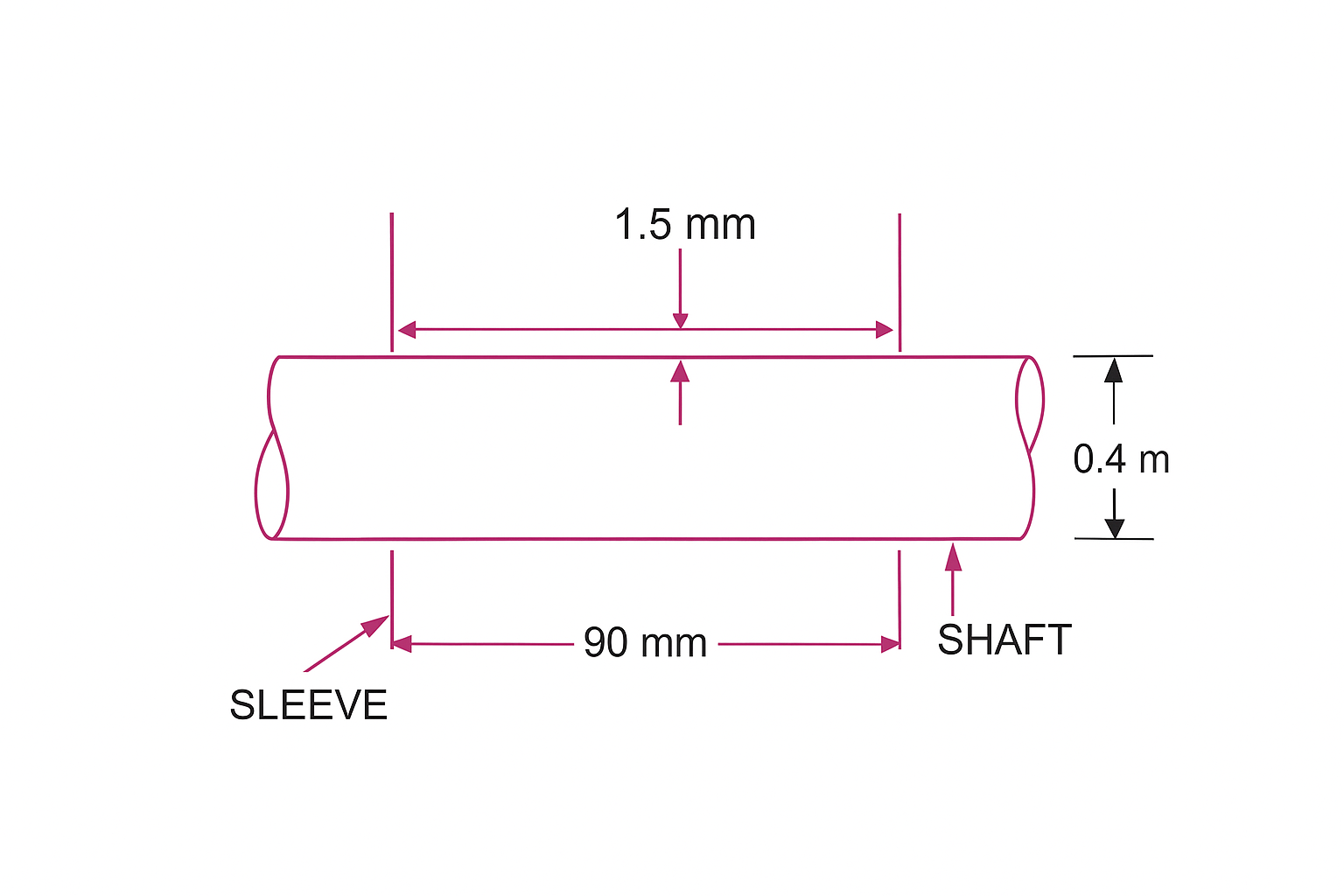
The dynamic viscosity of oil used for lubrication between a shaft and sleeve is 6 poise. The shaft has a diameter of 0.4 m and rotates at 190 rpm. Calculate the power lost in the bearing for a sleeve length of 90 mm, given the thickness of the oil film is 1.5 mm.

The dynamic viscosity of oil used for lubrication between a shaft and sleeve is 6 poise. The shaft has a diameter of 0.4 m and rotates at 190 rpm. Calculate the power lost in the bearing for a sleeve length of 90 mm, given the thickness of the oil film is 1.5 mm.

Bearing Power Loss Analysis Power Loss in Bearing Lubrication Analysis Calculating energy dissipation in a rotating shaft bearing due to

The dynamic viscosity of oil used for lubrication between a shaft and sleeve is 6 poise. The shaft has a diameter of 0.4 m and rotates at 190 rpm. Calculate the power lost in the bearing for a sleeve length of 90 mm, given the thickness of the oil film is 1.5 mm. Read More »

Scroll to Top