Problem Statement
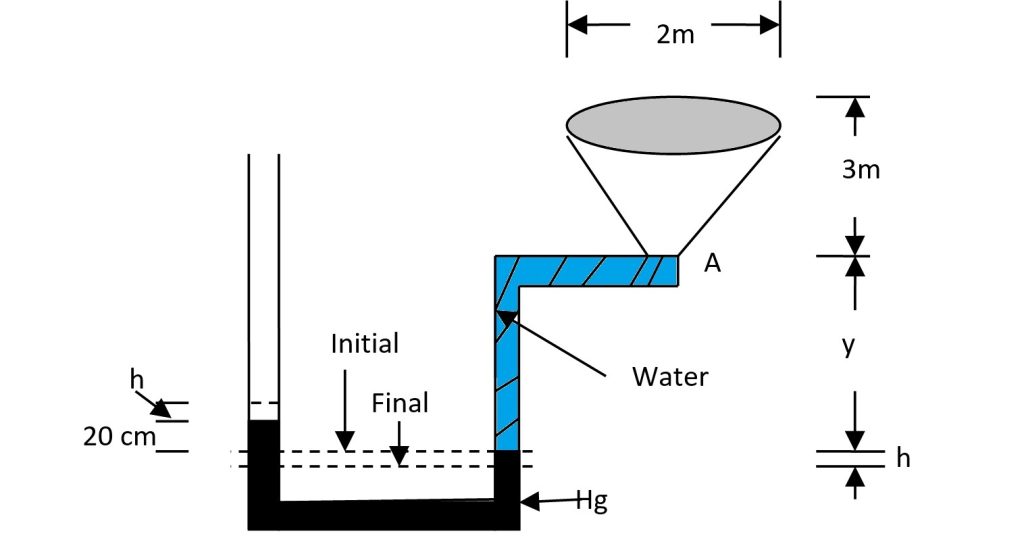
A conical vessel with an outlet at point A is connected to a U-tube manometer. Initial manometer reading is given when the vessel is empty. Find the manometer reading when the vessel is completely filled with water.
Given dimensions:
- Height of conical vessel = 3 m
- Initial mercury column height = 20 cm
Solution
1. Given Data
Specific weight of water:
\(\gamma = 9.81 \, \text{kN/m}^3\)
Specific weight of mercury:
\(\gamma_m = 13.6 \times 9.81 = 133.416 \, \text{kN/m}^3\)
2. Initial Condition (Empty Vessel)
Equating pressure at initial level:
\(9.81y = 133.416 \times 0.2\)
\(y = \frac{133.416 \times 0.2}{9.81}\)
\(y = 2.72 \, \text{m}\)
3. Final Condition (Filled Vessel)
When vessel is filled with water, mercury moves by height h
\(9.81 \times 3 = 133.416h + 9.81(2.72 – h)\)
\(29.43 = 133.416h + 26.68 – 9.81h\)
\(29.43 – 26.68 = 123.606h\)
\(h = 0.1145 \, \text{m}\)
Final manometer deflection:
\(2h + 0.2 = 2 \times 0.1145 + 0.2 = 0.429 \, \text{m}\)
Explanation
- Initial Equilibrium: The water column height (y) balances the mercury column (20 cm) when the vessel is empty.
- Final Equilibrium: When the vessel is filled:
- Water pressure from 3m height in vessel
- Additional mercury displacement (h)
- Reduced water column on the right side
- Total Deflection: The final reading includes both legs of the U-tube (2h) plus the initial mercury column (0.2 m).