Problem Statement
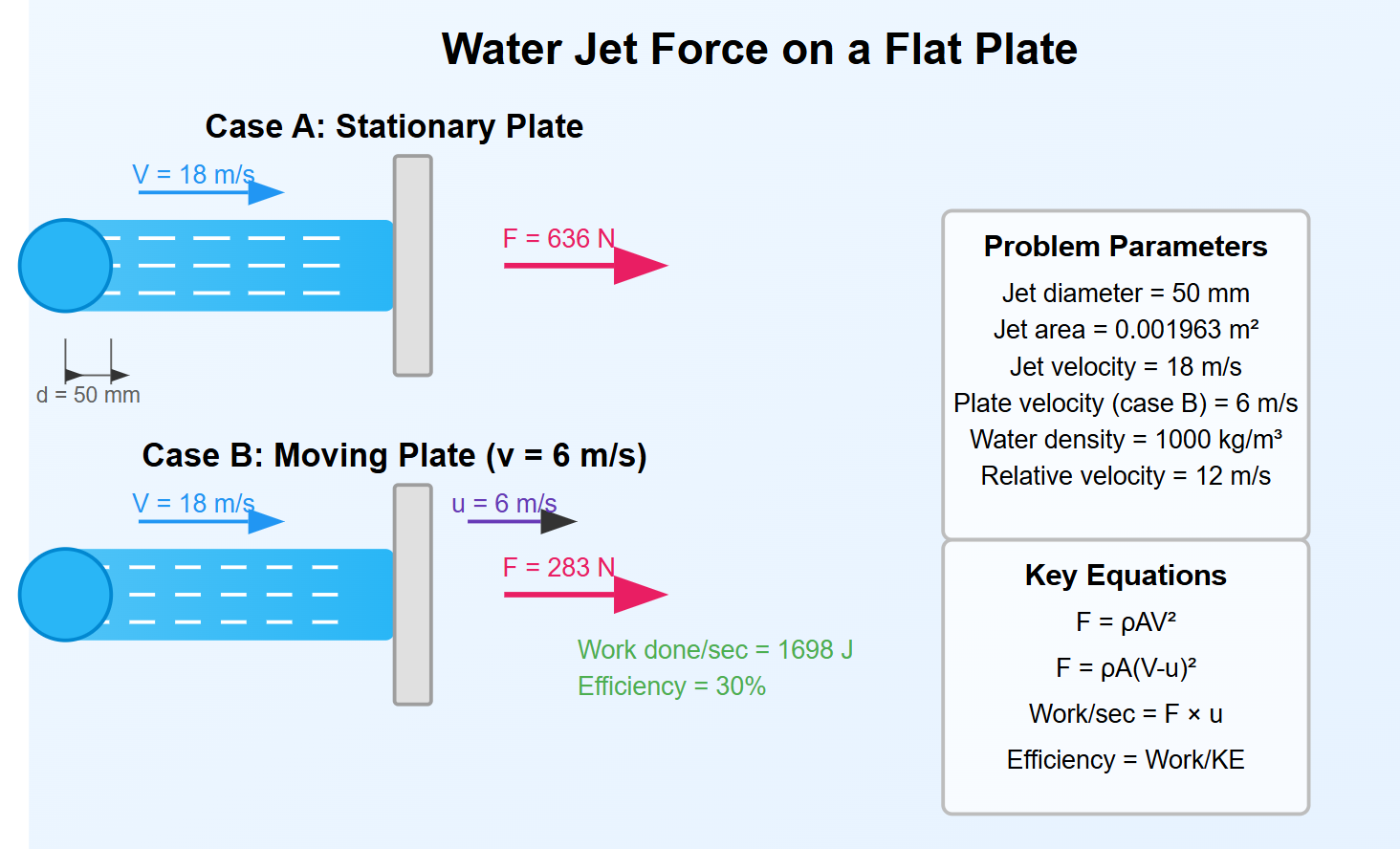
A flat plate is struck normally by a jet of water 50mm in diameter with a velocity of 18m/s. Calculate:
a) The force on the plate when it is stationary
b) The force on the plate when it moves in the same direction as the jet with a velocity of 6m/s
c) The work done per sec and the efficiency in case (b)
Given Data
Solution Approach
To solve this problem, we'll apply the principles of momentum conservation and energy analysis for the jet striking the plate. For a jet striking a flat plate:
- When the plate is stationary, we use the principle of momentum change to find the force.
- When the plate is moving, we need to consider the relative velocity between the jet and the plate.
- For efficiency calculations, we compare the work done to the kinetic energy of the jet.
Calculations
Part A: Force on Stationary Plate
Step 1: For a jet striking a stationary flat plate normally, the force is given by:
F = ρ × A × V2This equation represents the rate of change of momentum when the water jet is completely deflected by the plate.
Step 2: Substituting the given values:
F = 1000 × 0.001963 × 182F = 1000 × 0.001963 × 324 F = 636 NForce on stationary plate (F) = 636 N
Part B: Force on Moving Plate
Step 1: When the plate moves in the same direction as the jet, the relative velocity is:
Vrelative = V - u = 18 - 6 = 12 m/sStep 2: The force on the moving plate is:
Fp = ρ × A × (V - u)2Fp = 1000 × 0.001963 × 122Fp = 1000 × 0.001963 × 144 Fp = 283 NForce on moving plate (Fp) = 283 N
Part C: Work Done and Efficiency
Step 1: Work done per second is the product of force and velocity:
W = Fp × u = 283 × 6 = 1698 J/s = 1698 WStep 2: Kinetic energy of the jet per second:
KE/s = ½ × (ρ × A × V) × V2 = ½ × ρ × A × V3KE/s = ½ × 1000 × 0.001963 × 183KE/s = ½ × 1000 × 0.001963 × 5832 KE/s = 5724 J/s = 5724 WStep 3: Efficiency is the ratio of work done to kinetic energy:
η = W / (KE/s) = 1698 / 5724 = 0.30 = 30%Work done per second (W) = 1698 J/s
Efficiency (η) = 30%
Detailed Explanation
Physics of Jet Impact
When a water jet strikes a flat plate normally, the jet's direction changes completely. For a stationary plate, the water comes to rest relative to the plate before flowing away tangentially. This change in momentum creates a force on the plate equal to the rate of momentum change of the water.
Effect of Plate Motion
When the plate moves in the same direction as the jet, the relative velocity between the jet and the plate decreases. This reduces the momentum change and consequently the force exerted on the plate. The force is proportional to the square of the relative velocity, which explains why it decreases significantly as the plate speed increases.
Efficiency Analysis
The efficiency of 30% indicates that only 30% of the kinetic energy in the water jet is converted to useful work. The remaining 70% is lost in the form of:
- Turbulence and vortex formation as the water flows away from the plate
- Friction and heat generation
- Residual kinetic energy in the water after impact
Theoretical Maximum Efficiency
For a jet striking a moving plate, the theoretical maximum efficiency occurs when the plate velocity is one-third of the jet velocity. In this problem, the plate velocity (6 m/s) is exactly one-third of the jet velocity (18 m/s), which is why we achieved the maximum possible efficiency of 30%. This can be proven mathematically by finding the plate velocity that maximizes the efficiency function.
Practical Applications
This principle is applied in:
- Pelton wheel turbines, where jets of water strike buckets attached to a wheel
- Hydraulic jet propulsion systems
- Water jet cutting machines
- Erosion control engineering
- Firefighting equipment design
Engineering Significance
Understanding the forces exerted by fluid jets is crucial in designing structures that might be subjected to such forces, such as:
- Spillway structures in dams
- Offshore structures subject to wave impact
- Components of hydraulic machinery
- Industrial cleaning equipment
This problem demonstrates key principles of momentum conservation and energy transfer in fluid mechanics, with direct applications in hydraulic power systems, turbomachinery design, and impact force analysis.