
Problem Statement
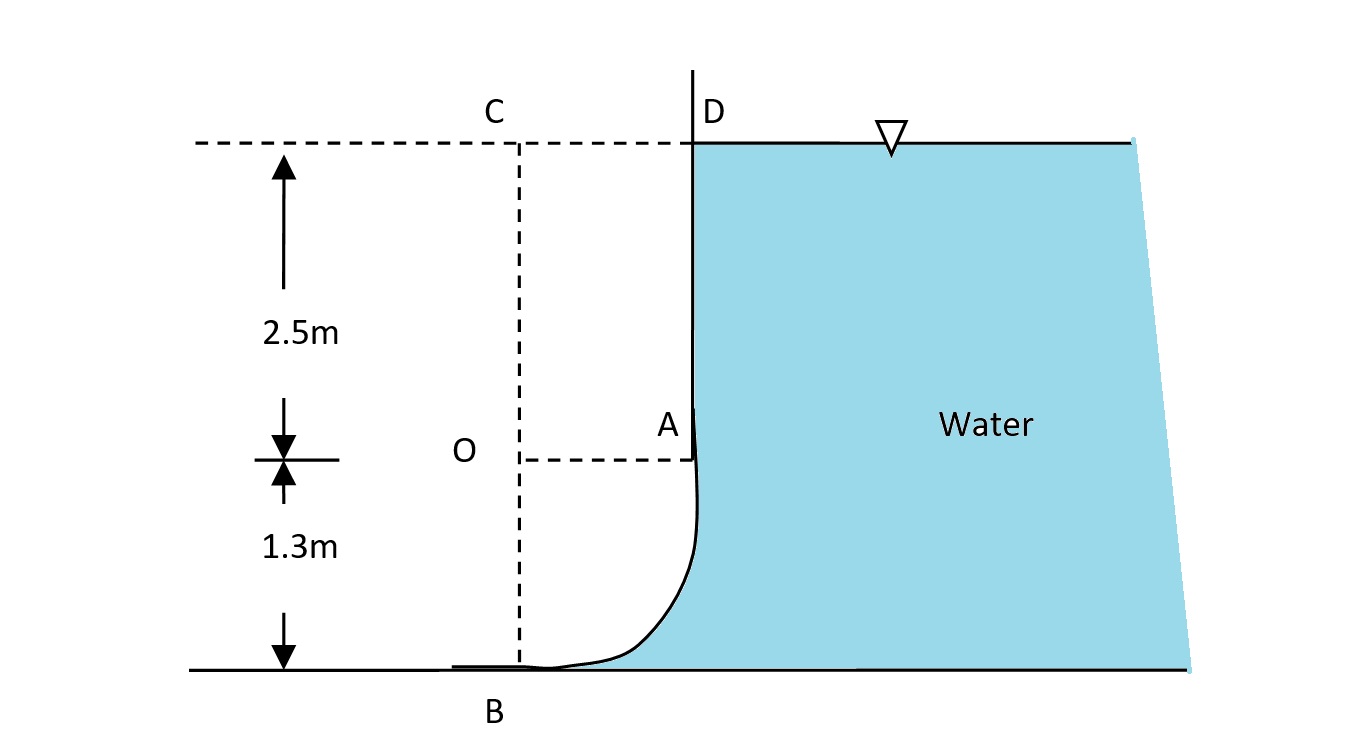
The water is on the right side of the curved surface AB, which is one quarter of a circle of radius 1.3 m. The tank’s length is 2.1 m. Find the horizontal and vertical components of the hydrostatic force acting on the curved surface.
Solution
Horizontal Force
The horizontal force is calculated as:
\( F_H = \gamma \cdot A \cdot \bar{y} \) \( F_H = 9810 \times (1.3 \times 2.1) \times (2.5 + \frac{1.3}{2}) \) \( F_H = 84361 \, \text{N} = 84.361 \, \text{kN} \) (right)Vertical Force
The vertical force is equal to the weight of the imaginary volume of water vertically above AB:
\( F_V = \gamma \cdot [ \text{Volume}_{AOB} + \text{Volume}_{AOCD} ] \)Calculating the volumes:
\( F_V = 9810 \times \left[ \left( \frac{\pi \times 1.3^2}{4} \right) \times 2.1 + (2.5 \times 1.3 \times 2.1) \right] \) \( F_V = 94297 \, \text{N} = 94.297 \, \text{kN} \) (downward)Results:
- Horizontal Force: \( F_H = 84.361 \, \text{kN} \) (right)
- Vertical Force: \( F_V = 94.297 \, \text{kN} \) (downward)
Explanation
- Horizontal Force: The horizontal component of the hydrostatic force is due to the projected area of the curved surface and acts at the center of pressure.
- Vertical Force: The vertical component is equivalent to the weight of the water volume directly above the curved surface.
Physical Meaning
This problem demonstrates the decomposition of hydrostatic forces into horizontal and vertical components. Understanding these forces is critical for designing stable structures in contact with fluids, such as dams and curved gates.