
Problem Statement (Civil Services Exam 1991)
A compacted cylindrical soil specimen has:
- Dimensions: 50 mm diameter × 100 mm long
- Water content (\( w \)) = 15%
- Air voids (\( a_c \)) = 20%
- Specific gravity (\( G \)) = 2.69
Calculate the weight of dry soil and water required for preparation.
Solution
1. Calculate Total Volume (\( V \))
\( V = \frac{\pi}{4} \times (5 \, \text{cm})^2 \times 10 \, \text{cm} = 196.35 \, \text{cm}^3 \)
2. Volume Relationships
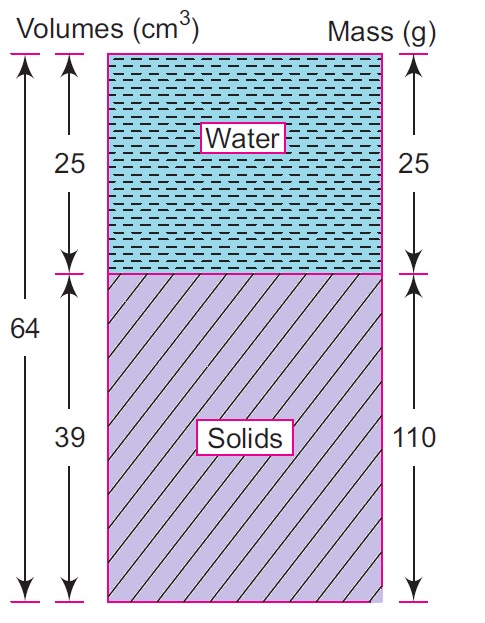
Air voids: \( V_a = 0.20 \times 196.35 = 39.27 \, \text{cm}^3 \)
Water volume: \( V_w = 0.4035 \, V_s \) (from \( w = 15\% \))
Total volume: \( V = V_a + V_w + V_s \)
\( 196.35 = 39.27 + 0.4035V_s + V_s \implies V_s = 111.92 \, \text{cm}^3 \)
3. Calculate Mass of Dry Soil (\( M_d \))
\( M_d = V_s \times G \times \rho_w = 111.92 \times 2.69 \times 1 = 301.1 \, \text{g} \)
4. Calculate Mass of Water (\( M_w \))
\( M_w = 0.15 \times M_d = 0.15 \times 301.1 = 45.2 \, \text{g} \)
Results:
- Dry soil required: \( 301.1 \, \text{g} \)
- Water required: \( 45.2 \, \text{g} \)
Explanation
Key Steps:
- The total volume is partitioned into air, water, and solids.
- Water content (\( w \)) links water mass to dry soil mass.
- Specific gravity (\( G \)) connects dry soil mass to its volume.
Physical Meaning
1. Air Voids (20%):
- Indicates moderate compaction, leaving space for air and water movement.
2. Water Content (15%):
- Optimal moisture for compaction, balancing workability and strength.
Exam Context: Tests understanding of soil phase relationships for engineering applications like embankments or foundations.

This explanation is very well-structured, breaking down the calculations step by step to make the process clear for readers. I particularly appreciate how you’ve included key parameters like water content, air voids, and specific gravity to provide a complete understanding of soil phase relationships. Could you also elaborate on how these calculations can be applied practically in field compaction tests or construction scenarios? It would help bridge the gap between theory and application. Great work overall!