
Problem Statement
Determine the maximum possible voids ratio for a uniformly graded sand of perfectly spherical grains.
Solution
1. Assumptions
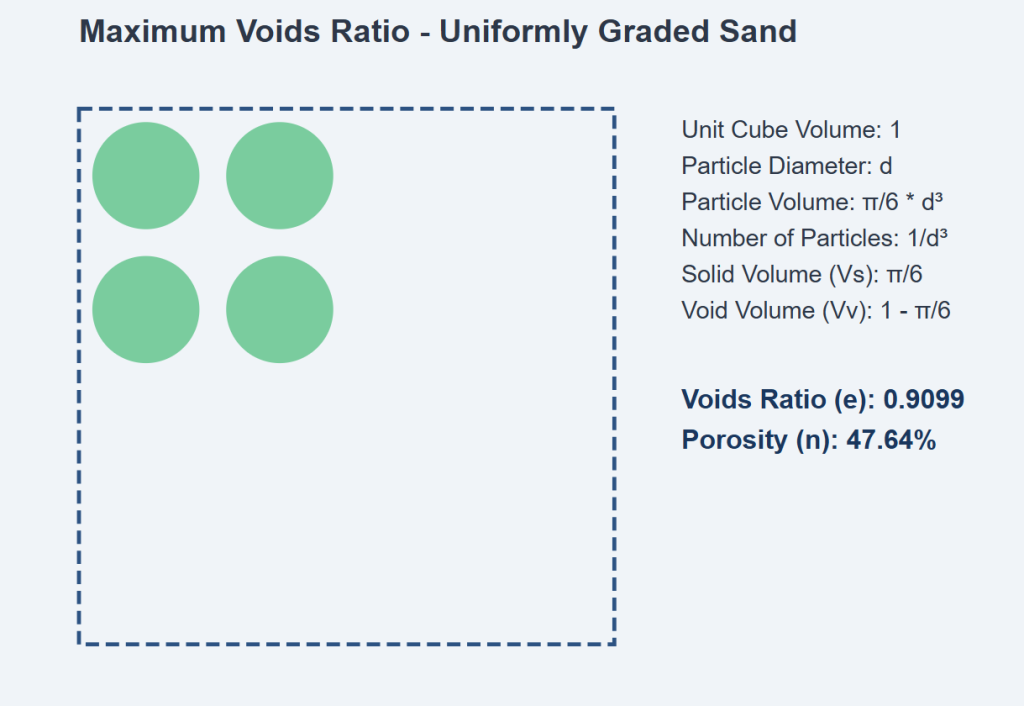
The soil will have the maximum possible voids when its grains are arranged in a cubical array of spheres. Consider a unit cube of soil containing spherical particles of diameter \( d \).
2. Volume Calculations
Volume of each spherical particle:
Total volume of the container (unit cube):
Number of spherical particles in the container:
Total volume of solids (\( V_s \)):
Volume of voids (\( V_v \)):
3. Voids Ratio and Porosity
Voids ratio (\( e \)):
Porosity (\( n \)):
- Maximum voids ratio: \( e \approx 0.9099 \)
- Porosity: \( n \approx 47.64\% \)
Explanation
The maximum voids ratio occurs when spherical grains are arranged in a cubical array, creating the largest possible void spaces. The calculations involve:
- Determining the volume of a single spherical particle.
- Calculating the total volume of solids in a unit cube.
- Finding the volume of voids by subtracting the volume of solids from the total volume.
- Using the voids ratio formula \( e = \frac{V_v}{V_s} \) and porosity formula \( n = \frac{e}{1 + e} \).
Physical Meaning
The voids ratio and porosity are critical measures of soil structure. A high voids ratio indicates a loose arrangement of particles, which is common in uniformly graded sands with spherical grains. This arrangement affects permeability, compressibility, and shear strength, making it essential for geotechnical engineering applications.
