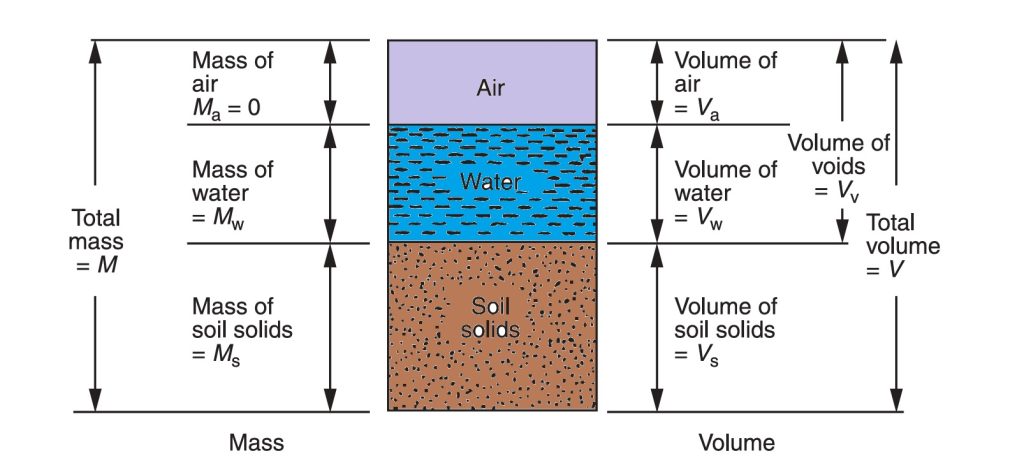
Problem Statement
A moist soil sample has the following properties:
- Mass = 633 g
- Volume = 300 cm³
- Water content (\( w \)) = 11%
- Specific gravity (\( G \)) = 2.68
Determine:
- Void ratio (\( e \))
- Degree of saturation (\( S \))
- Air content (\( n_a \))
- Water content at full saturation (\( w_{\text{sat}} \))
- Unit weight at saturation (\( \gamma_{\text{sat}} \))
Solution
1. Calculate Dry Mass and Water Mass
\( M_{\text{total}} = M_s + M_w = 633 \, \text{g} \)
\( M_s = \frac{633}{1 + 0.11} = 570.27 \, \text{g} \)
\( M_w = 633 – 570.27 = 62.73 \, \text{g} \)
2. Calculate Void Ratio (\( e \))
\( V_v = V_{\text{total}} – V_s = 300 – 212.79 = 87.21 \, \text{cm}^3 \)
\( e = \frac{V_v}{V_s} = \frac{87.21}{212.79} = 0.41 \)
3. Calculate Degree of Saturation (\( S \))
\( S = \frac{V_w}{V_v} \times 100 = \frac{62.73}{87.21} \times 100 = 71.9\% \)
4. Calculate Air Content (\( n_a \))
5. Water Content at Full Saturation (\( w_{\text{sat}} \))
6. Unit Weight at Saturation (\( \gamma_{\text{sat}} \))
- Void ratio (\( e \)) = 0.41
- Degree of saturation (\( S \)) = 71.9%
- Air content (\( n_a \)) = 8.16%
- Water content at full saturation (\( w_{\text{sat}} \)) = 15.3%
- Unit weight at saturation (\( \gamma_{\text{sat}} \)) = 21.5 kN/m³
Explanation
1. Void Ratio (\( e \)):
The void ratio of 0.41 indicates a moderately dense soil structure. This value is calculated by dividing the volume of voids (\( V_v \)) by the volume of solids (\( V_s \)). A lower void ratio typically suggests better compaction and higher soil strength.
2. Degree of Saturation (\( S \)):
The degree of saturation of 71.9% means that 71.9% of the voids are filled with water. This partial saturation indicates that the soil is not fully saturated, and there is still room for additional water absorption without changing the total volume.
3. Air Content (\( n_a \)):
The air content of 8.16% represents the proportion of the total volume occupied by air. This value is derived by subtracting the volume of water from the total void volume and then dividing by the total volume.
4. Water Content at Full Saturation (\( w_{\text{sat}} \)):
The water content required to fully saturate the soil without increasing its volume is 15.3%. This is calculated using the relationship between void ratio and specific gravity.
5. Unit Weight at Saturation (\( \gamma_{\text{sat}} \)):
The unit weight at saturation is 21.5 kN/m³, which represents the total weight of the soil (solids + water) per unit volume when all voids are filled with water.
Physical Meaning
1. Void Ratio and Soil Structure:
A void ratio of 0.41 suggests that the soil has a moderate amount of pore space. This is typical for soils that have been compacted but still retain some porosity. The void ratio directly affects the soil’s compressibility and permeability.
2. Degree of Saturation and Water Retention:
A degree of saturation of 71.9% indicates that the soil is partially saturated. This means that the soil can still absorb additional water, which is important for understanding its behavior under wet conditions. Partial saturation also affects the soil’s shear strength and stability.
3. Air Content and Compaction:
The air content of 8.16% shows that there is still some air trapped in the soil. This air can be expelled with further compaction or water addition, leading to increased density and strength.
4. Water Content at Full Saturation:
The water content required for full saturation (15.3%) is a critical parameter for understanding the soil’s water-holding capacity. It helps in designing drainage systems and predicting the soil’s behavior under saturated conditions.
5. Unit Weight at Saturation:
The unit weight at saturation (21.5 kN/m³) is important for calculating the total stress in the soil under saturated conditions. This value is used in stability analysis and foundation design.