Problem Statement
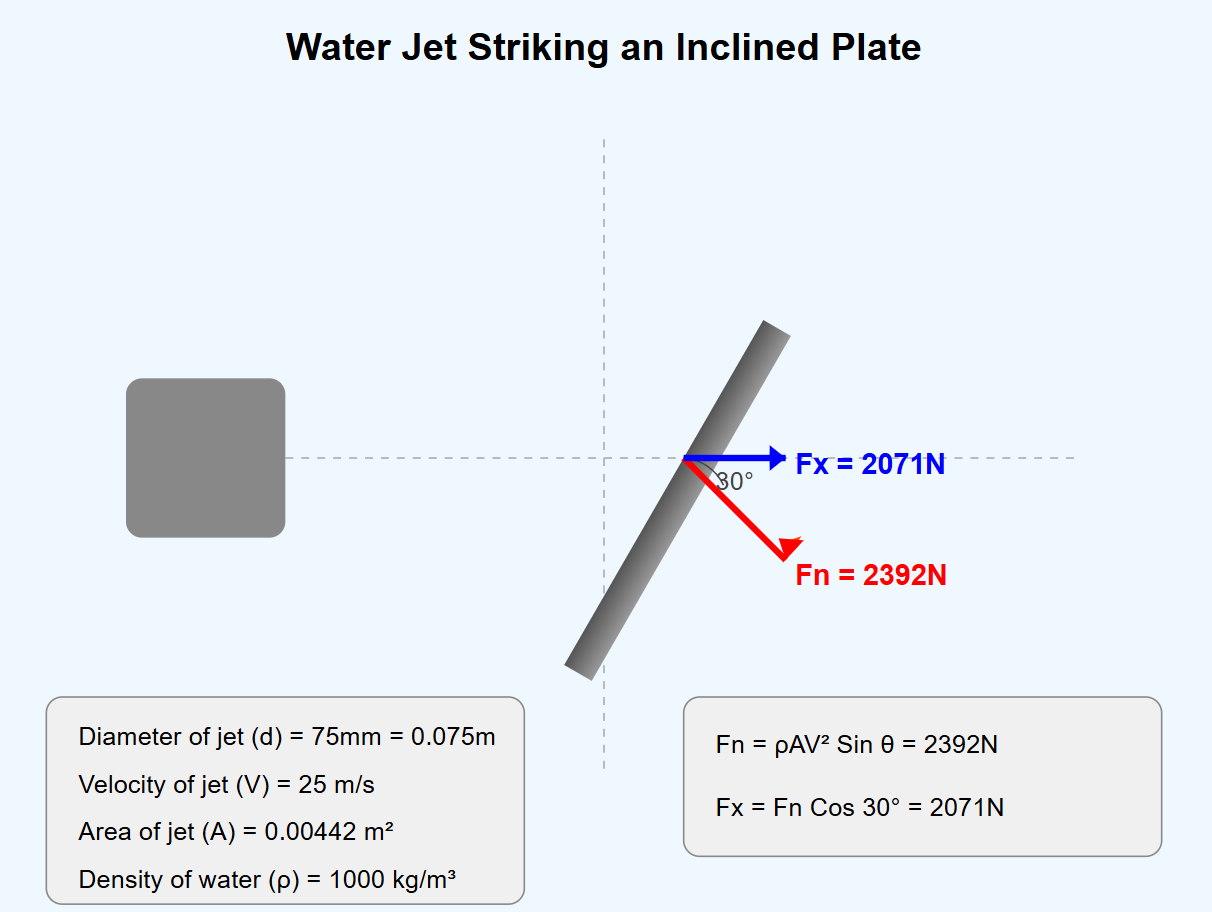
A 75mm diameter jet of water having a velocity of 25m/s strikes a flat plate, the normal of which is inclined at 30° to the jet. Find the force normal to the surface of the plate and in the direction of the jet.
Given Data
Solution Approach
To find the forces acting on the plate, we'll use the principle of momentum change when a water jet strikes an inclined surface. The force exerted by the water on the plate can be resolved into components normal to the plate and in the direction of the jet.
Calculations
Force Normal to the Plate
Step 1: When a jet strikes a flat plate, the normal force can be calculated using the momentum equation:
Fn = ρ × A × V² × sin θWhere θ is the angle between the jet axis and the normal to the plate (30° in this case).
Step 2: Substituting the given values:
Fn = 1000 × 0.00442 × 25² × sin(60°) Fn = 1000 × 0.00442 × 625 × 0.866 Fn = 2392 NForce Normal to the Plate (Fn) = 2392 N
Force in the Direction of the Jet
Step 3: The component of the normal force in the direction of the jet is:
Fx = Fn × cos(30°)Step 4: Substituting the value of Fn:
Fx = 2392 × cos(30°) Fx = 2392 × 0.866 Fx = 2071 NForce in the Direction of the Jet (Fx) = 2071 N
Detailed Explanation
Fluid Jet Impact Principle
When a fluid jet strikes a surface, it undergoes a change in momentum. According to Newton's Second Law, this change in momentum produces a force on the surface. The magnitude and direction of this force depend on the angle of impact and the properties of the fluid.
Derivation of Force Equations
The force normal to the plate (Fn) is derived from the momentum equation, considering that the component of velocity normal to the plate changes during impact. For a flat plate, the fluid particles after impact move along the plate surface, losing their normal velocity component.
Significance of the Angle
The angle between the jet and the normal to the plate significantly affects the force distribution. When the angle is 60° (as measured from the jet axis to the plate), the normal force reaches 86.6% of its maximum possible value (which would occur at 90°).
Practical Applications
Understanding jet impact forces is crucial in many engineering applications:
- Design of hydraulic turbines and pumps
- Water jet cutting technology
- Firefighting equipment design
- Erosion control in hydraulic structures
- Jet propulsion systems
Force Components and Vector Analysis
The total force acting on the plate can be resolved into different components for analysis purposes:
- Normal force (Fn): Perpendicular to the plate surface
- Tangential force: Along the plate surface
- Horizontal and vertical components: Relative to a fixed coordinate system
- Force in jet direction (Fx): Component along the original jet axis
Analysis of Results
The calculated normal force of 2392 N indicates the significant impact pressure that can be generated by even a moderate-sized water jet. This force is distributed across the impact area of the jet on the plate. The force component in the direction of the jet (2071 N) represents 86.6% of the normal force, which aligns with the cosine of 30°.
These forces must be considered in the structural design of any surface or component that might be subjected to fluid jet impacts to ensure adequate strength and stability.