
Problem Statement
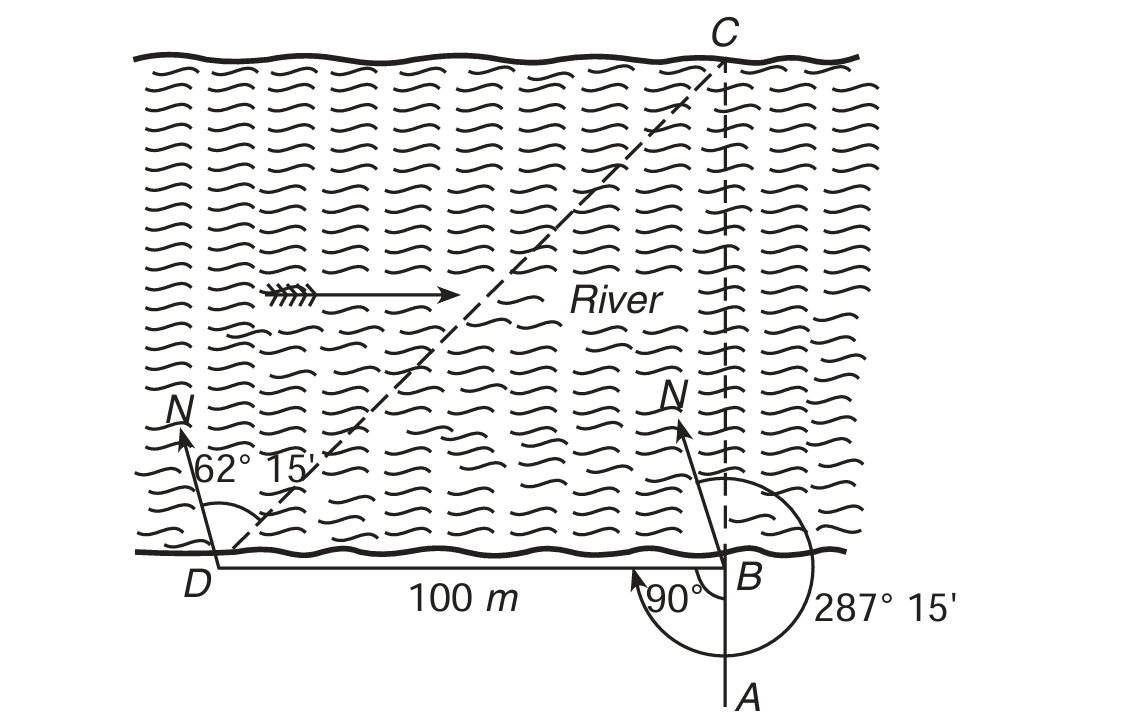
A chain line ABC crosses a river, B and C being on the near and distant banks respectively. A line BD of length 100 m is set out at right angles to the chain line at B. If the bearings of BD and DC are 287° 15′ and 62° 15′ respectively, find the width of the river.
Step-by-Step Solution
Key Information
- Chain line ABC crosses river (B near bank, C distant bank).
- Line BD = 100 metres.
- BD is perpendicular to ABC at B (∠DBC = 90°).
- Bearing of BD = 287° 15′.
- Bearing of DC = 62° 15′.
- Goal: Find the width of the river (distance BC).
Step 1: Calculate Back Bearing of DB
To calculate angles at D, we first need the bearing from D back to B (Bearing DB).
Bearing of DB = Bearing of BD ± 180°
Since Bearing BD > 180°, we subtract 180°:
Bearing of DB = 287° 15′ − 180° 00′
Bearing of DB = 107° 15′
Step 2: Calculate Angle CDB
The angle CDB at point D is the difference between the bearing of DB and the bearing of DC.
∠CDB = Bearing of DB − Bearing of DC
∠CDB = 107° 15′ − 62° 15′
∠CDB = 45°
Step 3: Determine Triangle Type & Calculate BC (River Width)
Consider triangle BCD. We know:
– ∠DBC = 90° (Given BD is perpendicular to ABC at B).
– ∠CDB = 45° (Calculated in Step 2).
The sum of angles in a triangle is 180°. Therefore, we can find ∠DCB:
∠DCB = 180° − ∠DBC − ∠CDB
∠DCB = 180° − 90° − 45°
∠DCB = 45°
Since ∠CDB = ∠DCB = 45°, triangle BCD is an isosceles triangle.
In an isosceles triangle, sides opposite equal angles are equal in length.
Therefore, BC (opposite ∠CDB) = BD (opposite ∠DCB)
Since BD = 100 m (Given):
BC = 100 metres
Final Result
Conceptual Explanation & Applications
Core Concepts:
- Chain Line: The primary survey line crossing the obstacle.
- Bearings & Back Bearings: Using bearings (angles from North) to define line directions and calculating back bearings (180° difference) to find angles within triangles.
- Perpendicular Offset: Establishing a line BD at 90° to the chain line ABC at a known point B. This creates a right-angled triangle (ΔBCD).
- Triangle Angle Sum: The internal angles of any triangle add up to 180°. Used here to find the third angle (∠DCB) once two were known.
- Isosceles Triangle Properties: A triangle with two equal angles also has two equal sides opposite those angles. Recognizing ∠CDB = ∠DCB = 45° allowed the conclusion that BC = BD.
- Right Triangle Trigonometry: Although not explicitly used in the final step of the source solution, tan(45°) = BC/BD could also be used to find BC once ∠CDB was known.
Real-World Applications:
- Measuring River/Obstacle Widths: A fundamental technique in surveying to determine distances across inaccessible features.
- Setting Out Right Angles: Establishing perpendicular lines is common for building layouts, property boundaries, and grid systems.
- Indirect Measurement: Using angles and known distances to calculate unknown distances is a core principle in surveying and many engineering fields.
- Topographic Mapping: Locating features relative to a baseline using angle and distance measurements.
Why It Works:
The solution cleverly uses geometric principles. Setting out a perpendicular BD creates a right-angled triangle BCD. By measuring bearings, the angle CDB at the remote point D can be calculated. Knowing two angles (∠DBC = 90° and ∠CDB = 45°) in the triangle allows the third angle (∠DCB) to be determined using the 180° sum rule.
The fact that two angles (∠CDB and ∠DCB) turn out to be equal (both 45°) means the triangle is isosceles. This provides a direct link between the unknown river width (BC) and the known length of the perpendicular offset (BD), revealing they are equal. This method accurately finds the river width using measurements made from the near bank and the offset point D.


