Problem Statement
A pressure gauge consists of two cylindrical bulbs B and C each of 10 sq. cm cross-sectional area, which are connected by a U-tube with vertical limbs each of 0.25 sq. cm cross-sectional area. A red liquid of specific gravity 0.9 is filled into C and clear water is filled into B, the surface of separation being in the limb attached to C. Find the displacement of the surface of separation when the pressure on the surface in C is greater than that in B by an amount equal to 1 cm head of water.
Given Data
- Area of bulbs B and C, \(A = 10 \, \text{cm}^2\)
- Area of U-tube limbs, \(a = 0.25 \, \text{cm}^2\)
- Fluid in Bulb B: Water (\(\rho_w = 1000 \, \text{kg/m}^3\))
- Fluid in Bulb C: Red liquid (\(S_L = 0.9 \implies \rho_L = 900 \, \text{kg/m}^3\))
- Added pressure on C: \( \Delta P = 1 \, \text{cm head of water}\)
Diagram
Solution
1. Initial Equilibrium
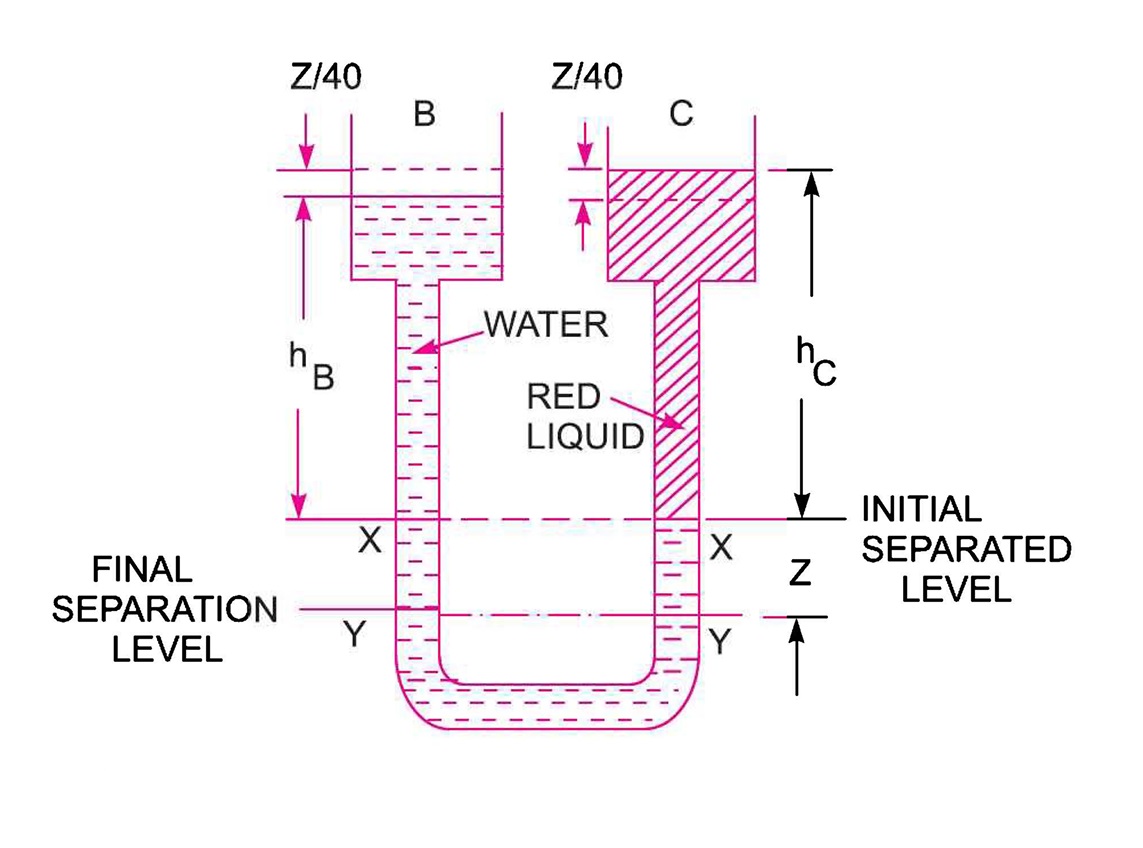
Initially, the pressures are balanced. Let's set the initial separation level as the datum X-X. The pressure from the water column in the left limb must equal the pressure from the liquid column in the right limb.
This establishes the initial relationship between the heights of the two liquids.
2. Fluid Displacement Analysis
When extra pressure is applied to C, the separation level moves down by a distance \(Z\). Due to volume conservation, the liquid levels in the wide bulbs also change. The volume displaced in the narrow limb (\(Z \times a\)) must equal the volume change in the wide bulb (\(\text{level change} \times A\)).
So, the liquid level in bulb C falls by \(Z/40\), and the water level in bulb B rises by \(Z/40\).
3. Final Equilibrium
Let's establish a new datum at the final separation level, Y-Y. We balance the pressures at this new level. The pressure on the right side now includes the added pressure, \(\Delta P\).
The total height of the water column above Y-Y is the original height \(h_B\), plus the drop \(Z\), plus the rise in the bulb \(Z/40\).
The total height of the red liquid column above Y-Y is its original height \(h_C\), plus the drop \(Z\), minus the fall in the bulb \(Z/40\). The pressure on the right also includes the added pressure head.
The added pressure \(\Delta P\) is 1 cm of water: \(\Delta P = \rho_w g (0.01 \, \text{m})\).
4. Solving for Displacement (Z)
Now we set the left and right pressure equations equal and solve for Z.
Substitute \(\rho_w = 1000\) and \(\rho_L = 900\), and divide the entire equation by \(g\).
Now, substitute \(h_B = 0.9 h_C\) from Step 1.
The \(900h_C\) terms cancel out. Now, group the Z terms.
The displacement of the surface of separation is \( Z \approx 6.78 \, \text{cm} \).
Explanation of Principles
This problem demonstrates the mechanics of a sensitive manometer or micromanometer. The key principles are:
1. Pressure Balance: As in any manometer, the core idea is that the pressure at a common datum level within a continuous fluid is equal on both sides. An equation can be set up to balance the hydrostatic pressures (\(p = \rho g h\)) of all fluid columns.
2. Volume Conservation and Magnification: The sensitivity of the gauge comes from the large difference in cross-sectional areas between the bulbs (\(A\)) and the narrow limbs (\(a\)). A small change in fluid volume, caused by a level drop in the wide bulb, results in a much larger vertical displacement (\(Z\)) in the narrow tube. This magnifies the reading, allowing for the measurement of very small pressure differences.
Physical Meaning
The result is a clear demonstration of the gauge's sensitivity. A very small applied pressure, equivalent to just a 1 cm head of water, caused a large and easily measurable displacement of the separation surface of 6.78 cm.
This means the gauge has a magnification factor of nearly 7. Such instruments are crucial in applications where precise measurement of small pressure differences is required, such as in wind tunnels, ventilation system testing, and gas flow monitoring.